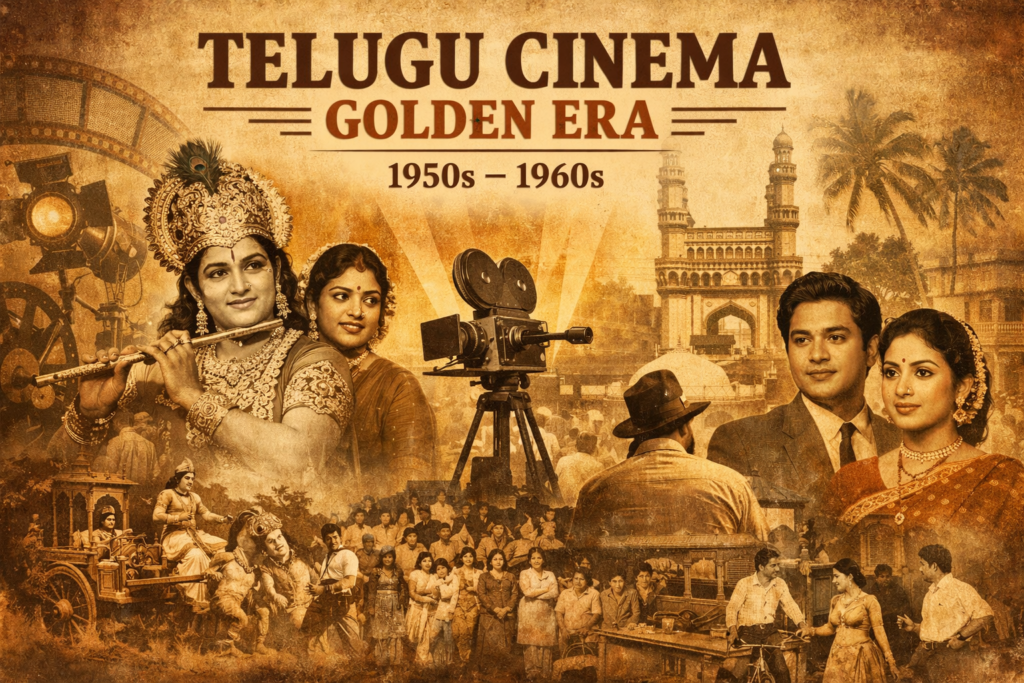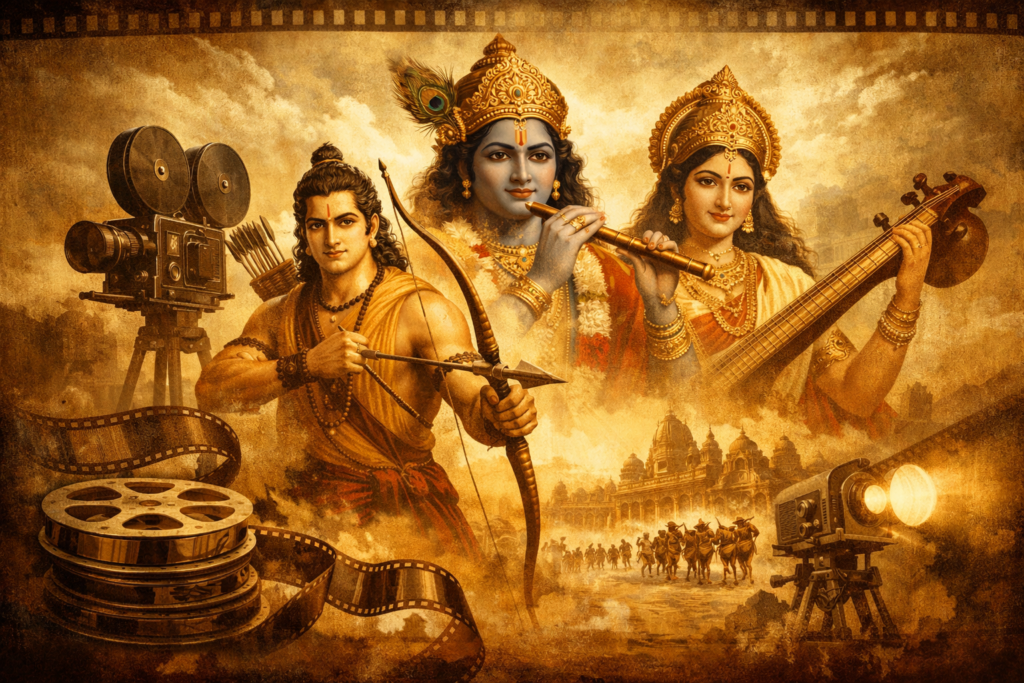

Exploring the history of Telugu cinema from its earliest silent experiments to the foundations of one of India’s most influential film industries.
ENG | हिंदी
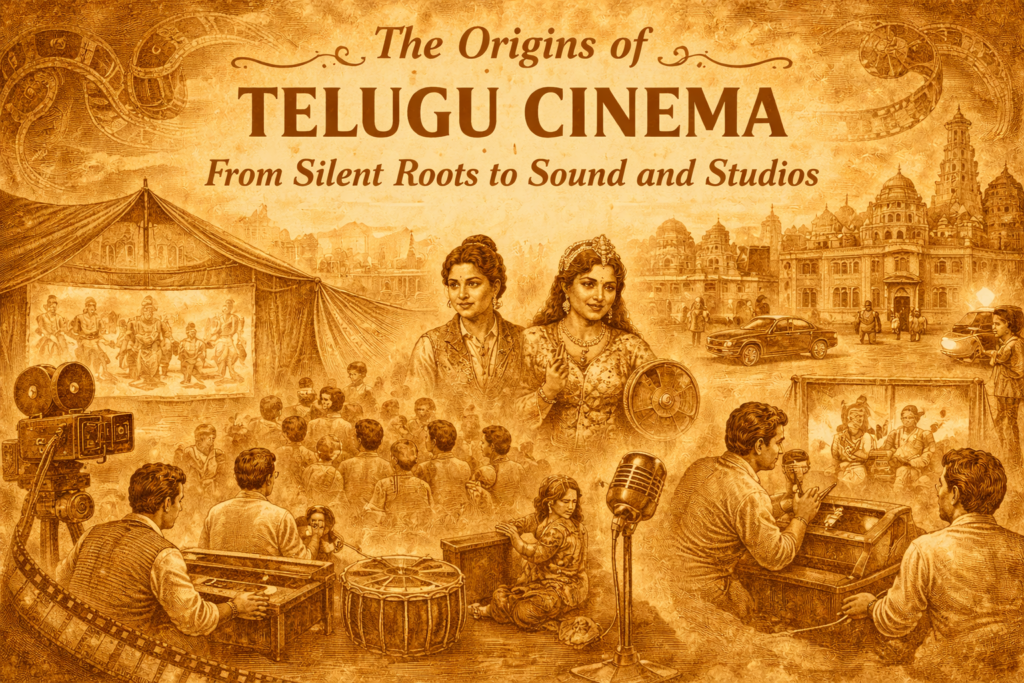
Early Telugu cinema roots—silent-era, cultural storytelling, theatres.
Long before Telugu cinema became known for epic storytelling and iconic stars, it was shaped by silent films, theatrical traditions, and the transformative arrival of sound.
Before Telugu cinema became synonymous with mythic heroes, mass imagination, and larger-than-life storytelling, it underwent a quiet yet transformative journey of experimentation, cultural grounding, and technological innovation.
The history of Telugu cinema begins not with stardom or spectacle, but with a society already rich in storytelling traditions—ready to embrace the moving image as a powerful new artistic medium.
Like cinema elsewhere in the world, Telugu cinema did not emerge overnight. It evolved gradually through stage traditions, early silent filmmaking, and eventually the revolutionary arrival of sound and organized studio production.
This evolution formed part of the broader rise of Indian cinema, when moving images transformed from visual attractions into compelling narrative storytelling. Readers interested in this wider context may also explore How Cinema Began: The Journey from Shadows to Screens to understand how cinema first took root in India, inspired by the Lumière Brothers and the global spread of early motion pictures.
📑 In This Article
Before the Camera Rolled — Cultural Roots of Telugu Cinema
Long before cameras and studios entered the scene, Telugu society had a deeply visual and performative culture.
Traditional forms such as Harikatha, Yakshagana, and village theatre were central to public life, blending music, narration, mythology, and moral instruction. These traditions trained audiences to engage with stories that were episodic, musical, and emotionally heightened—qualities that would later become central to Telugu cinema.
When cinema arrived in India, Telugu audiences were already primed to accept it not merely as entertainment, but as a continuation of familiar storytelling forms—now amplified by technology.
–– ✦ ✦ ––
The Silent Era and Early Experiments (1910s–1920s)
Before Telugu cinema found its voice through sound, it went through a formative silent phase marked by experimentation and gradual audience acceptance.
Tent cinemas, silent filmmaking, early audiences
This period laid the visual and narrative foundations of Telugu cinema, even though spoken dialogue was absent and language identity was still evolving.
Silent Films and Regional Identity
The earliest phase in the origin of Telugu cinema coincided with India’s silent film era. Language barriers were minimal in silent films, but regional identity still played an important role through costumes, themes, and narrative choices.
Many early silent films shown in Telugu-speaking regions featured mythological or historical subjects that resonated culturally, even when dialogue was conveyed only through intertitles.
While few silent Telugu productions survive today, this period marked the first time Telugu themes found expression through cinema.
Exhibition Culture and Early Audiences
Cinema initially reached Telugu regions through touring exhibitors and tent cinemas, which travelled from town to town. These screenings were social events—drawing curiosity, excitement, and growing acceptance of film as a mass medium.
Gradually, permanent theatres began to emerge, signaling that cinema was no longer a novelty but a cultural fixture.
–– ✦ ✦ ––
The Arrival of Sound — Birth of Telugu Talkies
The arrival of sound marked the most decisive turning point in the history of Telugu cinema.
Early microphones, studio recording, mythological talkies
With spoken dialogue and music entering films, cinema became linguistically intimate, culturally rooted, and emotionally immersive for Telugu-speaking audiences.
Bhakta Prahlada (1931): A Turning Point
The defining moment in the history of Telugu cinema came with the release of Bhakta Prahlada (1931)—widely regarded as the first Telugu talkie.
With synchronized dialogue and songs in Telugu, cinema suddenly felt intimate and culturally rooted. Mythological themes, already popular in performance traditions, found a powerful new medium through sound cinema.
This transition was not merely technical—it reshaped audience expectations forever.
How Sound Changed Telugu Cinema
The arrival of sound transformed Telugu cinema in three crucial ways:
- Language became central, strengthening regional identity
- Music and dialogue became narrative drivers
- Mythological and devotional films gained renewed dominance
Cinema was no longer silent spectacle; it had found its voice—literally and culturally.
–– ✦ ✦ ––
Studios, Stars, and Early Narrative Forms (1930s–1940s)
Madras studios, early film crews, mythological/social film sets
Following the success of early talkies, Telugu cinema entered a phase of structural consolidation.
Studios, recurring performers, and familiar narrative patterns began to shape an identifiable industry, preparing Telugu cinema for large-scale growth.
Studio Systems and Production Hubs
During the 1930s and 1940s, much of Telugu film production was centered in Madras (now Chennai), which had established studios, technical infrastructure, and trained personnel.
Early studio systems emphasized discipline and efficiency. Films were produced within controlled environments, with clear divisions between writers, directors, musicians, and technicians.
This industrial structure helped Telugu cinema mature rapidly during its formative decades.
Dominant Genres and Storytelling Styles
The early decades of Telugu cinema were dominated by:
- Mythological films
- Devotional narratives
- Social dramas with moral themes
These films reflected contemporary concerns while reinforcing cultural values. Characters were often symbolic, and stories carried clear ethical frameworks—traits that would later influence mass cinema.
–– ✦ ✦ ––
Telugu Cinema on the Eve of Transformation
By the late 1940s, Telugu cinema had established:
- A loyal and expanding audience base
- Familiar genres and narrative rhythms
- A functioning studio ecosystem
Technically and creatively, the industry was ready to evolve. What followed would be a period of unprecedented scale, stardom, and cultural influence.
–– ✦ ✦ ––
Laying the Foundation for the Golden Era
The silent experiments, early talkies, and studio-driven discipline of the pre-1950 decades laid the groundwork for what many regard as Telugu cinema’s most influential phase.
These formative years shaped audience tastes, narrative confidence, and mythic imagination—elements that would define the industry’s next chapter.
To explore how Telugu cinema transformed these foundations into spectacle, stardom, and mass devotion, continue with:
👉 The Golden Era of Telugu Cinema: Myth, Stardom, and Mass Imagination
The industry that grew from these early foundations would eventually expand into one of Indian cinema’s major filmmaking traditions. Its continuing national presence can be seen in contemporary recognition such as the 72nd National Film Awards, where Kalki 2898 AD was named Best Popular Film Providing Wholesome Entertainment and 35 – Chinna Katha Kaadu won Best Children’s Film.
–– ✦ ✦ ––
Frequently Asked Questions About Early Telugu Cinema
This section addresses common questions about the origins of Telugu cinema, its early films, and the transition from silent storytelling to sound-based filmmaking.
These concise answers help clarify key milestones from Telugu cinema’s formative decades.
Q1. What was the first Telugu film?
Bhakta Prahlada (1931) is widely recognized as the first Telugu talkie.
Q2. Did Telugu cinema exist during the silent era?
Yes. Telugu themes were present in silent films, even though dialogue was not spoken.
Q3. Why were mythological films so dominant early on?
They connected deeply with existing performance traditions and devotional culture.
Q4. Where was early Telugu cinema produced?
Most early Telugu films were produced in Madras due to studio availability.
Q5. How did sound change Telugu cinema?
Sound introduced language, music, and dialogue as central storytelling tools, strengthening regional identity.
🌐 Read in Hindi
Prefer reading this article in Hindi?
👉 हिंदी में पढ़ें:
तेलुगु सिनेमा की उत्पत्ति: मूक परंपराओं से ध्वनि और स्टूडियो तक
This version of the article offers the same depth, perspective, and storytelling.