
The decades when mythology became spectacle, social stories found a voice, and stars became cultural icons.
ENG | हिंदी
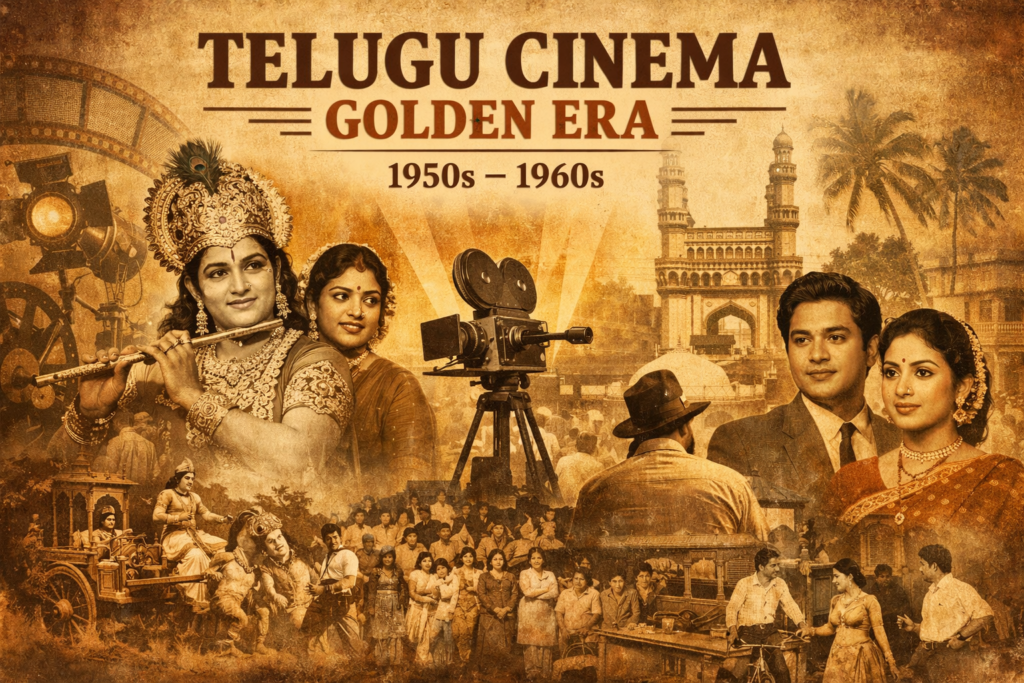
Before Telugu cinema became an industrial powerhouse, the 1950s and 1960s established the stories, stars, studios, and traditions that would define its identity for generations.
The Telugu cinema golden era—spanning roughly from the early 1950s to the late 1960s—represents the most formative and culturally influential phase in the history of Telugu films. This was the period when cinema in Andhra Pradesh evolved from studio-driven experiments into a powerful medium of mythology, social reform, and mass entertainment.
Marked by iconic stars, legendary studios, and timeless narratives, this golden age laid the foundations for what would eventually become one of India’s largest and most influential film industries.
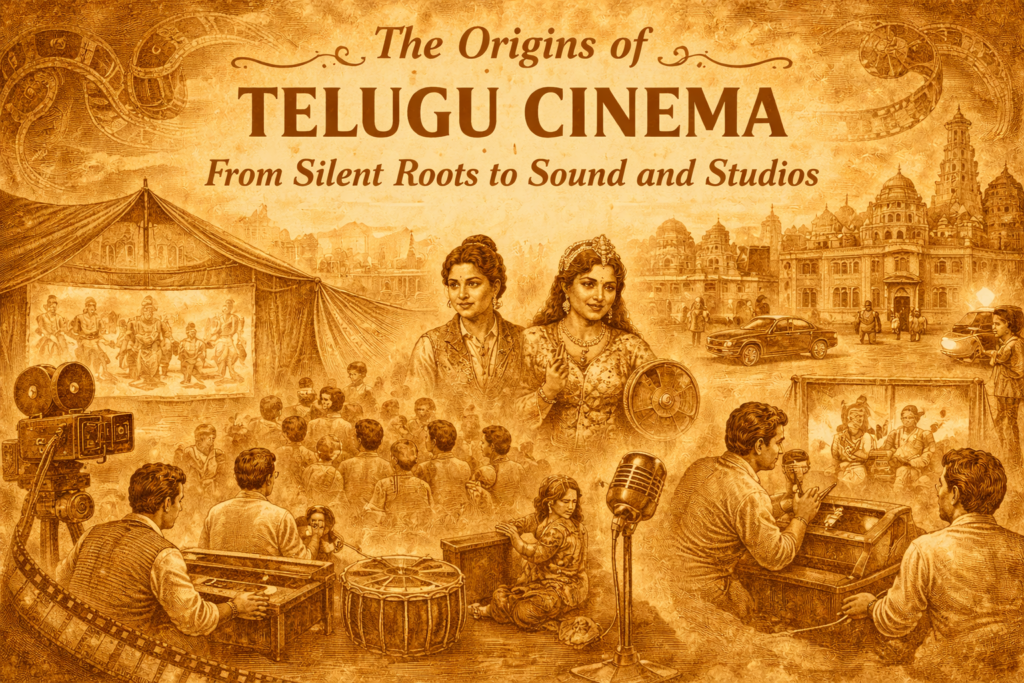
To fully understand the rise of the Telugu cinema golden era, it is important to trace how the industry took shape during its formative years. Technological advances, the emergence of early studios, and the transition from silent films to sound created the foundation on which later masterpieces were built, as explored in our detailed post on Telugu Cinema Origins.
By the early 1950s, Telugu cinema had moved decisively beyond its experimental phase. With sound firmly established and studio systems stabilised in Madras, filmmakers began producing ambitious mythological and socially conscious films that would define Telugu cinema throughout the 1950s and 1960s. These decades transformed cinema from a developing entertainment medium into a powerful cultural force—one in which mythology, society, music, performance, and stardom came together to shape a lasting cinematic identity.
📑 In This Article
🔍 Quick Facts: Telugu Cinema Golden Era
A snapshot of the years, stars, studios, and cultural forces that defined the era.
The 1950s and 1960s were more than a period of popular films; they were the decades when stars, studios, and mythological and social stories shaped a distinctive Telugu cinematic identity.
- Time Period: 1950s–1960s
- Dominant Genres: Mythologicals, folklore, and social dramas
- Key Studio: Vijaya Vahini Studios
- Iconic Actors: N. T. Rama Rao (NTR), Akkineni Nageswara Rao (ANR)
- Language and Cultural Reach: Andhra Pradesh, Telangana, and Telugu-speaking communities beyond South India
- Cultural Impact: Strengthened mythology, Telugu linguistic pride, social values, and the emerging culture of film stardom
Telugu cinema, often associated with the term Tollywood, developed a distinctive identity through its strong studio tradition, literary storytelling, mythological narratives, and socially relevant films. By the 1950s, these elements had begun to come together in a more organised and influential film industry.
–– ✦ ✦ ––
🎬 Rise of the Golden Age of Telugu Cinema
When mythology, social change, and technological progress converged on the big screen.
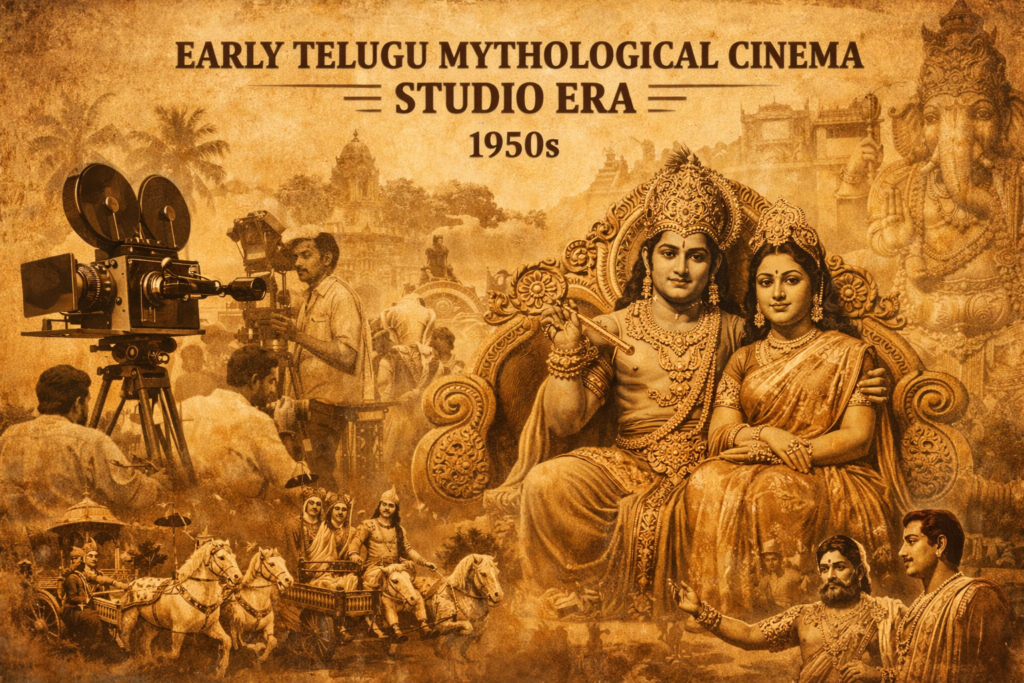
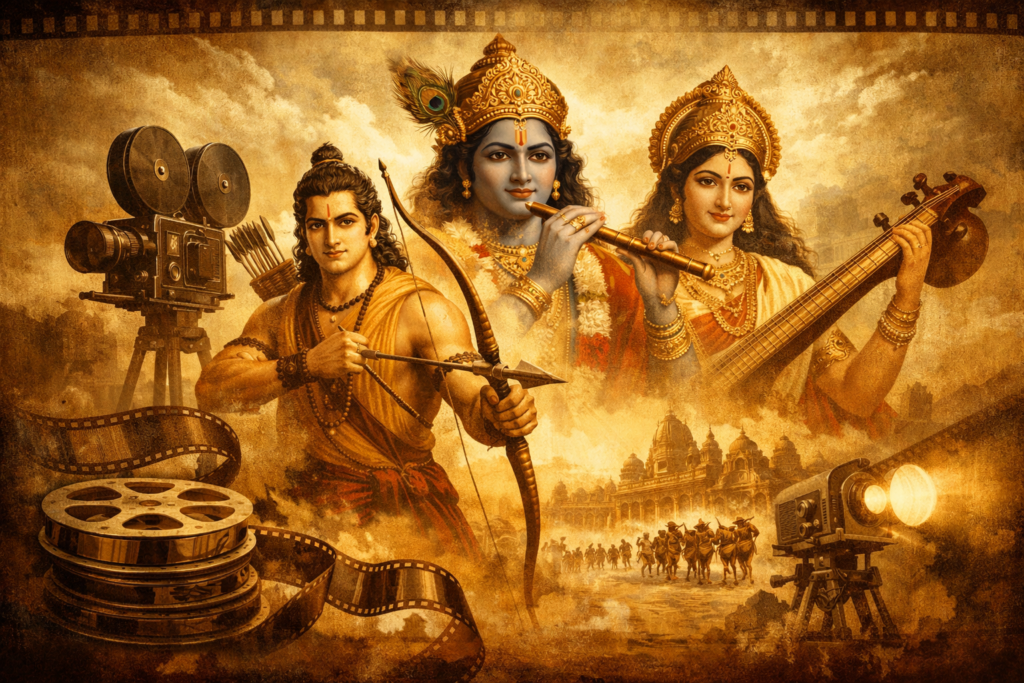
Mythological narratives shaped early Telugu cinema, blending epic imagination with classical theatrical influence
By the 1950s, Telugu cinema had moved beyond its experimental beginnings, bringing epic traditions and the aspirations of a changing society into a new cinematic language.
The years following Indian independence marked a decisive phase in the development of Telugu cinema. Improved studio infrastructure, more established sound technology, expanding theatrical exhibition, and a growing audience gave filmmakers greater confidence to attempt ambitious stories.
The transition from silent cinema to sound had already transformed filmmaking, but the 1950s brought a further change in scale and ambition. Filmmakers increasingly drew upon the Ramayana, Mahabharata, Puranic traditions, folklore, literature, theatre, and contemporary social life to create films that could appeal to audiences across different generations.
Mythological narratives were particularly powerful because Telugu-speaking audiences were already deeply familiar with the stories and characters of Indian epics and devotional traditions. Cinema therefore became a visual extension of storytelling traditions that had previously flourished through oral narratives, stage performances, literature, and religious culture.
At the same time, filmmakers were beginning to look beyond inherited stories. Social dramas explored family relationships, education, morality, social inequality, and the tensions created by a rapidly changing society.
The result was a distinctive cinematic culture in which tradition and modernity could exist side by side. Mythological spectacle attracted audiences through familiarity and grandeur, while social films allowed cinema to engage directly with the realities and aspirations of post-independence society.
–– ✦ ✦ ––
⭐ The Era of NTR and ANR
Two legendary stars, two distinct screen identities, and a star system that transformed Telugu cinema.
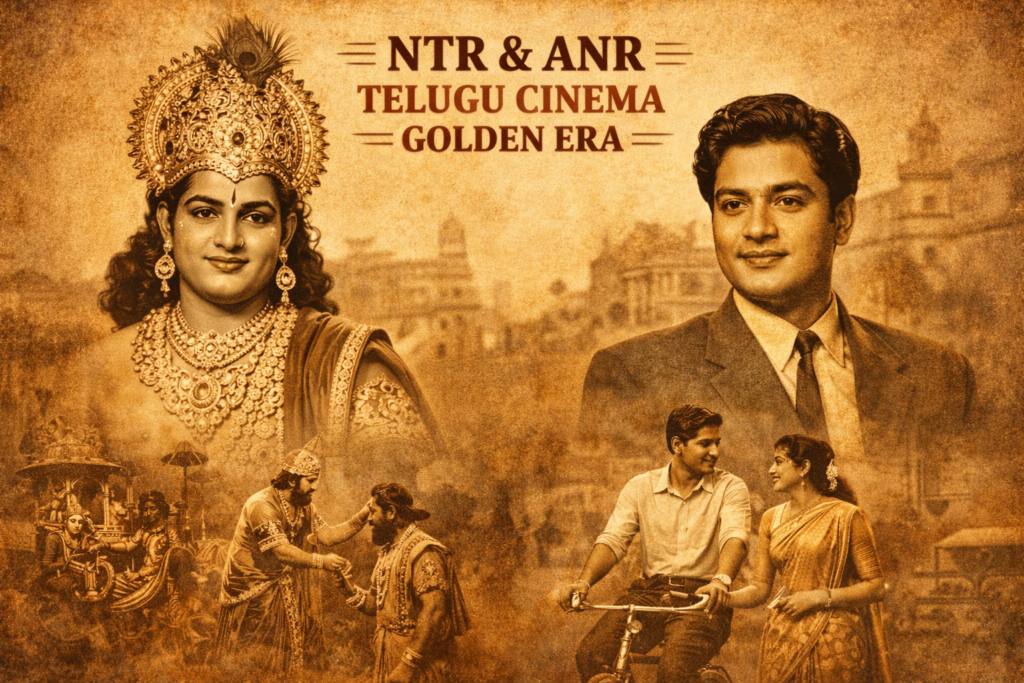
Two icons, two cinematic paths—divine mythology and human drama defined the golden age of Telugu storytelling
While N. T. Rama Rao gave extraordinary presence to mythological and divine roles, Akkineni Nageswara Rao brought human emotion to social and romantic stories.
N. T. Rama Rao and Akkineni Nageswara Rao emerged as the defining male stars of post-independence Telugu cinema. Their careers developed along different but complementary lines, helping establish the two major performance traditions that characterised the golden era.
N. T. Rama Rao (NTR)
NTR became closely associated with mythological and heroic roles, particularly his portrayals of Krishna, Rama, and other revered figures. His commanding screen presence, voice, physicality, and ability to project dignity gave these characters an extraordinary cinematic authority.
His mythological performances resonated deeply with audiences because they connected the star persona with characters already embedded in Telugu cultural and religious imagination. As a result, NTR’s image extended beyond conventional film stardom and became an important part of popular culture.
Akkineni Nageswara Rao (ANR)
ANR followed a different but equally influential path. He became closely associated with romantic, social, and emotionally driven dramas, bringing greater emphasis to relationships, vulnerability, aspiration, and everyday human experience.
His performances helped broaden the emotional vocabulary of Telugu cinema. Where NTR could embody heroic and divine grandeur, ANR often represented the complexities of ordinary human life.
Two complementary traditions
Together, NTR and ANR gave Telugu cinema a remarkable balance between mythological grandeur and human drama. Their contrasting screen identities helped audiences develop new expectations of what a leading Telugu actor could represent.
Their influence also extended beyond individual films. They helped establish the enduring importance of the star system in Telugu cinema, creating a model in which an actor’s screen persona could become closely associated with particular genres, values, and cultural ideals.
The legacy of NTR and ANR therefore goes beyond box-office success. They helped define the language of Telugu stardom for decades to come.
–– ✦ ✦ ––
🏛️ Studio Culture and Film Production
When studios were more than production spaces—they were the engines of a cinematic ecosystem.
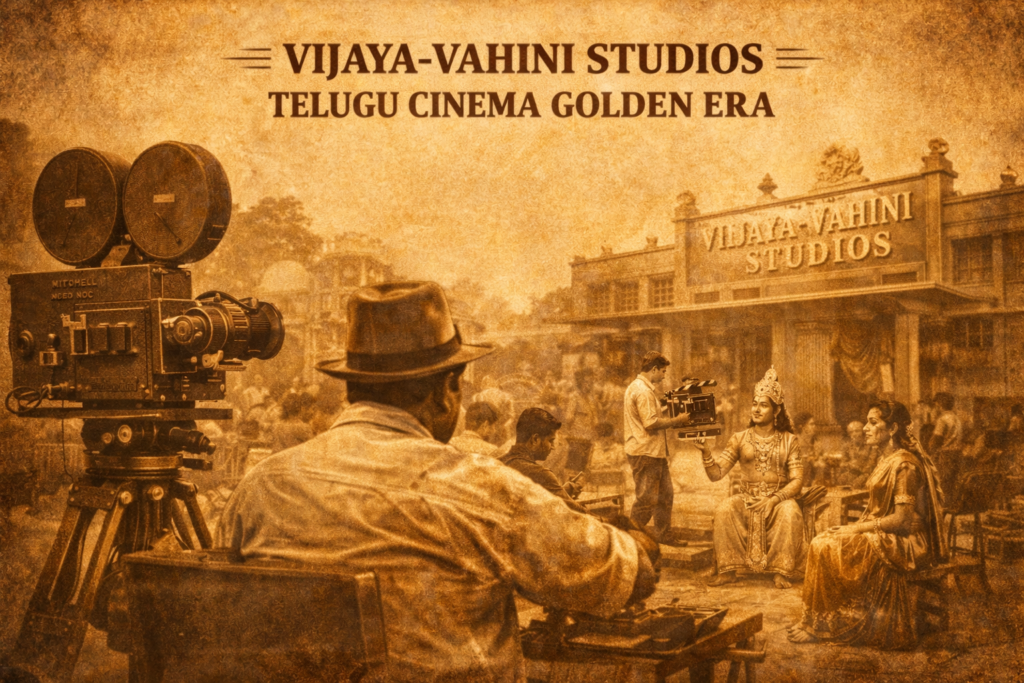
Inside the studio era—precision filmmaking, elaborate sets, and collaborative craftsmanship built a lasting legacy
During the 1950s and 1960s, studio-based production brought greater organisation to filmmaking, from technical craft and acting discipline to elaborate sets and ambitious storytelling.
The golden era was closely associated with studio-based filmmaking. Madras, now Chennai, was an important centre of South Indian film production, and Telugu filmmakers benefited from the technical infrastructure, trained personnel, production facilities, and creative networks that had developed there.
Vijaya Vahini Studios became one of the most important institutions associated with this period. Its large-scale production facilities supported films that demanded elaborate sets, controlled studio environments, carefully planned cinematography, and substantial technical coordination.
Studio filmmaking helped establish several characteristics of the period:
- Consistent production standards
- Strong theatrical and performance discipline
- Literary and theatrical influences on screenwriting
- Large-scale sets and carefully designed visual environments
- Greater coordination among directors, actors, technicians, musicians, and production teams
This system gave many Telugu films of the 1950s and 1960s a distinctive sense of craftsmanship. Mythological productions could recreate elaborate worlds inspired by epics and folklore, while social dramas could make use of carefully constructed domestic and urban environments.
The studio system also encouraged a more professional division of labour. Filmmaking increasingly became a coordinated industrial process rather than an isolated creative experiment.
This combination of organisation, technical expertise, theatrical tradition, and literary influence helped establish the visual and narrative polish associated with the golden era.
–– ✦ ✦ ––
🎭 Mythological and Social Films
One world of gods and epics, another of social realities—and Telugu cinema embraced both.
One of the defining strengths of the golden era was its ability to bring cultural tradition and contemporary social consciousness together on the same screen.
Storytelling during the golden era reflected both inherited tradition and a rapidly changing society. Telugu cinema could draw upon centuries-old mythology while simultaneously addressing the everyday concerns of post-independence audiences.
Broadly, the films of this period can be understood through two major traditions: mythological narratives rooted in epics and folklore, and social dramas concerned with family, morality, relationships, education, and social change.
Mythological Films
Mythological films were not simply religious retellings. They transformed familiar stories into large-scale cinematic spectacles while reinforcing ideas about duty, morality, sacrifice, leadership, and cultural identity.
The Ramayana, Mahabharata, and Puranic traditions provided filmmakers with a rich narrative foundation. Elaborate costumes, studio sets, classical language, music, devotional elements, and theatrical performance styles combined to create immersive worlds that audiences already understood at a cultural level.
NTR’s portrayals of mythological figures became particularly influential. His performances helped establish a powerful connection between the screen image of the actor and the cultural imagination surrounding the characters he portrayed.
Telugu mythological cinema therefore became an important part of the broader Indian tradition of mythological filmmaking while developing its own distinctive linguistic and performance style.
Social Films
Alongside mythology, social dramas addressed the realities of everyday life.
These films explored themes such as:
- Women’s education and changing social roles
- Family relationships and responsibilities
- Caste and class tensions
- Moral values and social expectations
- Education and social mobility
- The pressures created by social change
Social cinema allowed filmmakers to engage with the aspirations of a newly independent society. Instead of looking exclusively to the past, these films examined the problems and possibilities of contemporary life.
The coexistence of mythological spectacle and social realism became one of the defining characteristics of Telugu cinema’s golden era.
–– ✦ ✦ ––
📈 Cultural and Political Impact
When cinema moved beyond the screen to influence language, society, and public life.
The influence of Telugu cinema extended far beyond the box office, with its language, dialogue, heroic ideals, and social narratives shaping the wider cultural imagination.
Cinema during this period was deeply connected with the society around it. Films provided entertainment, but they also reinforced cultural memory, linguistic identity, moral values, and ideas about social responsibility.
The use of refined Telugu in dialogue and song strengthened the cultural prestige of the language. Memorable dialogues and performances could travel beyond theatres into everyday conversation, allowing cinema to become part of the broader public culture.
Mythological films reinforced familiar cultural narratives, while social dramas addressed contemporary questions about family, education, social status, and changing values. The two traditions together allowed cinema to speak simultaneously to cultural continuity and social transformation.
The heroic and morally authoritative images created on screen also had consequences beyond entertainment. In later decades, several major personalities from Telugu cinema entered public life and politics, demonstrating the unusual reach that film stardom could achieve in the region.
The foundations for this connection were established during the golden era, when cinema increasingly became a source of cultural leadership and public influence.
The period therefore represents more than the rise of a successful film industry. It marks the point at which Telugu cinema became a major institution within the cultural life of Telugu-speaking society.
–– ✦ ✦ ––
⚡ Frequently Asked Questions (FAQs)
Clear answers to the key questions surrounding Telugu cinema’s golden era.
Take a quick look at the essential facts behind this influential period of Telugu film history.
What years are considered the Telugu cinema golden era?
The 1950s and 1960s are widely regarded as the golden era of Telugu cinema, particularly because this period saw the consolidation of major stars, studios, genres, and storytelling traditions.
Which genres dominated Telugu films during this period?
Mythological films and social dramas were particularly prominent. Folklore and other traditional narrative forms also played an important role.
Why was NTR so influential in Telugu cinema?
NTR became closely associated with mythological and heroic roles, including Krishna and Rama. His performances connected film stardom with characters deeply rooted in Telugu cultural and religious imagination.
Where were most Telugu films produced during the golden era?
Madras, now Chennai, was a major centre of Telugu film production. Studios such as Vijaya Vahini provided important production infrastructure during this period.
–– ✦ ✦ ––
🎯 Conclusion
A golden era that did more than make films—it shaped the identity of Telugu cinema.
The legacy of the 1950s and 1960s can still be seen in Telugu cinema’s stars, stories, language, and enduring cultural influence.
The Telugu cinema golden era was not merely a successful period in the industry’s history. It was the period in which many of the traditions that would define Telugu filmmaking for generations became firmly established.
The rise of NTR and ANR demonstrated the growing power of film stardom. Studio-based production gave filmmakers the infrastructure and technical discipline needed for increasingly ambitious projects. Mythological cinema connected the screen with India’s epic and devotional traditions, while social dramas gave voice to the concerns of a changing society.
Together, these developments transformed Telugu cinema from a developing regional industry into a powerful cultural institution.
The influence of this era can still be seen in contemporary Telugu filmmaking—in the importance of stars, the continuing popularity of mythological and historical themes, the strength of dialogue-driven storytelling, and the close relationship between cinema and Telugu cultural identity.
For anyone seeking to understand the history of Indian regional cinema, the Telugu golden era is therefore an essential chapter. It was during these decades that mythology, society, music, performance, studio craftsmanship, and stardom came together to establish a cinematic identity whose influence continues to endure.
Readers interested in factual recall, cinema history, and exam-oriented questions can also explore our dedicated Reel GK section, where important developments in Indian film history are presented through objective and descriptive practice questions.
–– ✦ ✦ ––
❓ Key Questions & Answers
A closer look at the defining features, personalities, and legacy of Telugu cinema’s golden era.
These questions offer a deeper look at the period’s major characteristics, cultural influence, and historical significance.
What defines the golden age of Telugu cinema?
The golden age was defined by studio-driven production, mythological storytelling, socially relevant dramas, iconic stars, strong theatrical traditions, and growing cultural influence.
How did Telugu cinema develop a distinctive identity during this period?
It brought together several traditions: Indian mythology and folklore, Telugu literary and theatrical culture, social storytelling, music, and a powerful emerging star system. The combination gave Telugu cinema a recognisable identity that distinguished it within Indian regional filmmaking.
What was the importance of NTR and ANR during the golden era?
NTR became strongly associated with mythological and heroic characters, while ANR became known for social, romantic, and emotionally driven roles. Their contrasting screen identities helped establish the modern Telugu star system.
Why is the golden era important in the history of Indian cinema?
The period demonstrates how a regional-language film industry could develop its own industrial infrastructure, stars, genres, and cultural influence while drawing upon both traditional Indian narratives and contemporary social realities.
Why is this period important for cinema GK and film-history study?
The 1950s and 1960s established many of the personalities, production traditions, genres, and cultural developments that shaped later Telugu cinema. Understanding this period therefore provides essential context for studying the industry’s subsequent evolution.
🌐 Read in Hindi
Prefer reading this article in Hindi?
👉 हिंदी में पढ़ें:
तेलुगु सिनेमा का स्वर्ण युग (1950–1960 का दशक): जब मिथक, समाज और स्टारडम ने एक उद्योग को आकार दिया
This version of the article offers the same depth, perspective, and storytelling.
🔖 External sources are referenced for educational and historical context. All rights and credits belong to their respective owners.