
ENG | हिंदी
The sound era cinema history can be traced back to 1920s. During this period, the world of cinema underwent a seismic shift: film screens that had relied solely on expressive visuals and intertitles suddenly began to speak.
Welcome to the era of the talkies’ revolution — a transformation that reshaped how stories were told on screen, who told them, and how audiences experienced them.
Between 1927 and 1935, the transition from silent to sound cinema accelerated across Hollywood, Europe and India.
This post explores that journey in depth: the technology, the business upheaval, the global ripple-effects, and how the silent era gave way to a new audiovisual language.
💡Missed the pre-sound era history of cinema? Explore it in the: 👉 The Silent Era: Birth of Storytelling on Screen, here!
📑 In This Article
The Technological Leap: From Silent to Sound
The foundation of the revolutionary shift lay not just in artistic ambition but in technological advancement.
The invention and refinement of synchronized sound-on-film (and sound-on-disc) systems made the leap from novelty to standard.
- In 1926, Don Juan (US) used the Vitaphone sound-on-disc system to provide a synchronized score and effects, though no spoken dialogue.
- On 6 October 1927, The Jazz Singer premiered, widely heralded as the first feature film with synchronized dialogue and songs (though it was technically a part-talkie).
- Sound-on-film systems (such as the Movietone and RCA Photophone) soon outpaced sound-on-disc in reliability and practicality.
- The transition was remarkably rapid: in the United States, only about 2.3% of films in 1927 included sound; by 1929 that number had risen to over 70%, and by 1930 nearly 97% of films were talkies.
Why the sound era cinema history matters for storytelling:
With spoken dialogue, ambient sound, and musical tracks integrated directly into the film print, filmmakers gained newfound expressive tools—and simultaneously faced new constraints (sound-proofing, camera noise, actor’s voices).
Silent film actors with expressive faces and physical charisma sometimes struggled to transition; camera mobility and editing rhythms had to adapt to the realities of early sound technology.
–– ✦ ✦ ––
Hollywood’s Upheaval: Business, Talent and Genres
The arrival of sound didn’t just change the look and feel of movies—it disrupted entire business models, star systems and creative practices in Hollywood.
- The major studios scrambled to convert production and exhibition infrastructure: theatres had to be wired for sound, sound‐trained projectionists hired, new sets adapted.
- For example, while Warner Bros. acted early (with The Jazz Singer and other talkies), many studios initially dismissed sound as a fad—but soon realized the financial imperative.
- Genres shifted: musicals and revue‐style films flourished as the novelty of sound invited song-and-dance spectacles; talkies allowed actors and voices to become stars in new ways.
- On the flip side, some silent era directors and actors saw their careers decline: physical expressiveness alone was no longer enough; vocal performance, diction, and sound design became part of the craft.
Key milestone:
By July 1928, Lights of New York (1928) became the first all-talking feature (with full dialogue) and marked the tipping point for industry adoption.
–– ✦ ✦ ––
The Global Spread: Europe, India and Beyond
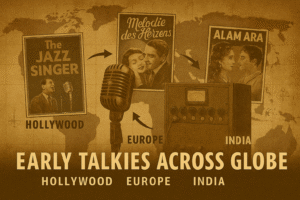
While Hollywood led the transformation, the talkies revolution quickly became global—though each region followed its own pace and pattern.
- In Europe, sound cinema arrived in rapid succession: the UK, Germany, France began producing talkies by 1929–1930. For instance, Blackmail (1929) directed by Alfred Hitchcock is among the first British all-talking features.
- In India, the first Hindi sound film, Alam Ara, released in 1931, marked a watershed moment in Indian cinema: local languages, songs, and voices became central.
- The sound transition in regions such as Asia and the Middle East took longer due to technical, economic and infrastructural constraints. For example, Egypt’s first talkie was released in 1932.
Impact on Indian cinema:
With talkies, Indian filmmakers embraced musical numbers, local dialects, and regional sensibilities—these would become defining features of Indian cinema.
The earliest talkies helped shift film production from imported silent reels to domestically made sound films.
–– ✦ ✦ ––
Artistic & Cultural Implications
The revolution of talkies was more than a technical upgrade—it altered how cinema was conceived, shot and received.
- Storytelling became more reliant on dialogue and voice, which changed pacing, editing strategies and performance styles. Some critics argue that the visual expressiveness of silent cinema was diminished.
- Audiences now ‘heard’ their heroes, heard ambient sounds and music integrated; this created deeper immersion but also changed the “cinematic imagination” — what the viewer supplied in silence was replaced by what the film delivered.
- Technical constraints: early sound equipment was bulky and limited camera movement; studios often froze the camera, actors had restricted mobility, and sets had to be re-designed for microphone coverage.
- Silent cinema’s aesthetics (e.g., expressive gestures, intertitles, live musical accompaniment) were not “primitive” but an alternate form of cinematic language; the transition to sound should not erase that legacy.
–– ✦ ✦ ––
Defining Films & Milestones (1927-1935)
Here are some landmark titles and dates to anchor this era:
- 1927: The Jazz Singer (USA) – widely regarded as the catalyst for talkies.
- 1928: Lights of New York (USA) – first full all-talking feature.
- 1929: Blackmail (UK) – early British talkie.
- 1931: Alam Ara (India) – first Indian sound film in Hindi.
- Circa 1930: By this time, the transition was essentially complete in Hollywood, with silent features largely phased out.
–– ✦ ✦ ––
Why 1927–1935? Defining the Window
While the silent-to-sound transition began in the mid-1920s, the period from 1927 (The Jazz Singer) to about 1935 marks the moment when sound cinema became fully entrenched and universal in major film industries.
After 1935, talkies were the norm, and silent-era production techniques receded into history. The 1927-1935 window thus captures the turbulence, the experimentation, the adaptation and the consolidation of the talkies revolution.
–– ✦ ✦ ––
Legacy for Modern Cinema & For You, the Cinema Enthusiast
For a blog like The Reel Retro, this era matters because:
- It marks a fundamental shift in how stories are told on screen — from gestural and silent to vocal and auditory.
- It lays the groundwork for genres (musicals, sound-driven narrative films), star systems (voice identity matters), and global cinematic integration (sound technology, language versions, dubbing).
- Understanding this shift gives context to both Hollywood and Bollywood trajectories: how Indian cinema’s talkies era took off, how regional cinemas adapted, and how the global film industry matured.
As you dive into this era for your blog posts, you might consider:
- A case-study format (e.g., compare a silent film just before 1927 with an early talkie in 1930).
- Spotlighting how talkies changed regional cinema in India (Hindi, Marathi, Tamil) and what that meant socially and culturally.
- Exploring how technical limitations (camera, microphone, soundproofing) forced creative choices that still impact film grammar today.
–– ✦ ✦ ––
Conclusion
The journey “from silence to sound” was not a gentle evolution but a disruptive leap. Between 1927 and 1935, the talkies revolution rewrote the rulebook of cinema: technology, performance, business, storytelling—all were up for reinvention.
For cinema lovers and historians alike, the sound era cinema history offers rich insights into how film matured into the fully audiovisual medium we know today.
As we move onward in our Reel Origins series, the legacy of the talkies will continue to ripple through every frame, song, voice and story that followed.
🎬 Enjoyed this dive into the talkies revolution? Then check out our next post “The Golden Age of Classical Cinema (1935-1955)” and subscribe to The Reel Retro newsletter for more vintage cinema deep-dives. Don’t forget to leave your favourite early talkie film in the comments—let’s spark the discussion!
–– ✦ ✦ ––
Frequently Asked Questions (FAQs)
Q1: What exactly is a “talkie”?
A. A talkie is a film with synchronized recorded dialogue (and usually music and sound-effects) integrated into the film itself, rather than live accompaniment. The term became common by the late 1920s.
Q2: Did silent films immediately disappear after talkies arrived?
A. No. The transition was rapid but not instantaneous. In the U.S., by 1930 the vast majority of films were sound, but silent features and part-talkies still existed in 1928-29.
Q3: Why did Indian cinema take until 1931 for its first sound film?
A. Technical and economic constraints (equipment, studios, theatrical infrastructure) slowed the adoption of sound in India. When Alam Ara arrived in 1931, it leap-frogged several limitations and set a new standard.
Q4: How did the arrival of sound affect actors and filmmakers?
A. Actors had to adapt from expressive mime-style silent acting to voice delivery and dialogue; filmmakers had to rethink camera movement, editing and production logistics. Some silent-era stars and directors did not transition well.
💡Want to Explore the fascinating history of Hollywood? Step into our: 👉 Hollywood section here. And, also, if you would like to discover the rich legacy of Bollywood, its classic films, beloved stars, and unforgettable stories that touched millions of hearts, visit our: 👉 Bollywood section here!
Further Reading: Explore Sound Era Cinema History in More Detail
Before you go — if you’d like to explore more authentic sources and perspectives beyond The Reel Retro, check out the curated links below.
💡 Recommended External Resources:
- Wikipedia: Early History of Sound Film – Several technological developments contributed to making sound cinema commercially viable
- Wikipedia: Alam Ara became the first talkie – Ardeshir Irani made his next project, the Alam Ara, a sound film which he produced and directed in 1931
- Stephen Follows: Evolution from Silent to Sound Cinema – When did talkies take over from silent movies?
- MedCrave Group: Explores the Human-Technology Relationship – Visual expressiveness of silent cinema was diminished with the introduction of sound
🌐 Prefer reading this article in Hindi?
👉 Read:
मूक से संवाद तक (1927–1935): टॉकीज़ क्रांति की कहानी
🔖 External sources are referenced for educational and historical context. All content rights and credits belong to their respective owners.