
How storefront theatres and early pioneers laid the foundation of Hollywood’s film industry.
ENG | हिंदी
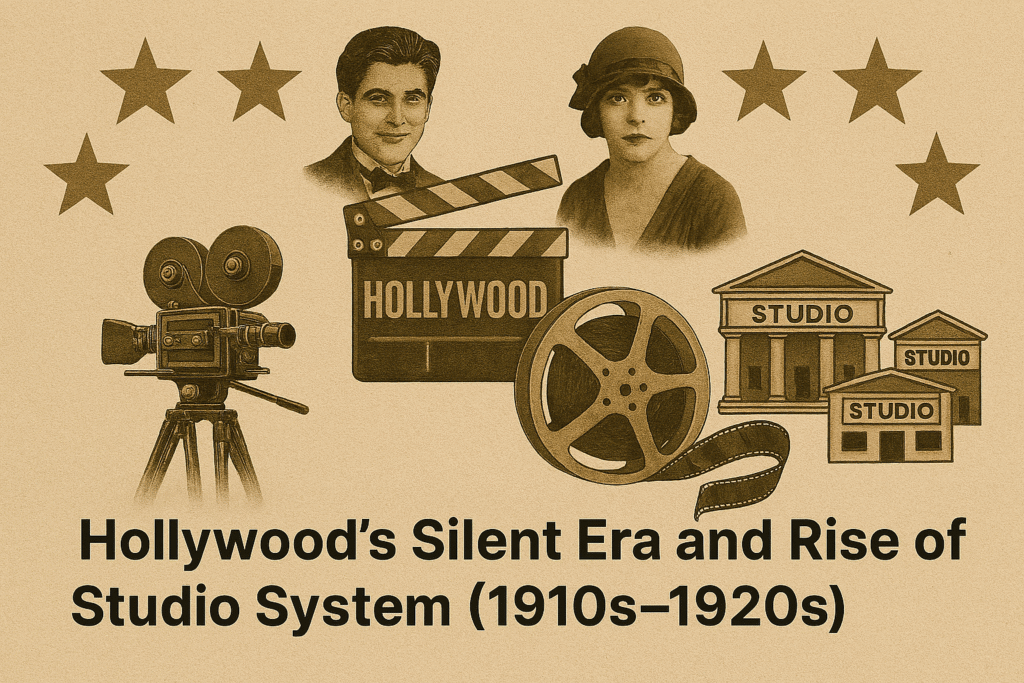
In the early twentieth century, a young art form began its transformation into a global industry.
Creativity met organization as silent films and powerful studios transformed Hollywood into a cinematic powerhouse.
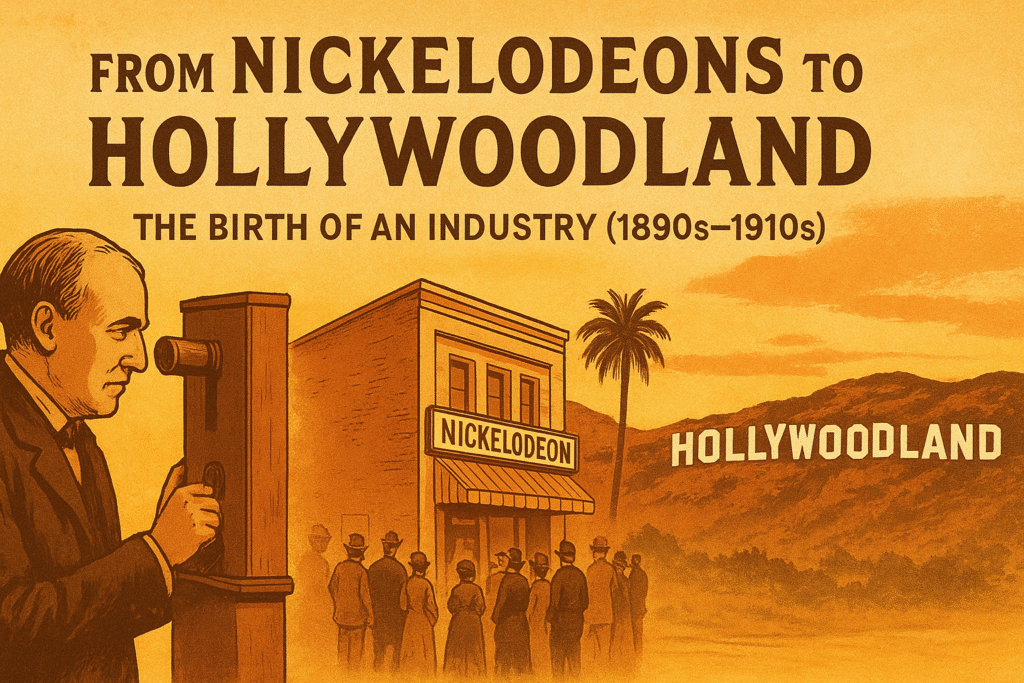
Cinema did not begin in Hollywood. In fact, the earliest American films were created in laboratories, modest studios on the East Coast, and small storefront theatres known as nickelodeons. Between the 1890s and 1910s, a remarkable transformation took place as moving pictures evolved from a popular novelty into a rapidly growing entertainment industry.
The journey from Nickelodeons to Hollywoodland marked the birth of modern American filmmaking, laying the foundations for what would soon become the world’s most influential film capital. In this article, we’ll explore how that extraordinary transition shaped the future of cinema.
📑 In This Article
Introductory FAQ
What was the Hollywood Silent Era and Studio System?
The Hollywood Silent Era refers to the period in the 1910s and 1920s when films were produced without synchronized dialogue, relying instead on visual storytelling and intertitles. The Studio System emerged during this same period as major companies centralized production, distribution, and exhibition under one corporate structure.
–– ✦ ✦ ––
The Dawn of the Silent Era (1910s)
The 1910s marked a decisive shift in filmmaking. What had once been a novelty attraction evolved into a narrative art form capable of telling complex stories through visual language alone.
Directors developed techniques such as cross-cutting, close-ups, and expressive lighting. Without spoken dialogue, performances relied on gesture, facial expression, and careful framing. Editing became a storytelling tool rather than a mere technical necessity.
As Hollywood is born as a filmmaking hub, production gradually concentrated in California. The climate allowed year-round shooting, while varied landscapes provided natural backdrops. The foundations of the Hollywood Silent Era and Studio System were being constructed even before formal corporate structures were fully established.
Cinema was no longer an experiment — it was becoming an industry.
–– ✦ ✦ ––
Why Hollywood Became the Film Hub?
Several practical and economic factors turned Hollywood into the epicenter of filmmaking.
First, distance from New York-based patent restrictions gave independent producers greater freedom. Second, Southern California offered diverse landscapes — deserts, mountains, oceans — all within short travel distances. Third, reliable sunlight reduced production costs in an era before advanced artificial lighting.
As companies relocated, infrastructure followed. Studios built permanent sets, hired contracted workers, and standardized production schedules. The Hollywood Silent Era and Studio System advanced together: artistic growth demanded industrial organization.
By the early 1920s, Hollywood was no longer just a geographic location — it was a production ecosystem.
–– ✦ ✦ ––
Rise of the Studio System (1920s)
As filmmaking expanded, the need for centralized management became unavoidable. The 1920s witnessed the formal consolidation of the Hollywood Silent Era and Studio System into a structured industrial model.
Major studios such as Paramount, Warner Bros., MGM, Fox, and Universal adopted vertical integration — controlling production, distribution, and exhibition. This structure ensured financial stability and market dominance.
Actors, directors, and writers were placed under long-term contracts. Creative freedom became closely tied to studio policy. Production lines were standardized, allowing studios to release dozens of films annually.
The Hollywood Silent Era and Studio System was not simply about creative filmmaking; it was about efficiency, predictability, and industrial scale.
Each studio cultivated a recognizable identity:
- MGM became synonymous with glamour.
- Warner Bros. emphasized realism and urban grit.
- Paramount projected grandeur and sophistication.
The system provided structure — and structure enabled expansion.
As Hollywood’s influence and commercial power continued to grow, the industry also came under increasing public scrutiny. The controversies that followed ultimately led to the adoption of the Hays Code, establishing a system of self-regulation that shaped American filmmaking for decades.
–– ✦ ✦ ––
Stars and Studios
One of the most influential outcomes of the Hollywood Silent Era and Studio System was the emergence of the “star system.”
Audiences began recognizing actors by name rather than by character. Studios realized that recognizable faces guaranteed ticket sales. Carefully crafted public images turned performers into celebrities.
The relationship between stars and studios was contractual and strategic. Publicity departments shaped narratives around actors’ personal lives. Fan magazines reinforced celebrity culture.
This synergy between artistic identity and corporate branding became a defining feature of classical Hollywood — a development that would later mature during the Golden Age of Hollywood.
The Hollywood Silent Era and Studio System thus introduced not only industrial discipline but also the marketing blueprint of modern cinema.
–– ✦ ✦ ––
Arrival of Sound
The late 1920s introduced synchronized sound technology. With films like The Jazz Singer, cinema entered a new technological phase.
However, the arrival of sound did not dismantle the structure created during the Hollywood Silent Era and Studio System. Instead, it strengthened it.
Studios invested heavily in soundproof stages and technical upgrades. Because production was already centralized, adaptation was swift. The industrial framework absorbed technological change.
What began as silent storytelling evolved into dialogue-driven narratives — yet the organizational backbone remained intact.
The Hollywood Silent Era and Studio System had created a durable foundation capable of surviving technological revolution.
–– ✦ ✦ ––
Legacy of the Silent Era
The influence of the Hollywood Silent Era and Studio System extended far beyond the 1920s.
The studio structures developed during this period matured into what later became known as the Golden Age of Hollywood. The combination of industrial discipline and narrative craftsmanship shaped cinema for decades.
Visually driven storytelling techniques from the silent period continue to influence modern directors. Film preservation societies and archives restore early films, ensuring their continued relevance.
Even contemporary filmmakers draw inspiration from silent-era pacing, composition, and visual rhythm. The DNA of modern cinema can be traced back to this foundational period.
Ultimately, the Hollywood Silent Era and Studio System established two essential pillars of filmmaking:
- Cinema as an art form.
- Cinema as an industry.
It was in the balance between creativity and organization that Hollywood found its enduring strength.
–– ✦ ✦ ––
Quick Take – Hollywood’s Silent Era Explained
Here are some quick answers for readers curious about the golden beginnings of Hollywood’s silent age.
Que. 1. What years defined Hollywood’s silent era?
Ans. The silent era in Hollywood spanned roughly from the 1910s to the late 1920s, before synchronized sound transformed filmmaking.
Que. 2. Which studios led during the silent era?
Ans. Paramount, Universal, Warner Bros., and MGM rose to prominence, establishing the foundations of the Hollywood studio system.
Detailed FAQs — Hollywood’s Silent Era & The Studio System
Let’s dive deeper into common questions about Hollywood’s Silent Era and the birth of the studio system.
Que. 1. Why was the silent era so important for Hollywood’s growth?
Ans. The silent era laid the groundwork for modern filmmaking. It established genres, star culture, and production methods that shaped Hollywood for decades to come.
Que. 2. Who were the biggest stars of the silent era?
Ans. Ans. Icons like Charlie Chaplin, Buster Keaton, Mary Pickford, and Rudolph Valentino became international celebrities during this period.
Que. 3. How did the studio system change the film industry?
Ans. The studio system centralized film production, distribution, and exhibition, making Hollywood the dominant global movie hub by the 1920s.
Que. 4. What caused the silent era to end?
Ans. The arrival of synchronized sound, beginning with films like The Jazz Singer (1927), revolutionized cinema and marked the end of silent films.
Que. 5. Can we still watch silent films today?
Ans. Yes! Restored classics like The Kid, The General, and Metropolis are available through archives, streaming platforms, and film festivals dedicated to preservation.
Further Reading
🎬Explore Hollywood Silent Era and Studio System in More Detail – If you’d like to explore more authentic sources and perspectives beyond The Reel Retro, check out these links for detailed histories.
🌐 Prefer reading this article in Hindi?
👉 Read:
हॉलीवुड का मूक युग और स्टूडियो सिस्टम का उदय (1910s–1920s)
🔖 External resources above are referenced for educational and historical context. All rights belong to their respective publishers and content owners.