
How technology reshaped modern Hollywood cinema?
Since the 1990s, CGI, blockbuster franchises, and streaming platforms have transformed how Hollywood films are produced and experienced worldwide.
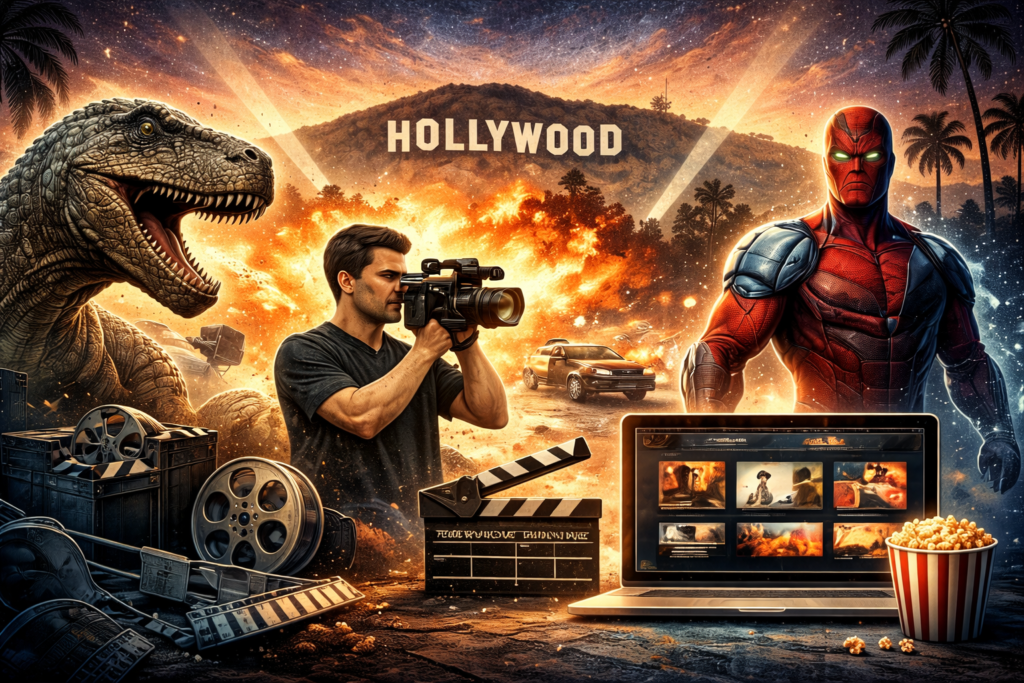
The digital era of Hollywood cinema brought CGI technology, blockbuster franchises, and streaming platforms to the forefront of filmmaking
The history of cinema is often described as a series of technological revolutions in filmmaking. The silent era introduced moving images to the world. The sound revolution of the late 1920s transformed storytelling. In the mid-20th century, colour cinema reshaped visual aesthetics and expanded the language of film.
But the digital Hollywood era, beginning in the 1990s, may be the most transformative of them all.
During this period, Hollywood experienced three massive shifts:
- The rise of computer-generated imagery (CGI)
- The dominance of global blockbuster franchises
- The emergence of streaming platforms
Together, these forces changed not only how films were made, but also how audiences watched them around the world.
–––– ✦ ✦ ✦ ––––
Table of Contents
–––– ✦ ✦ ✦ ––––
Key Takeaways
A quick summary of how technology reshaped modern Hollywood cinema:
- Digital Hollywood began in the 1990s with advances in computer-generated imagery.
- Global franchises became a dominant form of filmmaking.
- Streaming platforms transformed film distribution and viewing habits.
–– ✦ ✦ ––
A Quick Timeline of Hollywood’s Evolution
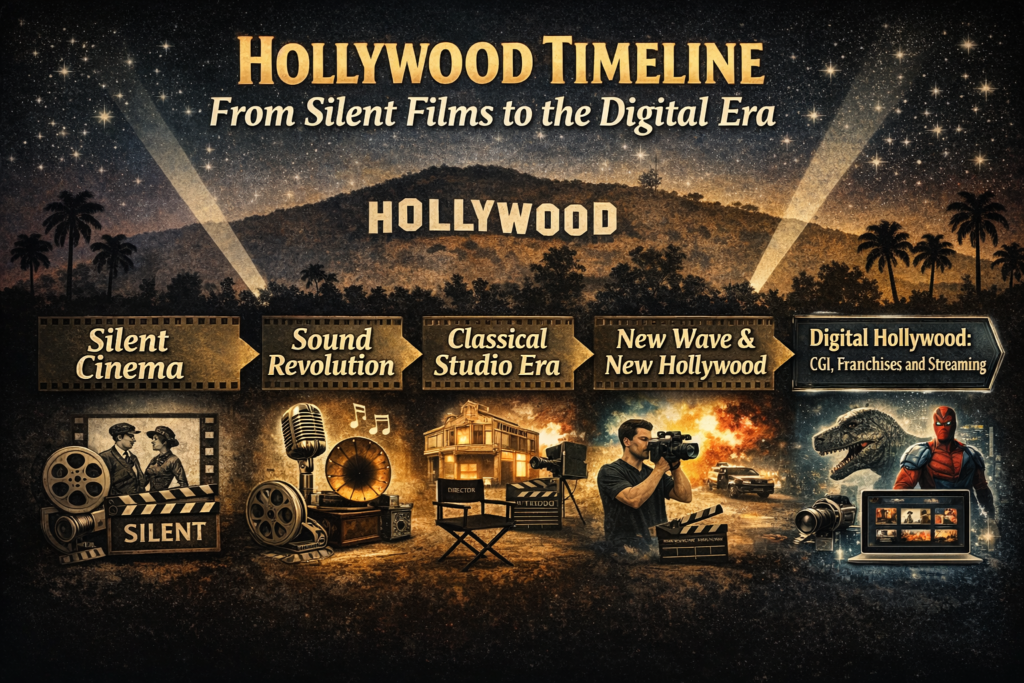
A short look at the major eras that shaped Hollywood filmmaking:
Before exploring the technologies and trends that define the digital era, it is helpful to see how Hollywood evolved over time. From the silent film experiments of the early twentieth century to the CGI-driven blockbusters and streaming platforms of today, each era introduced innovations that transformed filmmaking and storytelling. The timeline below highlights the major phases that shaped the development of Hollywood cinema.
🎞 Silent Era (1895–1927)
The earliest years of cinema when films had no synchronized sound.
Read more → Silent Hollywood: The Birth of American Cinema
🎙 Sound Revolution (1927–1939)
The arrival of synchronized sound transformed filmmaking forever.
Read more → The Sound Revolution in Hollywood
🎬 Golden Age (1930s–1950s)
The studio system produced classic stars and legendary films.
Read more → Hollywood Golden Age: Studios and Stars
🎥 New Hollywood (1967–1980)
Directors gained creative control and storytelling became more experimental.
Read more → New Hollywood: Directors Take Control
💻 Digital Hollywood (1990s–Today)
CGI, blockbuster franchises, and streaming reshaped modern cinema.
Read more → Digital Hollywood: CGI, Franchises, and Streaming
–– ✦ ✦ ––
The Beginning of Digital Hollywood
By the early 1990s, computers had begun to influence filmmaking in ways that earlier generations could hardly imagine.
The turning point came with the groundbreaking effects of films like:
- Terminator 2: Judgment Day
- Jurassic Park
These films demonstrated that digital effects could create realistic characters, creatures, and environments on screen.
The 1990s soon became a decade of rapid experimentation with digital technology. Hollywood studios began investing heavily in visual-effects studios such as:
- Industrial Light & Magic
- Digital Domain
The result was the CGI revolution in Hollywood cinema.
By the end of the decade, digital effects had become a standard part of filmmaking. Toy Story even proved that an entire feature film could be created using computer animation.
–– ✦ ✦ ––
By the 1990s, Hollywood began to enter a new phase driven by rapid technological innovation and global market expansion. Advances in digital tools, the rise of large-scale franchises, and new methods of film distribution started to reshape the industry. Together, these changes laid the foundation for what is now known as the digital era of Hollywood.
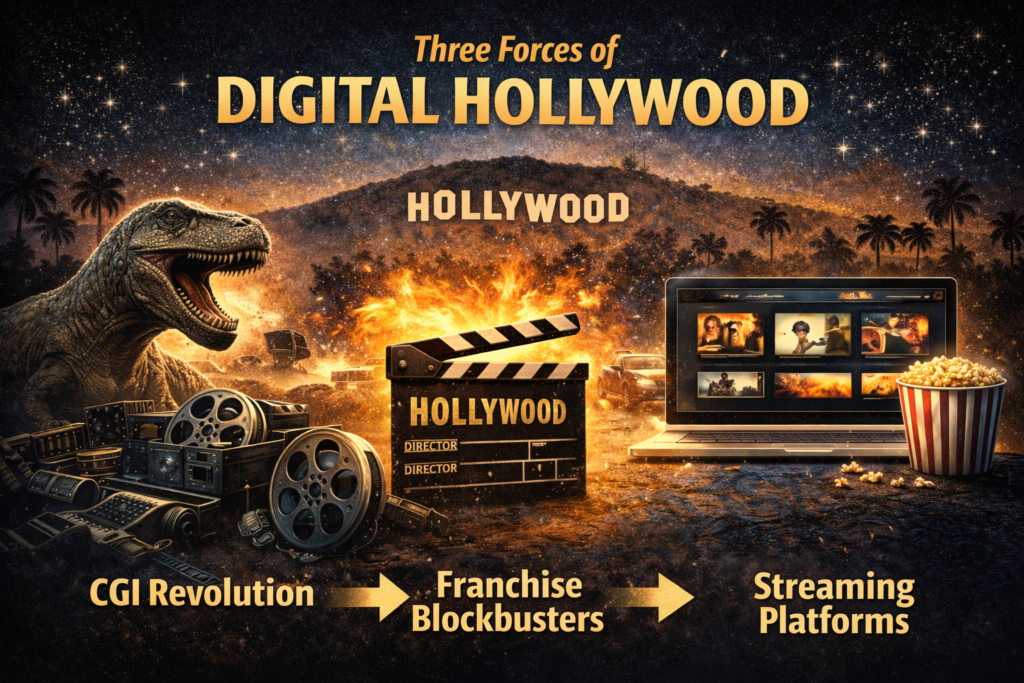
This infographic highlights the three key forces that define the digital era of Hollywood cinema.
The CGI Revolution in Hollywood
Computer-generated imagery transformed the way films are created and experienced.
One of the defining features of the digital Hollywood era has been the rapid rise of computer-generated imagery, commonly known as CGI. Beginning in the early 1990s, filmmakers started using digital technology to create visual effects that were previously impossible with practical methods. Over time, CGI evolved from a technical novelty into one of the most powerful storytelling tools in modern Hollywood cinema.
As part of the digital Hollywood era of CGI, franchises, and streaming, you can explore a detailed explanation of digital cinema and visual effects to better understand how filmmaking has evolved.
From Visual Trick to a Powerful Storytelling Tool
In the early years, CGI was used mainly to enhance action scenes or create spectacular visuals. But filmmakers quickly realized that digital technology could also expand storytelling possibilities.
Directors like:
- James Cameron
- Steven Spielberg
- Peter Jackson
began using CGI not just as a technical trick but as a narrative tool.
For example:
- The Matrix introduced revolutionary digital camera effects.
- The Lord of the Rings: The Fellowship of the Ring used CGI to create entire fantasy worlds.
- Avatar pushed motion capture and digital environments to new levels.
These films showed that digital technology could expand the scale and imagination of cinema.
By the 2000s, large-scale CGI became central to Hollywood filmmaking, especially in science fiction, fantasy, and superhero genres.
The Rise of Hollywood Franchises
Franchise filmmaking became a dominant force in modern Hollywood.
From the late 1990s onward, studios increasingly focused on building interconnected film series with recurring characters and expansive story worlds. These franchises allowed filmmakers to develop long-term narratives while giving audiences familiar and evolving characters to follow across multiple films.
Major studios increasingly relied on franchise films to attract global audiences and sustain long-term engagement.
This model also transformed the business side of cinema. Franchises generated consistent box office returns, global fan engagement, and opportunities for merchandising and cross-media storytelling. As a result, they became central to Hollywood’s strategy in the digital era.
Today, franchise filmmaking continues to shape mainstream cinema, influencing not only how stories are told but also how films are produced and marketed worldwide.
Digital Production and Filmmaking Technology
The digital era also transformed how films are made.
Earlier filmmakers relied heavily on film cameras, physical sets, and practical effects. Modern productions increasingly use digital tools such as:
- Motion capture technology
- Digital cinematography
- Virtual production stages
- Real-time CGI environments
Films like Avatar demonstrated how digital filmmaking could combine live actors with completely computer-generated worlds.
More recently, productions such as The Mandalorian have used LED volume stages, allowing actors to perform inside digital environments created in real time.
This technology has blurred the line between animation, live-action, and virtual filmmaking.
For a broader perspective on how digital technology reshaped filmmaking, it is useful to understand the role of digital cinema and visual effects in modern film production.
The Streaming Revolution
Streaming platforms transformed how audiences access and experience cinema.
The rise of digital platforms in the 2010s marked a major shift in film distribution and consumption. Instead of relying solely on theatrical releases, audiences could now watch films anytime and anywhere through online streaming services. This change expanded global access to cinema and reshaped viewing habits across different regions.
Platforms like Netflix and others played a key role in this transformation by producing original content and investing in diverse storytelling. As a result, the boundaries between cinema and television began to blur, creating new opportunities for filmmakers and audiences alike.
Today, streaming continues to influence how films are made, distributed, and consumed, making it one of the defining features of the digital Hollywood era.
–– ✦ ✦ ––
Globalization of the Film Industry
Digital Hollywood is also characterized by global audiences.
Modern blockbusters are designed to perform well not only in North America but also in international markets such as:
- China
- India
- Europe
- Latin America
The global box office now plays a crucial role in determining a film’s success.
This globalization has encouraged studios to produce visually spectacular films that can appeal across languages and cultures.
Spectacle—often powered by CGI—has therefore become central to modern Hollywood storytelling.
–– ✦ ✦ ––
Challenges of the Digital Era
Despite its success, the digital Hollywood era also faces several challenges.
Critics often argue that modern studios rely too heavily on:
- Sequels and reboots
- Established franchises
- Visual spectacle over storytelling
Independent filmmakers and smaller studios sometimes struggle to compete with the massive budgets of blockbuster productions.
At the same time, streaming has created new debates about:
- The future of theatrical cinemas
- Revenue models for filmmakers
- The balance between movies and television-style storytelling
Hollywood continues to adapt to these evolving conditions.
–– ✦ ✦ ––
Legacy of the Digital Hollywood Era
The digital era of Hollywood continues to shape the future of cinema.
From the rise of CGI and large-scale franchises to the expansion of streaming platforms, this period has transformed every aspect of filmmaking. These changes have not only enhanced visual storytelling but also redefined how films are produced, distributed, and experienced by audiences worldwide.
Today, Hollywood operates in a landscape where technology and storytelling are deeply interconnected. As new innovations emerge, the influence of the digital era remains central, ensuring that cinema continues to evolve with changing audience expectations and global trends.
–––– ✦ ✦ ✦ ––––
📚 Continue Exploring Cinema History
🎬 Previous Era
New Hollywood & Counterculture Cinema (1960s–1980s)
Explore how director-driven filmmaking reshaped Hollywood storytelling and creative control.
🎬 Next Topic
Hollywood Cinema History: From Silent Films to the Digital Era
Understand how the digital age fits into the complete evolution of Hollywood cinema.
🎬 Related Classic Films
Guide (1965) & Mother India (1957)
Discover how classic films from the Golden Age of Bollywood reflected similar shifts in storytelling and audience engagement.
📖 Related Reading
Explore more about the evolution of Hollywood and the eras that shaped modern cinema:
- Hollywood Cinema History: From Silent Films to the Digital Era
A complete overview of how Hollywood evolved across different technological and creative phases. - Hollywood Golden Age: Studios, Stars, and Classic Films
Discover the era when the studio system and star power defined global cinema. - New Hollywood & Counterculture Cinema (1960s–1980s)
Learn how director-driven storytelling transformed filmmaking before the digital era. - The Global Evolution of Cinema
Understand how Hollywood’s digital transformation connects with broader changes in world cinema.
❓ Detailed FAQs — Digital Hollywood Era
What is the digital Hollywood era?
The digital Hollywood era refers to the period from the 1990s to the present when digital technology—especially CGI, digital cinematography, and streaming platforms—transformed filmmaking and film distribution.
Why is CGI important in modern Hollywood?
CGI allows filmmakers to create realistic creatures, environments, and visual effects that would be impossible with traditional methods. It became widely used in Hollywood beginning in the 1990s.
How did streaming change Hollywood?
Streaming services changed the film industry by providing direct online distribution, allowing audiences to watch movies instantly without visiting theatres.
What are blockbuster franchises?
Blockbuster franchises are film series built around popular intellectual properties, such as the Marvel Cinematic Universe or the Star Wars saga.