
Read In English | हिंदी में पढ़ें
–––– ✦ ✦ ✦ ––––
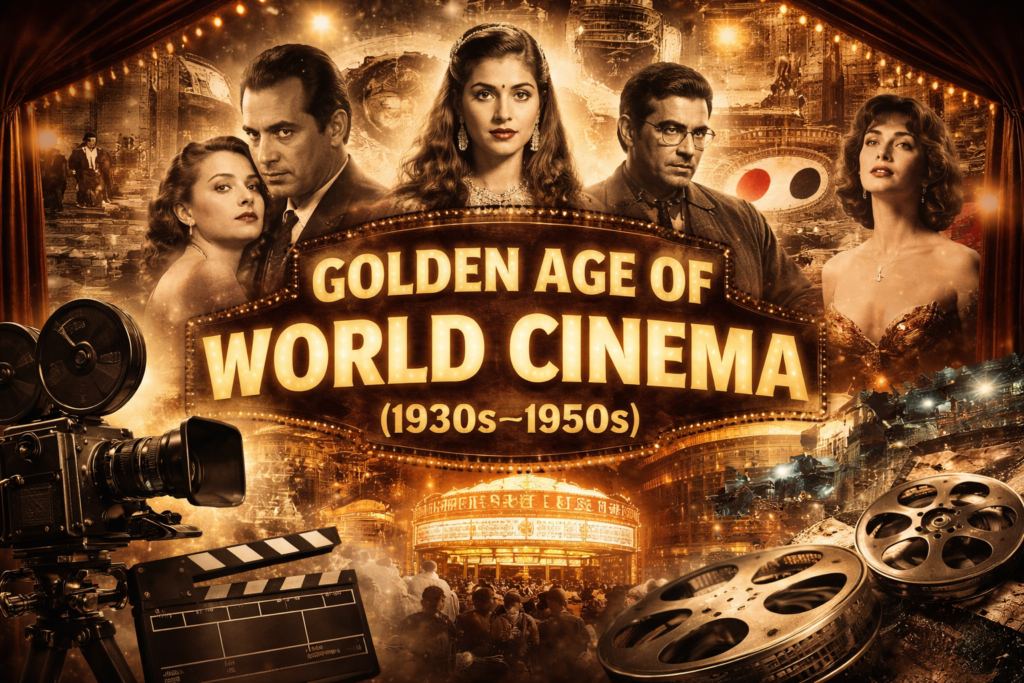
The period from the 1930s to the 1950s is widely regarded as the Golden Age of World Cinema — an era when filmmaking matured into a powerful blend of art, industry, and mass entertainment.
During these decades, cinema evolved from novelty into a global cultural force, shaping popular imagination, national identity, and collective memory.
This phase in the history of world cinema did not belong to one nation alone. While the Classical Hollywood era dominated international screens, parallel cinematic traditions flourished across Europe, Asia, and other regions.
Each responded to social change, technological progress, and historical upheavals in its own distinctive way.
–––– ✦ ✦ ✦ ––––
In This Post …
–––– ✦ ✦ ✦ ––––
The Rise of the Studio System in the 1930s–1950s (Classical Hollywood Era)
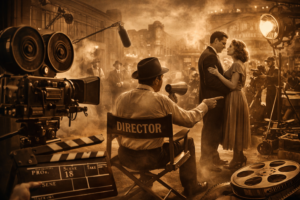
One defining feature of the Golden Age of Cinema was the emergence of large studio systems, especially in the United States.
Major studios controlled:
- Film production
- Distribution networks
- Theater chains
- Long-term contracts with actors, directors, and writers
This industrial model allowed studios to produce films efficiently and consistently, turning cinema into a reliable mass medium.
At the same time, similar early film studios began forming in:
- India (Bollywood’s First Frame: Lumière to Phalke (1896–1913))
- Japan
- Germany
- Italy
- The United Kingdom
Each adapted the model to local tastes, languages, and cultural traditions.
–– ✦ ✦ ––
The Birth of Movie Stardom during the Golden Age of Cinema
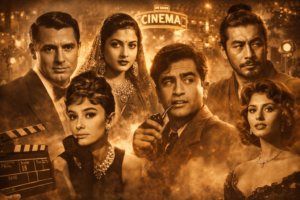
The Golden Age created the concept of the movie star as we know it today.
Audiences no longer watched films only for stories — they watched them for faces, personalities, and personas. Actors became:
- Cultural icons
- Style influencers
- Box-office guarantees
Fan magazines, studio publicity, and carefully crafted public images transformed performers into global celebrities, making cinema a powerful engine of aspiration and fantasy.
–– ✦ ✦ ––
Iconic Genres Take Shape
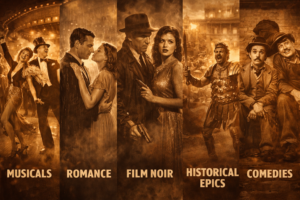
Many of cinema’s most enduring genres were defined during this period:
- Musicals brought spectacle, rhythm, and optimism
- Romantic dramas explored emotional intimacy
- Film noir reflected post-war anxiety and moral ambiguity
- Historical epics showcased scale and grandeur
- Comedies offered escape during times of hardship
These genres provided familiar frameworks, allowing audiences to connect emotionally while studios refined storytelling techniques.
–– ✦ ✦ ––
Cinema Beyond Hollywood: Global Cinema in the 1930s–1950s
While Hollywood dominated exports, the Golden Age was equally significant elsewhere.
Europe: European filmmakers explored realism, philosophy, and artistic expression, often responding to political instability and war.
Japan: Japanese cinema developed rich narrative traditions, blending historical themes with human drama (e.g., works of Akira Kurosawa such as Rashomon).
India: Indian cinema expanded rapidly, combining music, mythology, social themes, and spectacle — laying the groundwork for what would later become the Hindi film industry’s golden era.
Each region contributed unique styles, proving that cinema was not a single tradition but a global mosaic of voices.
–– ✦ ✦ ––
War-Time Cinema and Social Impact
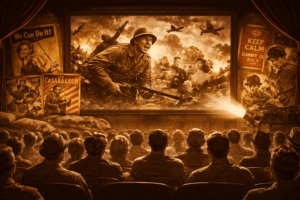
World War II profoundly influenced cinema across the world.
Films became:
- Tools of propaganda
- Reflections of national resilience
- Mediums for documenting trauma and hope
War-time cinema balanced entertainment with messaging, shaping public perception and collective memory long after the conflict ended.
–– ✦ ✦ ––
Technological and Artistic Advancements
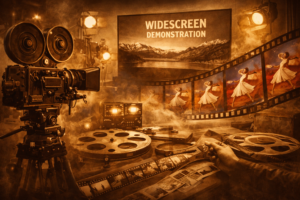
The Golden Age also saw major innovations:
- Improved sound recording
- Advances in lighting and cinematography
- Widescreen formats and color experimentation
- Sophisticated editing and narrative structures
Filmmakers learned how to control emotion through craft, transforming cinema into a mature storytelling art.
–– ✦ ✦ ––
Why the Golden Age Still Matters

Modern cinema — whether Hollywood blockbusters or global independent films — continues to draw from the foundations laid during this era.
Narrative structure, genre conventions, star systems, and visual language all trace their roots back to the Golden Age. Understanding this period helps us see why cinema became the dominant cultural medium of the 20th century.
Golden Age of World Cinema – Frequently Asked Questions
Q1: When did the Golden Age of World Cinema begin?
A: The era is considered to have started in the 1930s and lasted through the 1950s.
Q2: Which countries led global cinema during the 1930s–1950s?
A: The United States dominated with Hollywood’s studio system, while Europe, Japan, and India developed parallel cinematic traditions. Each region created films that reflected its unique culture, history, and technological advances.
Q3: How did the Golden Age of World Cinema influence modern filmmaking?
A: Innovations in storytelling, cinematography, genre development, and star systems set the foundation for modern films worldwide. Contemporary filmmakers still draw inspiration from techniques perfected during this period.
Q4: What are some iconic films from the Golden Age?
A: Hollywood’s Casablanca (1942) and Kurosawa’s Rashomon (1950) exemplify the era’s influence, showcasing strong narratives, innovative cinematography, and enduring cultural impact.
Q5: What were the major film genres of this era?
A: Musicals, romantic dramas, film noir, historical epics, and comedies were the defining genres.
–– ✦ ✦ ––
Final Cut
The Golden Age of World Cinema was not merely a nostalgic era — it was the moment when cinema truly came of age. It united audiences across borders, created lasting myths, and proved that moving images could shape culture itself.
At The Reel Retro, we continue this journey by exploring how cinema adapted, rebelled, and reinvented itself in the decades that followed.
–––– ✦ ✦ ✦ ––––
Next Best Move
By the late 1950s, cinema faced a new challenge — television. Audiences began staying home, studios struggled, and filmmakers searched for new ways to tell stories. This disruption gave rise to bold artistic movements across the world, setting the stage for the next chapter in cinema’s evolution.
Next in Cinema Origins:
👉 The Television Challenge & New Wave Cinemas (1950s–1970s)
–– ✦ ✦ ––
Internal Links to Earlier Posts in Cinema Origins
For a deeper dive into cinema’s evolution, explore these posts:
- From Nickelodeons to Hollywoodland: The Birth of an Industry (1890s–1910s)
- Mughal-e-Azam: The Pinnacle of Early Bollywood Storytelling
- Bollywood’s First Frame: Lumière to Phalke (1896–1913)
External References
For further reading on cinema history from reputable sources:
- Golden Age of Hollywood: Studio System and Star Culture – Wikipedia
- History of Film and Early Traditions – Encyclopaedia Britannica
🔖 Attribution Note: These external sources open in new tabs and are for reference only. All rights belong to their respective publishers and content owners.
–––– ✦ ✦ ✦ ––––