
Read In English | हिंदी में पढ़ें
–––– ✦ ✦ ✦ ––––
How we went from nickelodeons to Hollywoodland?
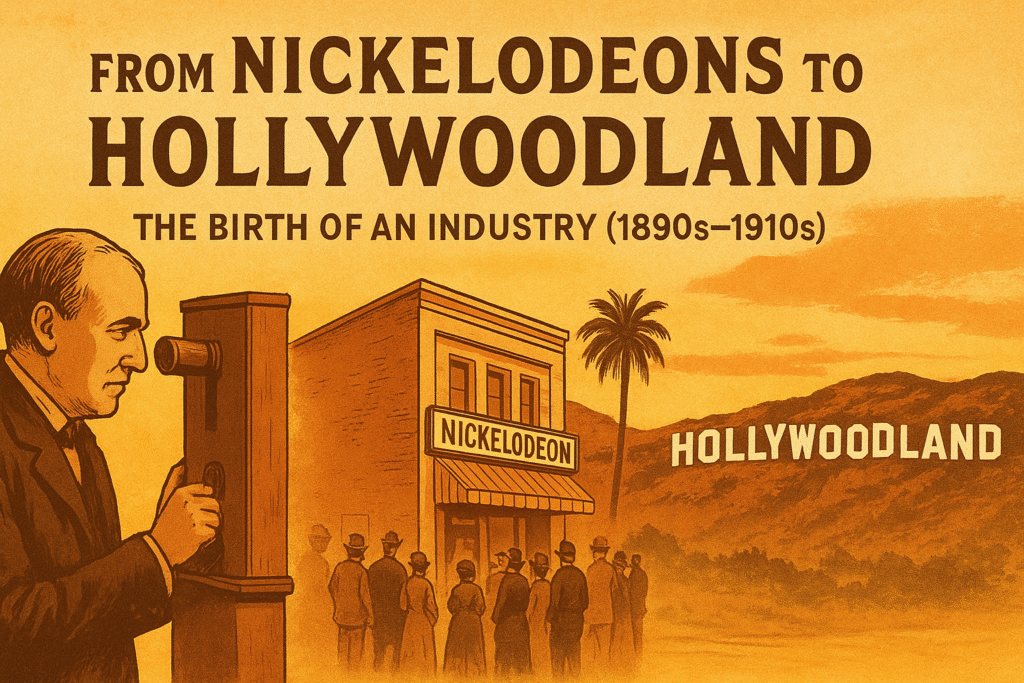
Cinema did not begin in Hollywood. In fact, the earliest American movies were made in laboratories, cramped studios on the East Coast, and tiny storefront theatres called nickelodeons.
Between the 1890s and 1910s, a remarkable transformation occurred: moving images went from a novelty attraction to a multi-million-dollar industry that would soon relocate to California.
This is the story of how we went to Hollywoodland from the nickelodeons.
–––– ✦ ✦ ✦ ––––
In This Post …
–––– ✦ ✦ ✦ ––––
The Age of Invention: Edison, Lumière, and the Kinetoscope
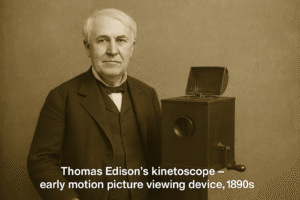
Before Hollywood became the global movie capital, cinema was born in laboratories and workshops. This was the age of inventors — visionaries like Thomas Edison and the Lumière brothers — who turned light, motion, and curiosity into the earliest moving pictures. Their mechanical experiments laid the foundation for what would soon become the world’s greatest storytelling medium.
- In the 1890s, Thomas Edison and his assistant W.K.L. Dickson developed the kinetoscope, a peephole machine that allowed individuals to watch short moving pictures.
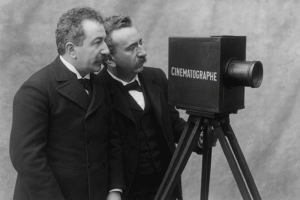
- Around the same time in France, the Lumière brothers introduced the Cinématographe — a portable camera and projector that allowed films to be screened to large audiences, unlike Edison’s single-viewer machine.
- These innovations spread quickly, with America embracing cinema not just as a scientific curiosity, but as a form of mass entertainment.
👉 Edison’s Black Maria Studio in New Jersey became the world’s first purpose-built film studio, churning out short films of vaudeville acts, dancers, and boxing matches.
–– ✦ ✦ ––
Nickelodeons: America’s First Movie Theatres
By the early 1900s, motion pictures had begun to leave the lab and enter the public space. Cheap, cozy theaters called Nickelodeons brought cinema to the masses for just five cents a show. These humble venues sparked a cultural revolution — turning movies into a shared experience and creating the first generation of filmgoers.
- By the 1900s, films had grown popular enough to move into permanent spaces. Storefront theaters charging five cents admission became known as nickelodeons.
- They attracted working-class audiences, immigrants, and families who found them cheaper than live theater.
- The boom was extraordinary — by 1910, there were more than 10,000 nickelodeons across the United States.
🎥 These theatres fuelled the demand for longer films and regular production schedules, laying the foundation for the future Hollywood industry.
–– ✦ ✦ ––
Early Film Studios and the Motion Picture Patents Company
As films became more popular, filmmakers realized the need for dedicated spaces to shoot, edit, and distribute their work. Small studios started appearing across America, but Edison’s powerful trust soon tried to control the entire industry through patents. This struggle for creative freedom pushed independent filmmakers west — toward a sunny land called California.
- Early film production was dominated by companies like Biograph, Vitagraph, Edison Studios, and Selig Polyscope.
- To control the industry, Edison spearheaded the Motion Picture Patents Company (MPPC) in 1908, often called the Edison Trust.
- The MPPC enforced strict patents on cameras and film stock, making it difficult for independent filmmakers to operate.
⚡ This stranglehold ironically pushed filmmakers to the West Coast, where courts were less favorable to Edison’s lawsuits and the weather allowed year-round filming.
–– ✦ ✦ ––
Why California? The Migration West
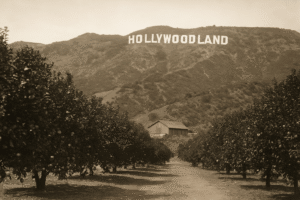
By the 1910s, the migration to California was underway. But why Hollywood?
- Weather: Southern California’s mild climate allowed outdoor filming year-round.
- Varied landscapes: Mountains, beaches, deserts, and cityscapes within driving distance.
- Distance from Edison’s lawyers: Being far from New Jersey made it easier to avoid patent lawsuits.
- Cheap land & labor: At the time, Los Angeles was still a small agricultural town with affordable property.
📍 In 1911, the Nestor Film Company opened the first permanent film studio in Hollywood. Soon, companies like Paramount, Universal, and Warner Bros. followed.
–– ✦ ✦ ––
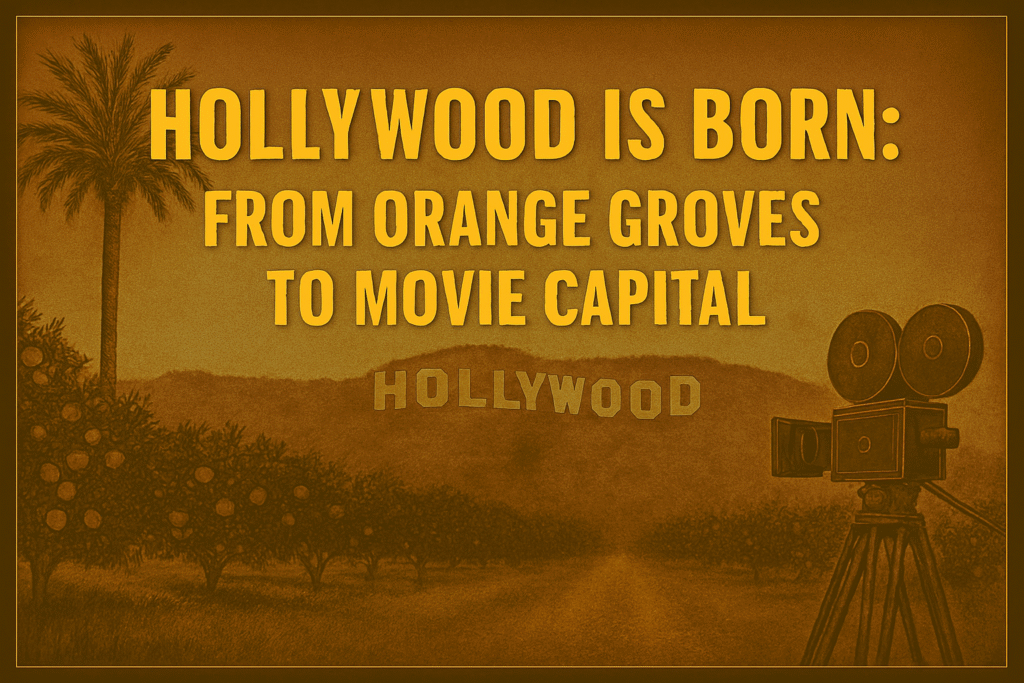
Hollywoodland Is Born
By the late 1910s, the sleepy suburb of Los Angeles had transformed into the epicenter of American cinema.
- In 1910, the Hollywoodland real estate development began, complete with its now-iconic sign (later shortened to Hollywood).
- As nickelodeons declined and full-length films rose in popularity, the industry centered in Los Angeles grew at a staggering pace.
- Within just two decades, the U.S. had gone from Edison’s kinetoscope parlors to the largest film industry in the world.
–– ✦ ✦ ––
Conclusion
The journey from nickelodeons to Hollywoodland was more than just a geographic shift — it marked the birth of a global cultural force. What started as short reels in storefront theaters evolved into a sprawling industry that would shape the 20th century.
And Hollywood was only getting started. Next came the Silent Titans — Chaplin, Keaton, and the stars who turned movies into modern myths.
🎬 Rewind the Reel, Discover More!
Loved exploring how early cinema came to life? Don’t stop here — head over to our Cinema Origins section for more stories that shaped the silver screen.
–––– ✦ ✦ ✦ ––––
Quick FAQs
Q1. What were nickelodeons in cinema history?
Nickelodeons were early storefront theatres in the 1900s that charged five cents for admission, showing short films to working-class audiences.
Q2. Why did filmmakers move from New Jersey to California?
They moved west to escape Edison’s patent lawsuits, take advantage of California’s weather, and access diverse filming locations.
Q3. What was the Edison Trust (MPPC)?
The Motion Picture Patents Company, formed in 1908, controlled film equipment patents and limited independent filmmakers, pushing many to relocate.
Q4. When was the first Hollywood studio established?
The first permanent studio in Hollywood was founded in 1911 by the Nestor Film Company.
–– ✦ ✦ ––
Nickelodeons to Hollywoodland – Frequently Asked Questions
Q1. Who invented the kinetoscope?
The kinetoscope was invented by Thomas Edison and W.K.L. Dickson in the 1890s.
Q2. How many nickelodeons existed by 1910?
Over 10,000 nickelodeons operated in the U.S. by 1910.
Q3. What role did the Lumière brothers play in U.S. cinema history?
Their projection technology influenced American filmmakers to move from individual viewing machines to mass screenings.
Q4. What was Hollywoodland?
Hollywoodland was a 1910s Los Angeles real estate development that gave its name to Hollywood, the future movie capital.
–––– ✦ ✦ ✦ ––––
🎥 Next – Hollywood is Born:
From the noisy nickelodeons to Edison’s studio empire, America’s movie dream was taking shape. But how did it all move west to the sunny orange groves of California? Read: Hollywood is Born – From Orange Groves to Movie Capital
–– ✦ ✦ ––
🎬 Further Reading – Explore Nickelodeons in more detail here:
- ENCYCLOpedia.com: Nickelodeons
- Wikipedia: Nickelodeon (movie theatre)
🔖 Attribution Note: External resources above are referenced for educational and historical context. All rights belong to their respective publishers and content owners.
–––– ✦ ✦ ✦ ––––