
The Silent Era: Early Indian cinema’s stories, emotions, and visual experiments
Read In English | हिंदी में पढ़ें
–––– ✦ ✦ ✦ ––––
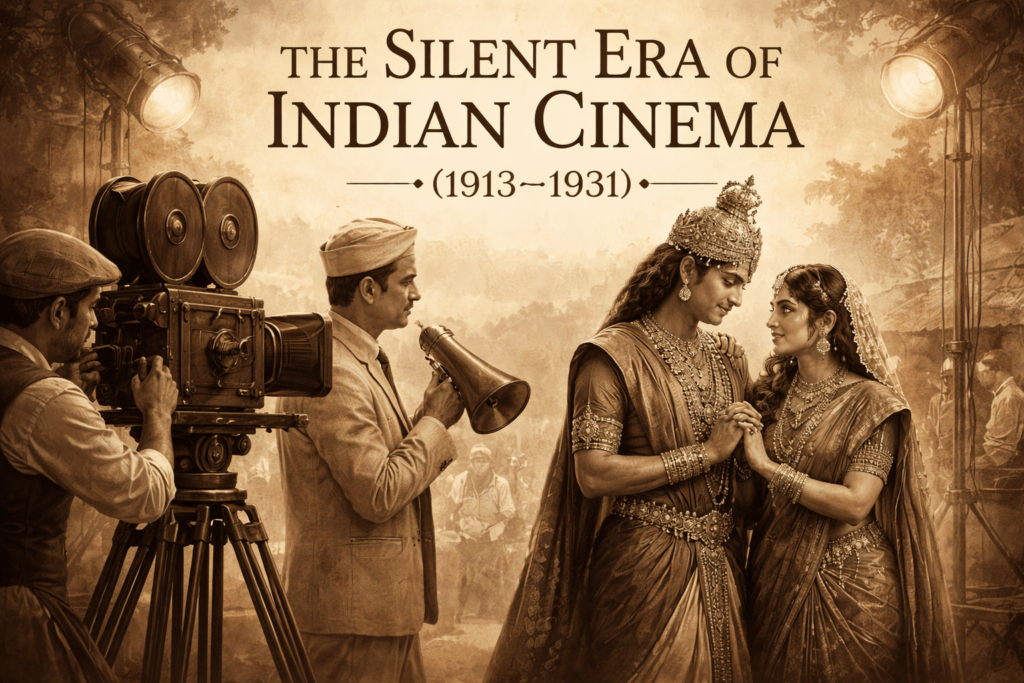
Before songs, dialogues, and dramatic monologues became the soul of Bollywood, Indian cinema spoke a language of its own — pure imagery.
The period between 1913 and 1931, known as the Silent Era of Indian Cinema, marked the foundation of a storytelling tradition that would soon echo across the world.
Long before microphones entered studios and songs defined popular cinema, filmmakers relied entirely on visuals, expressions, and live narration to tell stories that resonated deeply with Indian audiences.
This article continues the journey that began with the arrival of cinema in India between 1896 and 1913. The Silent Era was an extension of those early experiments and creative ambitions, laying the groundwork for what would later become one of the world’s most prolific film industries.
–––– ✦ ✦ ✦ ––––
In This Post …
–––– ✦ ✦ ✦ ––––
FAQs — Quick Facts About the Silent Era
What were “talkies” in Indian cinema?
“Talkies” were films that included recorded dialogue, songs, and sound. In India, the talkie era began in 1931 with Alam Ara, marking a major shift from silent visual storytelling to sound-based cinema.
How did the Silent Era shape Indian filmmaking?
The Silent Era shaped Indian cinema by emphasizing visual storytelling, expressive acting, and symbolic imagery. Filmmakers relied on gestures, intertitles, and composition to communicate emotions, a foundation that influenced later Indian films.
Why is the period 1913–1931 called the Silent Era?
The years between 1913 and 1931 are called the Silent Era because most Indian films produced during this time did not contain recorded sound or dialogue. This phase lasted until the arrival of talkies in the early 1930s.
Which regional cinemas produced silent films in India?
During the Silent Era, silent films were produced not only in Bombay but also in regional industries such as Bengali, Tamil, Telugu, Marathi, and Malayalam cinema. This early diversity helped shape Indian cinema as a multilingual tradition.
–– ✦ ✦ ––
The Beginning — Dadasaheb Phalke and Raja Harishchandra (1913)
Before exploring this defining phase, it is important to understand how cinema first arrived in India. Between 1896 and 1913, from the Lumière Brothers’ early screenings to Dadasaheb Phalke’s pioneering experiments, the foundations of Indian cinema were already in place. Readers interested in this formative period may explore Bollywood’s First Frame: Lumière to Phalke (1896–1913) for a clearer historical context to the Silent Era.
Fact Card / Trivia:
The very first Indian feature film, Raja Harishchandra (1913), was shown at Mumbai’s Coronation Cinema. Live narrators (“Shahenshahs”) explained scenes in real time to the audience.
India’s cinematic story began when Dhundiraj Govind Phalke, better known as Dadasaheb Phalke, created Raja Harishchandra in 1913. It wasn’t just India’s first full-length feature film — it was the birth of an industry.
Inspired by foreign films and Indian mythology, Phalke turned a modest experiment into a cultural revolution. Using hand-built cameras, painted backdrops, and family members as actors, he laid the cornerstone for Indian cinematic storytelling.
Although the film was silent, it spoke volumes about faith, dharma, and imagination.
Quote:
“Cinema, in India, is not just entertainment — it’s a celebration of life itself.” – Satyajit Ray
Trivia:
Phalke was inspired to make films after watching the British movie The Life of Christ (1910). His vision was to create Indian mythological stories for Indian audiences — thus beginning India’s cinematic journey.
–– ✦ ✦ ––
The Flourishing 1920s — Studios, Stars, and Stories
The 1920s marked a period of rapid growth and consolidation for Indian silent cinema. Filmmaking began to evolve from small experiments into a studio-driven industry, shaping stories, stars, and audience culture that would define Indian cinema for decades.
Key Studios and Their Contributions
The 1920s saw rapid expansion of film production in India. Studios like Kohinoor Film Company, Imperial Film Company, and Madan Theatres became hubs for experimentation and technical innovation. They not only produced films but also trained actors and filmmakers, shaping the early cinematic landscape.
Mythological and Social Themes
Films were predominantly mythological and historical, rooted in Indian tradition and culture. Social dramas also emerged, addressing reform, love, and the idea of a “modern India.” These films entertained audiences while delivering moral and social messages.
Early Film Stars
India’s first film stars — Patience Cooper, Sulochana (Ruby Myers), Seeta Devi, and Zubeida — became household names. Although audiences never heard their voices, their expressive performances laid the foundation for the star culture in Indian cinema.
–– ✦ ✦ ––
Challenges of the Silent Film Industry
The silent era was not only a time of creative breakthroughs but also one of significant struggle. Filmmakers worked under severe technical limitations, social constraints, and scarce resources—challenges that shaped the unique character of early Indian cinema.
Technological Limitations
Imported cameras and film reels were expensive and scarce. Filmmakers often relied on self-built equipment and inventive solutions.
Lack of Sound Synchronization
Every emotion had to be conveyed through body language, title cards, and live background music. Filmmakers mastered visual storytelling to compensate for the absence of dialogue.
Cultural Constraints
Many Indian women refused to act on screen, forcing men to play female roles initially. This challenge led filmmakers to innovate in performance and visual representation.
Western Influence and Indian Identity
Despite challenges, Indian filmmakers blended Indian themes with Western cinematic techniques, laying the foundation of Bollywood’s distinctive style.
–– ✦ ✦ ––
Regional Voices in a Silent Medium
Silent films were not limited to Bombay. Bengal, Madras, Pune, and other regions produced films in local languages and styles. These regional productions highlighted local stories, myths, and folklore, giving rise to diverse cinematic voices in India. Regional silent films allowed audiences to experience cinema in their own languages, fostering cultural pride and identity.
–– ✦ ✦ ––
The End of Silence — Alam Ara (1931)
The release of Alam Ara in 1931 marked a historic turning point in Indian cinema. It signalled the transition from silent storytelling to synchronized sound, bringing dialogues, music, and songs into mainstream filmmaking.
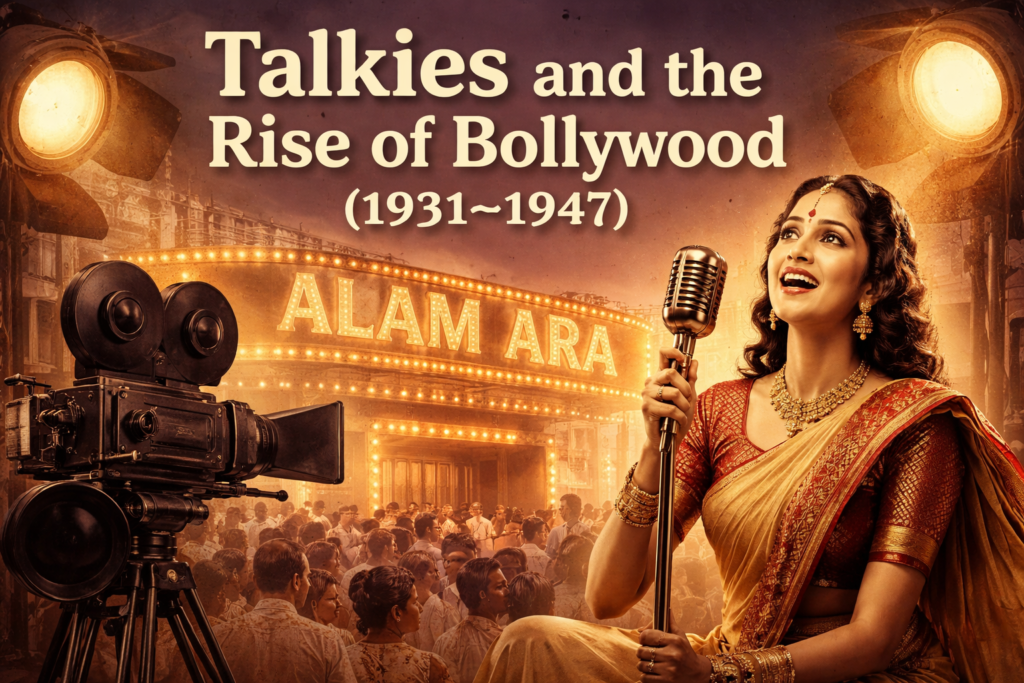
The arrival of Alam Ara marked the beginning of the Talkies not merely as a technological shift, but as a transformative moment in Indian cinema’s emotional and commercial evolution. The introduction of sound, dialogue, and songs reshaped storytelling and audience engagement, ushering in a new era whose impact is explored in detail in Talkies and the Rise of Bollywood (1931–1947).
Alam Ara: India’s First Talkie
Alam Ara (1931) introduced synchronized sound, songs, and dialogue to Indian audiences. It marked the end of the Silent Era and the beginning of the Talkies Era.
Impact on Hindi Cinema
The success of Alam Ara accelerated the production of talkies, establishing new standards for music and storytelling in both Hindi and regional cinema.
Way Ahead
This era set the benchmark for incorporating sound into Indian films and paved the way for the future of Indian cinema.
–– ✦ ✦ ––
Legacy of the Silent Era
Although silent films lacked spoken dialogue, their influence on Indian cinema remains profound. The visual language, performance styles, and narrative traditions developed during this era continue to echo in later cinematic forms.
The visual storytelling techniques, expressive body language, and technical experimentation developed during the Silent Era gradually refined the cinematic language of Indian films. This creative foundation later blossomed fully in the period now remembered as the Golden Era of Bollywood (1950–1970). Without the innovations of the Silent Era, this celebrated phase of Indian cinema would be difficult to imagine.
Establishing Cinematic Language
The Silent Era introduced visual storytelling techniques that continue to influence Indian cinema today.
Actors and Techniques
Early actors, directors, and cinematographers experimented with expressions, editing, and camera work.
These innovations shaped filmmaking art for decades.
Future of Indian Cinema
The foundations of storytelling, studio systems, and star culture laid during the Silent Era enabled a smooth transition to talkies and later, Bollywood’s Golden Era.
–– ✦ ✦ ––
Conclusion: Achievements and Significance of the Silent Era
The Silent Era (1913–1931) was more than a historical period — it was a birth of an art form reflecting India’s culture, imagination, and innovation.
–– ✦ ✦ ––
FAQs — Learn More About India’s Silent Film Heritage
The following questions explore the Silent Era in greater depth. They focus on historical context, cultural impact, and the long-term significance of silent films in shaping Indian cinema.
Which were the first talkies in Indian cinema?
India’s first talkie was Alam Ara (1931), followed by Shirin Farhad (1931). These films introduced synchronized sound, songs, and dialogue to audiences.
How did the talkies change Hindi cinema?
Talkies integrated songs, dialogues, and music into storytelling, increasing audience engagement and laying the foundation for Bollywood’s Golden Era.
What is the legacy of the Silent Era?
The Silent Era developed visual storytelling, acting techniques, and studio systems that influenced Indian cinema for decades.
–––– ✦ ✦ ✦ ––––
Further Reading: Exploring India’s Silent Film Legacy
To continue exploring the evolution of Indian cinema beyond the Silent Era, the articles below offer additional historical context and thematic connections.
- Wikipedia: History of Cinema of India
- Wikipedia: Raja Harishchandra
- GoSharpener: The Evolution of Indian Cinema: A Journey Through Time
- davuniversity: History of Indian Cinema.pdf
🔖 These external resources are referenced for educational and historical context. All rights belong to respective content owners.
–––– ✦ ✦ ✦ ––––