
ENG | हिंदी …
When faith, society, and storytelling shaped the identity of Telugu cinema.
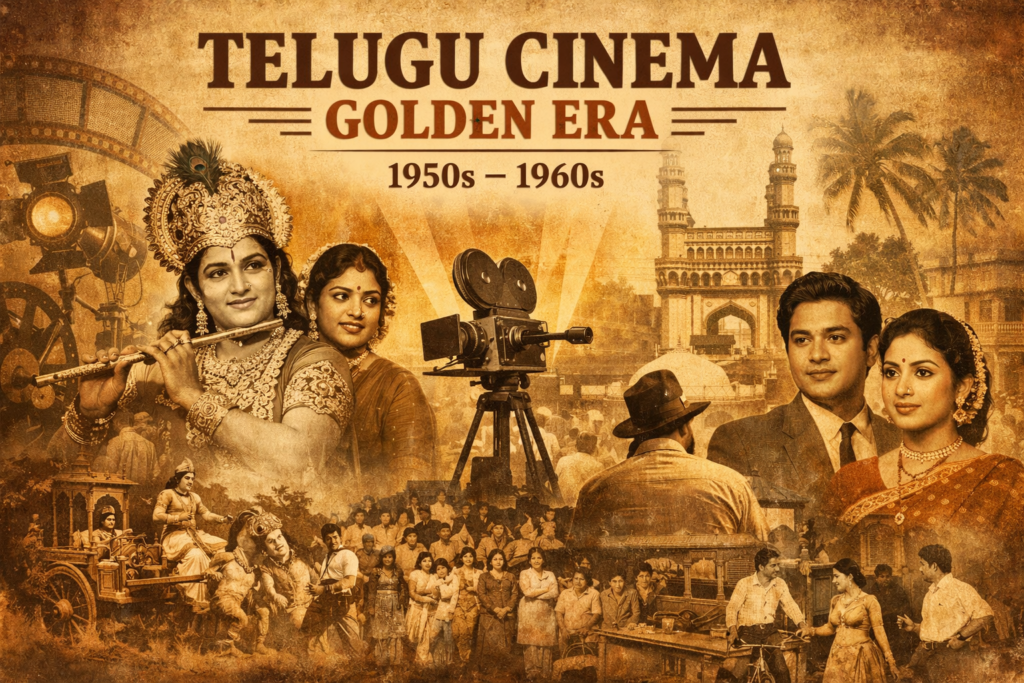
The Telugu cinema golden era—spanning roughly from the early 1950s to the late 1960s—represents the most formative and culturally influential phase in the history of Telugu films. This was the period when cinema in Andhra Pradesh evolved from studio-driven experiments into a powerful medium of mythology, social reform, and mass entertainment.
Marked by iconic stars, legendary studios, and timeless narratives, the golden age of Telugu cinema laid the foundations of what later became one of India’s largest film industries.
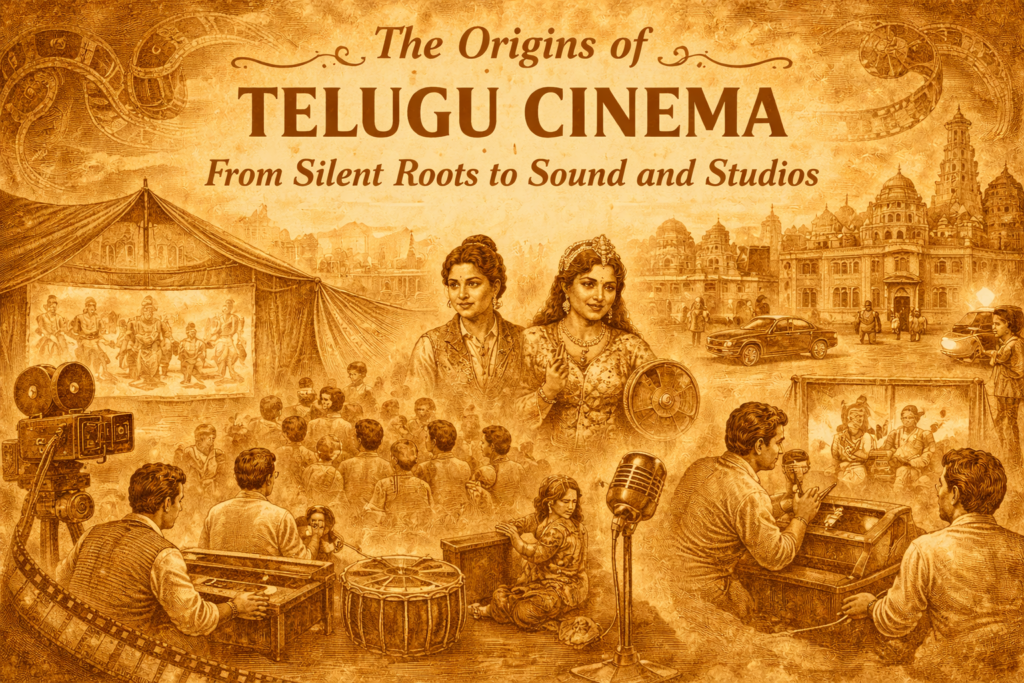
To fully understand the rise of the Telugu cinema golden era, it is important to trace how the industry took shape in its formative years. The technological beginnings, early studios, and silent-to-sound transition created the foundation on which later masterpieces were built, as explored in our detailed post on Telugu Cinema Origins.
By the early 1950s, Telugu cinema had already moved beyond its experimental phase. With sound firmly established and studio systems stabilised in Madras, filmmakers began producing large-scale mythological and social films that defined Telugu cinema throughout the 1950s and 1960s.
–––– ✦ ✦ ✦ ––––
In This Post …
–––– ✦ ✦ ✦ ––––
🔍 Quick Facts: Telugu Cinema Golden Era
- Time Period: 1950s–1960s
- Dominant Genres: Mythologicals, folklore, social dramas
- Key Studios: Vijaya Vahini Studios, Annapurna Studios
- Iconic Actors: N. T. Rama Rao, Akkineni Nageswara Rao
- Language Reach: Andhra Pradesh, Telangana, South Indian diaspora
- Cultural Impact: Reinforced mythology, language pride, and social values
Telugu cinema, also known as Tollywood, is one of the largest film industries in India, with a rich studio-driven tradition and a legacy dating back to the early 20th century.
–– ✦ ✦ ––
🎬 Rise of the Golden Age of Telugu Cinema
The history of Telugu cinema entered a decisive phase after Indian independence. With improved studio infrastructure and rising audience literacy, filmmakers began experimenting with ambitious narratives rooted in Indian epics and social realities.
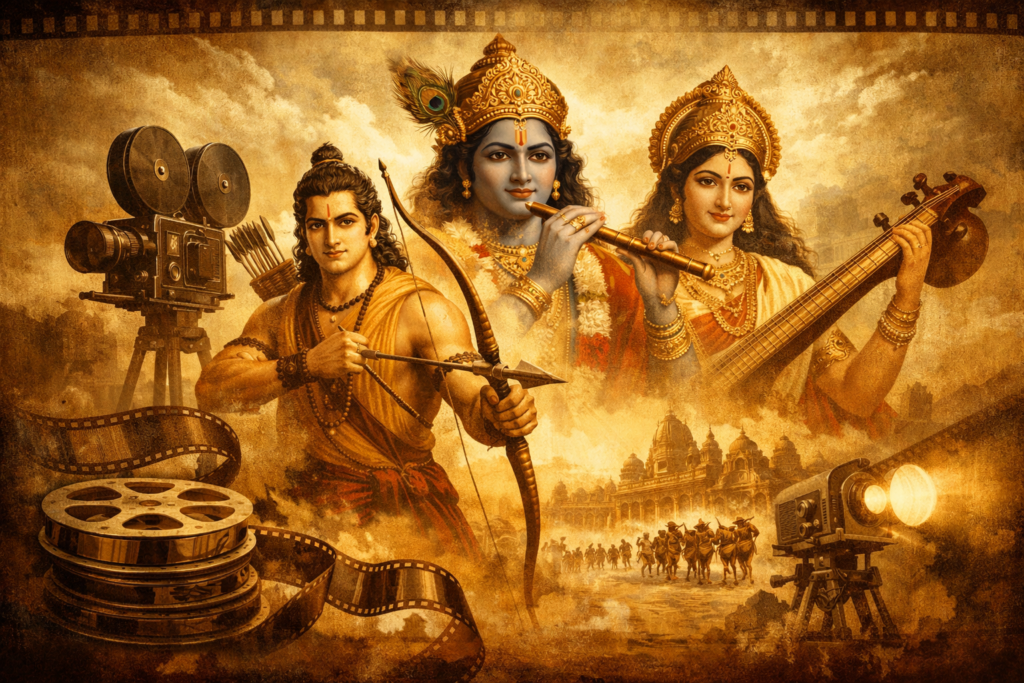
Mythological narratives shaped early Telugu cinema, blending epic imagination with classical theatrical influence
The 1950s witnessed a surge in mythological films, which resonated deeply with Telugu-speaking audiences familiar with the Ramayana, Mahabharata, and Puranic traditions. Cinema became a visual extension of oral storytelling.
–– ✦ ✦ ––
⭐ The Era of NTR and ANR
No discussion of the Telugu cinema golden era is complete without mentioning the towering presence of NTR and ANR.
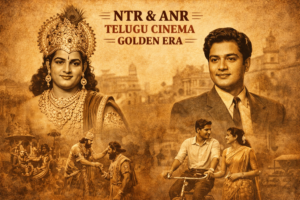
Two icons, two cinematic paths—divine mythology and human drama defined the golden age of Telugu storytelling
While N. T. Rama Rao became closely identified with divine and heroic mythological roles, Akkineni Nageswara Rao emerged as a leading figure in social and romantic dramas, giving Telugu cinema a balanced star system during its golden age.
- N. T. Rama Rao (NTR) became synonymous with divine roles, portraying Krishna, Rama, and other mythological figures with unmatched authority.
- Akkineni Nageswara Rao (ANR) excelled in romantic and social dramas, bringing emotional realism to Telugu cinema.
Together, NTR–ANR Telugu cinema symbolized a rare balance between mythological grandeur and human drama. The impact of these two legends extended far beyond box-office success, as their contrasting yet complementary screen personas shaped audience expectations and star culture for decades—a subject explored in detail in our upcoming feature on the legacy of NTR and ANR in Telugu cinema.
–– ✦ ✦ ––
🏛️ Studio Culture and Film Production
The golden era was dominated by studio-based filmmaking. Vijaya Vahini Studios in Chennai (then Madras) emerged as a powerhouse, producing technically refined and narratively rich films.
Inside the studio era—precision filmmaking, elaborate sets, and collaborative craftsmanship built a lasting legacy
Studios ensured:
- Controlled production quality
- Theatrical acting discipline
- Strong literary scripts adapted from epics and plays
This system gave Telugu films of the 1950s and 1960s a distinctive classical polish.
During this period, studio-backed filmmaking ensured uniform technical standards. Studios such as Vijaya Vahini played a key role in producing some of the most influential Telugu films of the 1950s, contributing to the industry’s transition from folklore-based storytelling to socially conscious narratives.
–– ✦ ✦ ––
🎭 Mythological and Social Films
Storytelling during the golden era reflected both inherited tradition and a rapidly changing society, allowing Telugu cinema to speak simultaneously to faith and everyday life.
Broadly, films of the Telugu cinema golden era can be grouped into two dominant categories—mythological narratives rooted in epics and folklore, and social dramas addressing family structures, moral values, and contemporary social change.
Mythological Films
Mythological films in Telugu cinema were not mere religious retellings—they reinforced ethical ideals, leadership values, and cultural identity.
NTR’s portrayal of gods elevated cinema to a quasi-sacred experience for audiences.
The popularity of mythological films during this phase was not unique to Andhra Pradesh. Telugu cinema contributed significantly to the broader tradition of mythological cinema in India, using refined language, elaborate costumes, and devotional storytelling to create a deeply immersive cinematic experience.
Social Films
Parallelly, social films in Telugu cinema tackled themes like:
- Women’s education
- Family values
- Caste and class tensions
These films mirrored the aspirations of a newly independent society.
–– ✦ ✦ ––
📈 Cultural and Political Impact
Cinema during this period was not isolated from society. Dialogues written in refined Telugu strengthened linguistic pride. The heroic image crafted on screen later influenced public life—most notably in the political rise of cinema personalities.
The dialogue-driven narrative style and emphasis on ethical leadership during this era ensured that cinema became a medium of cultural instruction as much as entertainment, influencing public perception well beyond the theatre.
The golden age thus extended beyond entertainment into cultural leadership.
–– ✦ ✦ ––
⚡ Boost FAQs (Quick Answer)
Q1. What years are considered the Telugu cinema golden era?
The 1950s and 1960s are widely regarded as the golden era.
Q2. Which genres dominated Telugu films during this period?
Mythologicals and social dramas were most prominent.
Q3. Why was NTR so influential in Telugu cinema?
His mythological roles connected cinema with religious imagination.
Q4. Where were most Telugu films produced then?
Primarily in Chennai-based studios like Vijaya Vahini.
–– ✦ ✦ ––
🎯 Conclusion
The telugu cinema golden era was not merely a historical phase—it was the ideological backbone of Telugu filmmaking. Its stars, studios, and stories continue to influence contemporary cinema and remain essential knowledge for any serious student of Indian film history.
Readers interested in factual recall, firsts, and exam-oriented cinema questions can explore our dedicated Cine GK section, where key developments from Telugu film history are converted into objective and descriptive practice questions.
–––– ✦ ✦ ✦ ––––
❓ Key Questions & Insights
Q1. What defines the golden age of Telugu cinema?
It was defined by studio-driven production, mythological storytelling, iconic stars, and cultural influence.
Q2. How did Telugu cinema differ from Hindi cinema during the same period?
While Hindi cinema leaned toward romance and urban themes, Telugu cinema emphasized mythology and rural social narratives.
Q3. Why is this era important for cinema GK exams?
Because many “firsts,” iconic personalities, and genre foundations originated in this phase.
🔖 Attribution Note: The external sources links in this post open in new tabs and are for reference only. All rights belong to their respective publishers and content owners.