

How action, emotion, and the Angry Young Man transformed Bollywood into mass entertainment
ENG | हिंदी
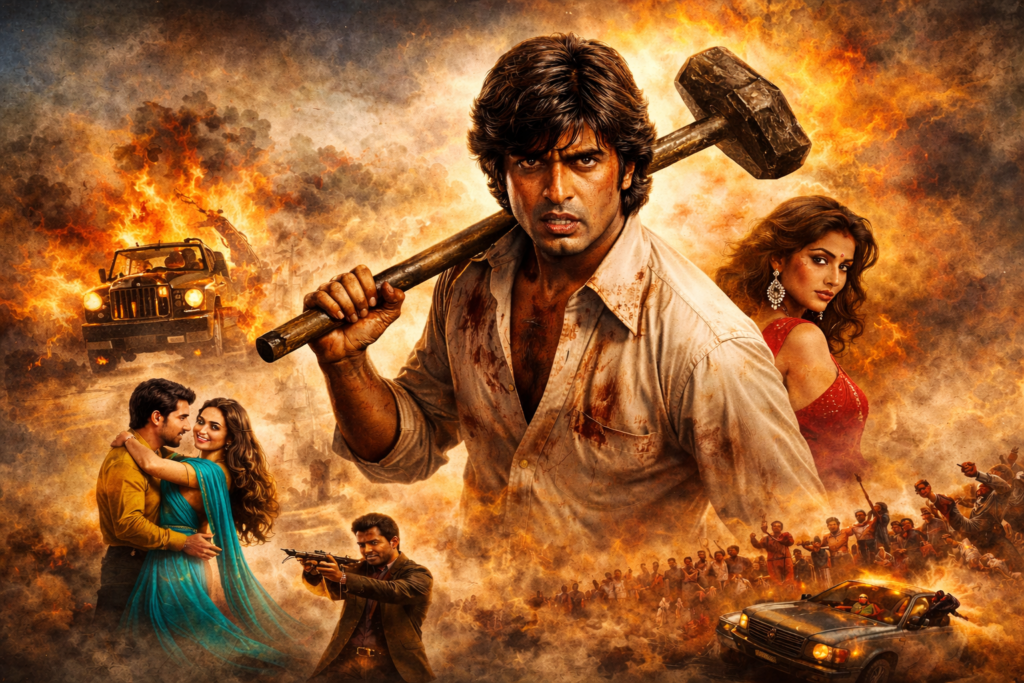
The Angry Young Man — the defining face of Bollywood’s masala era in the 1970s and 1980s.
A new generation of filmmakers and unforgettable heroes reshaped Bollywood with larger-than-life stories that reflected the hopes, frustrations, and aspirations of a changing India
Bollywood didn’t change quietly in the 1970s—it transformed with remarkable energy.
The poetic romance of the Golden Era gradually gave way to something louder, grittier, and more emotionally charged. This marked the beginning of the Masala Era of Bollywood, when filmmakers blended action, drama, romance, comedy, and music into a powerful cinematic formula designed to entertain millions.
At the heart of this transformation stood a new kind of hero—the Angry Young Man, immortalized by Amitabh Bachchan and shaped by the groundbreaking writing of Salim–Javed.
This was more than a change in filmmaking.
👉 It reflected a changing India—restless, frustrated, and determined to challenge the status quo.
In this post, we’ll explore how the Masala Era reshaped Bollywood and created one of the most influential periods in Indian cinema history.
📑 In This Article
🌟 Quick Facts & Insights — Masala & Angry Young Man Era
The masala era of Bollywood marked a dramatic shift in storytelling, where cinema became louder, more emotional, and deeply connected to the struggles of everyday life. It introduced a new cinematic formula and a new kind of hero that continues to influence Indian films even today.
- 📅 Timeframe: Early 1970s to late 1980s
- 🎥 Shift: Romantic realism → action-driven mass cinema
- 🔥 Defining figure: Amitabh Bachchan as the “Angry Young Man”
- ✍️ Writing revolution: Salim–Javed redefine storytelling
- 🎭 Formula: Action + Drama + Romance + Comedy = “Masala”
- 🎶 Music: More energetic, dramatic, and situation-based
- 🇮🇳 Context: Economic struggle, corruption, post-Emergency unrest
Together, these elements defined the masala era of Bollywood — a period where storytelling became louder, characters more intense, and cinema more deeply connected to the pulse of society.
To understand why this transformation happened, we must first look at the social and political realities of India in the 1970s.
–– ✦ ✦ ––
❗ Boost FAQs — Masala Era of Bollywood
What is the masala film formula?
A storytelling style that blends action, romance, comedy, drama, and music into one entertaining package.
Who was the Angry Young Man?
A rebellious character archetype, most famously portrayed by Amitabh Bachchan, representing anger against injustice.
Why did Bollywood change in the 1970s?
Because society changed — rising unemployment, corruption, and political instability influenced storytelling.
–– ✦ ✦ ––
🇮🇳 A Nation in Turmoil: Why Cinema Changed
By the early 1970s, India was no longer the hopeful nation portrayed in earlier films.
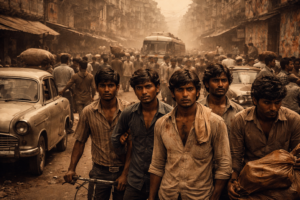
A glimpse of 1970s India — where social unrest and economic struggle reshaped the stories Bollywood began to tell.
Unemployment, corruption, and economic struggles were becoming more visible.
👉 The political climate, especially during the Emergency (1975–77), further deepened public frustration.
As a result, audiences began to disconnect from the soft, romantic heroes of the past.
In their place emerged:
- A man angry at the system
- A man fighting injustice
- A man who reflected real struggles
👉 This shift becomes even clearer when compared to the Golden Era of Bollywood (1950s–1970s), where stories focused more on romance, music, and social idealism.
Bollywood didn’t just change genres — it changed its emotional voice.
–– ✦ ✦ ––
🎬 The Rise of the Masala Formula
To connect with a broader audience, filmmakers developed a new storytelling approach — the masala film formula.
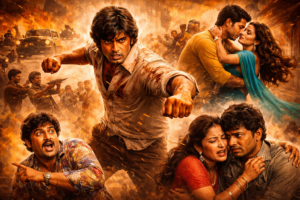
Action, romance, comedy, and drama — the perfect mix that defined the masala era of Bollywood.
This style combined multiple elements into one film, ensuring mass appeal across different audience groups.
- Action
- Romance
- Comedy
- Melodrama
- Music
Directors like Manmohan Desai popularized this format, creating films that were larger-than-life and emotionally intense.
👉 The goal was simple:
Deliver complete entertainment in a single cinematic experience
–– ✦ ✦ ––
🔥 The Angry Young Man Phenomenon
At the center of the masala era of Bollywood stood a new kind of hero — the Angry Young Man.

The Angry Young Man — a hero shaped by anger, injustice, and the realities of a changing India.
👉 And its most powerful face was Amitabh Bachchan.
Amitabh Bachchan rose to fame in the 1970s and has since become a key figure in the history of Indian cinema.
Through films like:
- Zanjeer (1973)
- Deewaar (1975)
- Sholay (1975)
Among these films, Sholay became a cultural phenomenon whose characters, dialogues and cinematic influence continued far beyond its original 1975 release.
Amitabh Bachchan redefined what a Bollywood hero could be.
Not charming. Not poetic.
👉 Angry. Intense. Rebellious.
Behind this transformation were the legendary writers Salim–Javed, who:
- Introduced sharp, impactful dialogues
- Focused on injustice and revenge
- Created morally complex characters
This was no longer just entertainment.
👉 It was cinema reflecting societal anger.
–– ✦ ✦ ––
🎶 Music in the Age of Masala
Music remained an essential part of Bollywood, but its style evolved.
Instead of purely melodic compositions, songs became more energetic and situational.
- Kishore Kumar dominated playback singing
- R.D. Burman experimented with new sounds
- Songs enhanced drama instead of slowing the narrative
👉 Music became a tool to intensify storytelling
Disco rhythms, synthesizers, and energetic film songs became an important part of Bollywood’s masala era identity. To explore the evolution of Bollywood music and playback singing across generations, read:
👉 Music in Bollywood: From Playback Singing to Modern Music
–– ✦ ✦ ––
⭐ Stardom, Style, and Screen Persona
The masala era created larger-than-life stars who became cultural icons.
- Amitabh Bachchan → Symbol of rebellion
- Dharmendra → Action with charm
- Hema Malini → The “Dream Girl”
- Rekha → Grace and intensity
Actors were no longer just performers.
👉 They became symbols of identity, attitude, and aspiration
–– ✦ ✦ ––
🎭 Genres That Ruled the Box Office
The masala era of Bollywood saw the rise of highly engaging and emotionally intense genres that connected strongly with audiences.
Some of the most popular genres included:
- 🔫 Revenge-driven action dramas
- 👨👩👦 Lost-and-found family sagas
- 🐎 Dacoit (bandit) films
- 🎬 Multi-starrer entertainers
What united all these genres was:
👉 High emotional stakes + mass appeal
–– ✦ ✦ ––
📽️ Legacy of the Masala Era
The masala era didn’t disappear — it evolved.
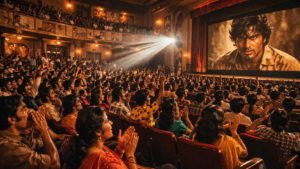
A packed cinema hall — where audiences didn’t just watch films, they lived every moment.
Its influence continued shaping:
- 1990s Bollywood blockbusters
- Modern commercial entertainers
- Pan-India mass cinema
- Hero-driven storytelling traditions
The emotional intensity, larger-than-life characters, action-driven narratives, and crowd-pleasing formulas introduced during this period continue to influence Indian cinema even today.
At the same time, Bollywood gradually entered a new phase shaped by globalization, digital filmmaking, multiplex audiences, and streaming culture.
Many of the storytelling styles introduced during the masala era reached new popularity during the blockbuster-driven Bollywood cinema of the 1990s.
The larger-than-life heroes, emotionally charged storytelling, and crowd-pleasing entertainment style popularized during Bollywood’s masala era also continued influencing modern South Indian commercial cinema and the rise of pan-India films. Explore this transformation further in:
👉 Regional Cinema Revolution: How South Indian Films Reshaped Indian Cinema
The transition from mass-market masala films to modern Hindi cinema can be explored further in:
👉 Modern Bollywood Era: Global Cinema, Multiplex Culture, and Streaming Revolution
–– ✦ ✦ ––
❓ Frequently Asked Questions (FAQs)
Why is Amitabh Bachchan called the Angry Young Man?
Because his characters represented social frustration and rebellion against injustice.
Are masala films still made today?
Yes, though modern versions are more stylized and global in appeal.
What made Salim–Javed important?
They introduced strong narratives, powerful dialogues, and social realism into mainstream cinema.
🔗 Connecting the Bigger Picture
If the Golden Era gave Bollywood its soul…
The masala era gave it its voice — loud, rebellious, and unforgettable.
👉 If you haven’t explored it yet, begin with the Golden Era of Bollywood to understand how this transformation took shape.
🏆 Up Next at The Reel Retro
🎬 The Global Turn: How Bollywood Reinvented Itself in the 1990s
From angry streets to global romance — the story continues.
🌐 Prefer reading this article in Hindi?
👉 Read:
बॉलीवुड का मसाला युग (1970s–1980s): एंग्री यंग मैन का उदय
🔖 External sources are referenced for educational and historical context. All content rights and credits belong to their respective owners.

Thank you for your like to the colors on my blog