
Tracing the evolution of the songs, voices, and soundtracks that gave Bollywood its unforgettable musical identity.
ENG | हिंदी
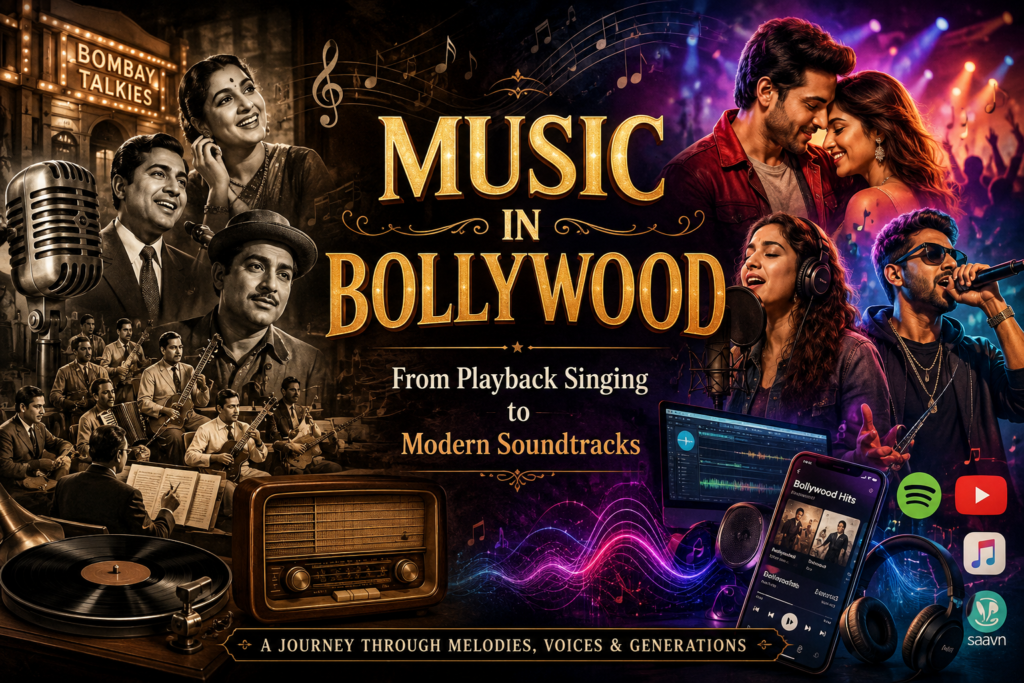
From timeless melodies to digital beats — Bollywood music evolved with every generation.
Long before streaming playlists and digital soundtracks, Bollywood songs were already shaping emotions, defining generations, and becoming an inseparable part of everyday life. From legendary playback singers to modern composers, the evolution of music in Bollywood reflects not only changing cinematic styles but also the cultural heartbeat of India.
Music has always been more than just entertainment in Bollywood.
From emotional melodies of the Golden Era to energetic dance tracks of modern cinema, songs have shaped the identity of Hindi films for decades. In many ways, the history of music in Bollywood is also the history of Indian popular culture itself.
Unlike many film industries where songs remain secondary, Bollywood transformed music into a storytelling tool capable of expressing romance, sorrow, rebellion, patriotism, and celebration. Generations of audiences have connected with films not only through characters and stories, but also through unforgettable songs and voices.
This journey from playback singing to modern soundtracks reflects the evolution of Bollywood itself — technologically, culturally, and emotionally.
In this post, we explore how music in Bollywood evolved across generations, how legendary playback singers shaped Hindi cinema, and how changing trends transformed film soundtracks from the Golden Era to the modern streaming age.
📑 In This Article
🌟 Quick Facts & Insights — Music in Bollywood
Music has remained one of the strongest pillars of Bollywood cinema. Over the decades, changing technology, audience tastes, and cultural influences reshaped the sound of Hindi films while preserving the emotional connection between songs and storytelling.
- 🎙️ Playback singing became mainstream in the 1940s and 1950s
- 🎶 Bollywood songs often drive a film’s popularity and marketing
- 📻 Radio and cassette culture helped songs reach millions
- 💿 Music shifted from orchestral melodies to electronic production
- 🌍 Global influences introduced disco, pop, hip-hop, and fusion styles
- 🎧 Streaming platforms transformed how audiences consume film music
- ⭐ Playback singers became celebrities alongside film stars
Together, these developments made Bollywood music one of the most recognizable elements of Indian cinema across the world.
–– ✦ ✦ ––
❗ Boost FAQs — Bollywood Music
What is playback singing in Bollywood?
Playback singing is a system where professional singers record songs that actors later lip-sync on screen.
Why is music important in Bollywood films?
Songs help express emotions, advance storytelling, and create audience engagement.
Who are the most famous Bollywood playback singers?
Lata Mangeshkar, Kishore Kumar, Mohammed Rafi, Asha Bhosle, and Arijit Singh are among the most influential voices in Hindi cinema.
–– ✦ ✦ ––
🎙️ The Rise of Playback Singing in Bollywood
One of the biggest innovations in Hindi cinema was the development of playback singing.
Playback singing transformed Bollywood by giving unforgettable voices to on-screen stars.
Before playback technology became common, actors often sang their own songs during filming. However, as recording techniques improved in the 1930s and 1940s, filmmakers began using trained singers whose voices could better match the emotional tone of songs.
This system transformed Bollywood forever.
Playback singing allowed filmmakers to:
- Use technically skilled vocalists
- Experiment with complex compositions
- Match different voices with different screen personalities
By the 1950s, playback singers had become an inseparable part of Bollywood’s identity.
The rise of playback singing completely transformed Hindi cinema and helped create some of the most iconic voices in Indian cultural history.
Readers interested in exploring the broader history of playback singers and Indian film music can also refer to archival resources and biographies of legendary artists such as Lata Mangeshkar and Mohammed Rafi.
–– ✦ ✦ ––
🎵 The Golden Era of Bollywood Music (1950s–1970s)
The Golden Era is often considered the finest period in the history of music in Bollywood.
Meaningful lyrics and soulful melodies defined Bollywood’s musical golden age.
This was the age of:
- Lata Mangeshkar
- Mohammed Rafi
- Kishore Kumar
- Mukesh
- Asha Bhosle
Music directors like:
- S.D. Burman
- Naushad
- Shankar–Jaikishan
- Madan Mohan
created melodies that continue to influence Indian music today.
Songs during this period focused heavily on:
- Poetry and meaningful lyrics
- Classical and folk influences
- Emotional storytelling
- Rich orchestration
Unlike modern fast-paced tracks, many songs from this era were deeply connected to character emotions and narrative development.
The emotional richness of this period continues to influence music in Bollywood even today.
If you want to explore the period when soulful music, emotional storytelling, and iconic stars came together to shape Hindi cinema’s identity, read:
👉 Golden Era of Bollywood (1950s–1970s): Music, Drama, and Stardom
–– ✦ ✦ ––
📻 Radio, Records, and the Rise of Mass Popularity
Bollywood music became a national phenomenon largely because of radio.
Programs such as Binaca Geetmala introduced film songs to millions of listeners across India. Gramophone records, cassette tapes, and later CDs expanded the reach of Hindi film music even further.
For many audiences:
👉 Songs became popular before the film itself released.
Music was no longer limited to cinema halls. It became part of daily life, weddings, festivals, and cultural memory.
–– ✦ ✦ ––
💃 Disco, Synthesizers, and the Changing Sound of the 1980s
By the late 1970s and 1980s, Bollywood music began changing rapidly.
Disco rhythms and electronic sounds transformed Bollywood music in the 1980s.
Western influences introduced:
- Disco rhythms
- Electronic instruments
- Synthesizers
- Dance-heavy compositions
Music directors like Bappi Lahiri popularized disco-inspired Bollywood music, creating energetic soundtracks that reflected urban youth culture.
This era also saw changing audience expectations, where catchy dance numbers became increasingly important for commercial success.
The changing sound of Bollywood music in the 1980s reflected a much larger cultural transformation within Hindi cinema. To explore the rise of action-driven storytelling, mass entertainment, and the Angry Young Man phenomenon, read:
👉 Masala Era of Bollywood: Rise of the Angry Young Man
The disco revolution of the 1980s introduced electronic sounds and energetic dance tracks that reshaped Bollywood music culture.
Much of this transformation is closely associated with the work of Bappi Lahiri, whose compositions became symbolic of the era’s changing musical identity.
–– ✦ ✦ ––
🌍 Globalization and the Musical Reinvention of the 1990s
The 1990s marked another major transformation in Bollywood soundtracks.
Economic liberalization, satellite television, and globalization introduced international musical influences into Hindi cinema.
This period saw the rise of:
- Romantic ballads
- Pop-inspired soundtracks
- Punjabi dance influences
- Fusion experimentation
Composers like A.R. Rahman revolutionized Bollywood music through innovative arrangements and digital production techniques.
Films such as Dil Se, Rangeela, and Bombay showcased a new cinematic sound that blended Indian traditions with global styles.
The globalization of Bollywood music during the 1990s reached new creative heights through composers such as A. R. Rahman, whose innovative fusion of Indian and international sounds helped redefine modern Hindi film music for global audiences.
–– ✦ ✦ ––
🎧 Streaming Era and Modern Bollywood Soundtracks
Today, Bollywood music exists in a completely different ecosystem.
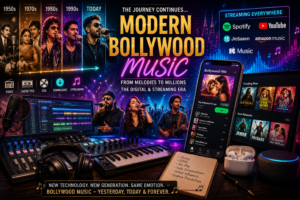
Streaming platforms changed how audiences discover and experience Bollywood music.
Streaming platforms such as Spotify, YouTube, and JioSaavn changed how audiences discover and consume songs.
Modern Bollywood soundtracks now include:
- Electronic dance music
- Hip-hop and rap
- Indie collaborations
- Remix culture
Songs now often release months before films as promotional tools, helping generate anticipation, online engagement, and social media buzz.
At the same time, many filmmakers continue revisiting retro Bollywood music, reflecting the enduring emotional and cultural influence of earlier cinematic eras.
Many of the sounds that define contemporary Bollywood music have roots in regional traditions. Punjabi music, in particular, has become a major influence on Hindi film soundtracks through bhangra rhythms, folk melodies, and global Punjabi pop culture. Explore this cultural journey in:
👉 Punjabi Cinema History: Music, Culture, and the Global Punjabi Identity
Despite the rapid evolution of technology and viewing habits, emotional storytelling continues to remain at the heart of music in Bollywood. The changing sound of Hindi cinema in the streaming age also reflects the broader transformation of Bollywood through globalization, multiplex culture, and OTT platforms.
Explore this modern transition further in:
👉 Modern Bollywood Era: Global Cinema, Multiplex Culture, and Streaming Revolution
–– ✦ ✦ ––
⭐ Legendary Voices That Defined Bollywood
The success of Bollywood music owes much to its legendary playback singers.
Some of the most influential voices include:
- Lata Mangeshkar
- Mohammed Rafi
- Kishore Kumar
- Asha Bhosle
- Udit Narayan
- Sonu Nigam
- Shreya Ghoshal
- Arijit Singh
These singers became emotional voices of generations, often shaping audience memories more powerfully than actors themselves.
–– ✦ ✦ ––
🎼 Why Music Remains Central to Bollywood Cinema
Even today, songs remain one of Bollywood’s most defining features.
Unlike many global film industries, Hindi cinema continues integrating music directly into storytelling and emotional expression.
Bollywood songs help:
- Build emotional connection
- Increase commercial reach
- Promote films before release
- Create long-term cultural impact
In many cases:
👉 Audiences remember songs long after they forget the film’s plot.
–– ✦ ✦ ––
📽️ Legacy of Bollywood Music
The history of music in Bollywood is ultimately a story of adaptation and continuity.
From classical melodies and playback legends to digital soundtracks and streaming culture, Bollywood music constantly evolved while preserving its emotional essence.
Even as filmmaking styles changed, songs remained the heartbeat of Hindi cinema — connecting generations through memory, emotion, and storytelling.
Today, music in Bollywood continues to connect generations across cinema, culture, and memory.
–– ✦ ✦ ––
❓ Frequently Asked Questions About Bollywood Music
Why are songs so important in Bollywood movies?
Because songs help communicate emotions, enhance storytelling, and attract wider audiences.
Who started playback singing in Bollywood?
Playback singing developed gradually during the 1930s and 1940s as recording technology improved.
How has Bollywood music changed over time?
It evolved from melody-heavy orchestral music to digitally produced global fusion soundtracks.
🔗 Connecting the Bigger Picture
If Bollywood’s Golden Era gave Hindi cinema emotional depth…
👉 Its music gave it a timeless voice.
From radio melodies to streaming playlists, Bollywood songs continue shaping cultural memory across generations.
🏆 Up Next at The Reel Retro
🎬 Modern Bollywood Era: Global Cinema, Multiplex Culture, and Streaming Revolution
🌐 Prefer reading this article in Hindi?
👉 Read:
बॉलीवुड में संगीत: प्लेबैक सिंगिंग से आधुनिक साउंडट्रैक तक
🔖 In this article, external sources are cited for educational and historical purposes. All trademarks, copyrights, and other intellectual property belong to their respective owners.