
Tracing the remarkable journey of Tamil cinema history—from pioneering silent films to one of the world’s most influential regional film industries.
ENG | हिंदी
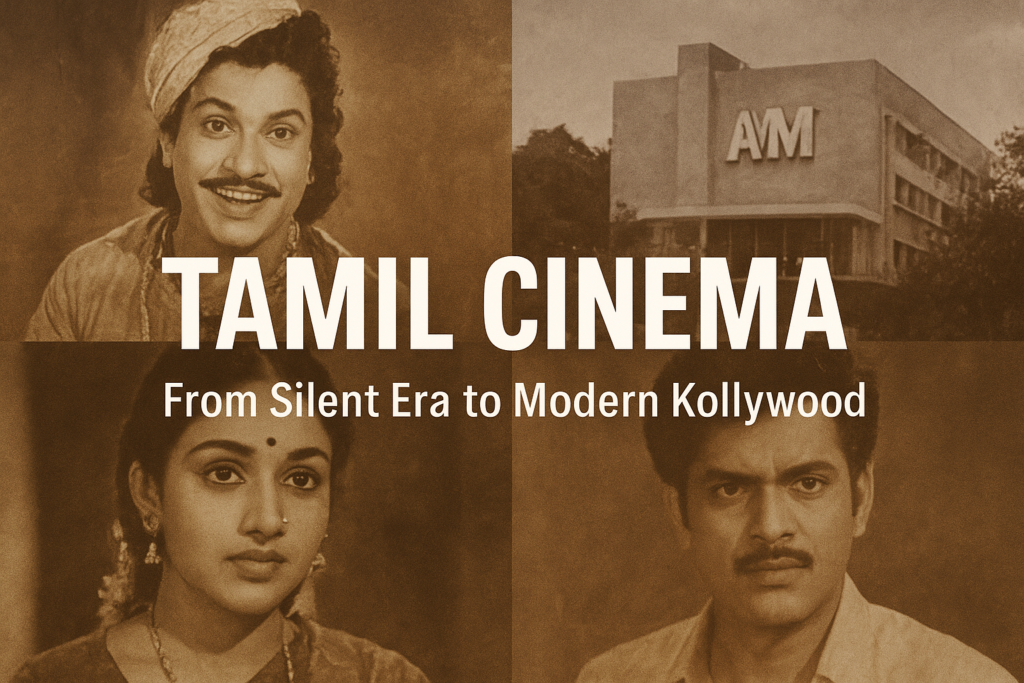
For over a century, Kollywood has blended tradition, innovation, and powerful storytelling to shape Indian cinema and captivate audiences around the globe.
Tamil Cinema, popularly known as Kollywood, is one of India’s oldest and most influential regional film industries.
Based in Chennai (Tamil Nadu), its storytelling, music, technical innovations, and iconic stars have shaped not only Indian cinema but also Tamil-speaking communities across the world.
In this article, we’ll explore Tamil cinema history in a clear, engaging, and easy-to-follow way.
You’ll discover:
- The early silent era and its pioneers
- The transition to sound (“talkies”)
- Key milestones, studios, and legendary personalities
- The evolution of modern Tamil cinema and its global impact
- FAQs and a quick self-quiz (MCQs)
The story of Tamil cinema is one of creativity, experimentation, and lasting cultural influence.
🎬 Did You Know?
The term Kollywood comes from a blend of Kodambakkam—the Chennai neighbourhood that became the heart of Tamil film production—and Hollywood. In the early decades, most Tamil studios were based in Kodambakkam, giving rise to this nickname that now represents the entire Tamil cinema industry worldwide.
📑 In This Article
The Silent Era in Tamil Cinema (1916–early 1930s)
Yes — Tamil cinema did have a silent era. Though few of those films survive today, the early period laid the foundation for what Kollywood would become. Here are the major facts:
- The first Tamil silent film (and the first feature film in South India) is Keechaka Vadham (1916), directed, produced, filmed and edited by R. Nataraja Mudaliar. All actors in the film were Tamils.
- Other early silent films by Mudaliar followed: Draupadi Vastrapaharanam (1918), Lava Kusa (1919), Shiva Leela (1919), Rukmini Satyabhama (1922), Mahi Ravana (1923) etc.
- The audiences in Madras (now Chennai) had seen silent short films and non-fictional recordings even before this, via early exhibitors and traveling showmen. For example, exhibitions of silent non-fiction films in Victoria Public Hall were happening in late 1890s.
- By the late 1920s and early 1930s, many silent films in Tamil were being adapted from mythology, epics, or stage plays (company dramas).
- Unfortunately, preservation was poor. Prints of almost all silent Tamil films are lost; none are known to survive. Keechaka Vadham is a “lost film.”
–– ✦ ✦ ––
The Sound Era Begins: The First Tamil Talkie and the New Phase of Tamil Cinema History
The arrival of sound transformed Tamil cinema forever. The silent era had already introduced audiences to moving stories, but the first Tamil talkie, Kalidas (1931), gave the industry a new voice — literally. It marked the beginning of musical storytelling and dialogue-driven plots that connected deeply with Tamil culture and its linguistic pride.
- The first Tamil talkie film was Kalidas (1931), directed by H. M. Reddy — one of the earliest multilingual sound films (Tamil + Telugu) in South India.
- By 1934, sound studios had started in Madras; Srinivasa Cinetone (founded by A. Narayanan) was among the first.
- After sound came in, more talkies (sound films) were produced rapidly. The nature of storytelling changed: dialogues, songs, audio effects became central.
–– ✦ ✦ ––
Major Milestones, Studios, and Personalities in Tamil Cinema History
Here are key moments and people that shaped Tamil cinema:
| Milestone | Year / Period | Significance |
|---|---|---|
| Establishment of India Film Company by R. Nataraja Mudaliar | ~1916-1920s | Pioneering production house; made early silent Tamil films. |
| Growth of studio system (Gemini Studios, AVM, etc.) | 1930s-50s | More formalization of production, larger budgets, better infrastructure. |
| First full-length talkies, introduction of playback singing, shift to social themes etc. | 1930s-1940s | Set base for modern Kollywood storytelling. |
| Expansion post-Independence, colour films, star system, rise of actors like M. G. Ramachandran, Sivaji Ganesan etc. | 1950s-60s | Cemented Tamil cinema as cultural power. |
| Technical & thematic reinvention (1970s onwards) | 1970s-2000s | New wave directors, global reach, music, experimental cinema. |
| Contemporary Era | 2000-present | Digital tech, OTT streaming, global Tamil diaspora audiences, pan-Indian films etc. |
–– ✦ ✦ ––
The Modern Era and Global Influence of Tamil Cinema
In the modern era, Tamil cinema has transcended linguistic and regional boundaries. With stars like Rajinikanth and Kamal Haasan gaining global recognition and filmmakers like Mani Ratnam and Shankar redefining Indian storytelling, Kollywood stands as one of Asia’s most dynamic and technically advanced industries.
- Tamil films today are not just for Tamil Nadu — they reach Tamil speakers in Sri Lanka, Singapore, Malaysia, Middle East, etc.
- Popular for their music, star power, technical quality (VFX, sound design), and for sometimes pushing boundaries in themes.
- Use of bilingual/multilingual releases, dubbed versions in other Indian languages, subtitled releases abroad.
- Strong contribution to Indian cinema’s reputation in international film festivals.
Even before expanding its reach on the global stage, Tamil cinema had established a significant presence at the national level—and that recognition continues today. At the 72nd National Film Awards, Amaran received honours for direction and background music, while awards for Captain Miller and Maharaja further reflected Tamil cinema’s strong presence within contemporary Indian filmmaking.
–– ✦ ✦ ––
FAQs About the Tamil Cinema History
Q. When did Tamil cinema begin?
A. Tamil cinema formally began with the production of Keechaka Vadham in 1916, which is considered the first Tamil silent feature film.
Q. Are there any silent Tamil films still available today to watch?
A. No known prints of early silent Tamil films survive; Keechaka Vadham and many others are lost.
Q. What was the first Tamil talkie?
A. Kalidas (1931) is recognized as the first sound film (talkie) in Tamil, directed by H. M. Reddy.
Q. What kinds of stories did Tamil silent era films tell?
A. Mythological episodes, stories from epics (e.g. Mahabharata), stage plays, drama. Many silent films were adapted from well-known myths or stage works.
–– ✦ ✦ ––
Conclusion: Tamil Cinema History in Perspective
From silent frames to soundscapes and digital marvels, the Tamil film industry’s journey reflects India’s creative evolution. It remains a cornerstone of Indian cinema — rich in language, culture, and experimentation — and continues to inspire generations of filmmakers nationwide.
- Tamil cinema has a solid silent era origin (starting 1916) though so much of that history is lost to time.
- The transition to sound in early 1930s marks a turning point.
- Studios, stars, and story types evolved rapidly.
- Today Kollywood is global in reach and continues to innovate.
🎞️ South Indian Cinema Series:
Explore how each South Indian film industry shaped Indian cinema.
–– ✦ ✦ ––
MCQs / Self-Quiz (sample)
Here are a few questions to test your knowledge:
- Who directed Keechaka Vadham (1916), the first silent feature film in South India?
A) Pammal Sambandha Mudaliar
B) R. Nataraja Mudaliar
C) H. M. Reddy
D) Swamikannu Vincent - Which year saw the first Tamil talkie (sound film)?
A) 1929
B) 1931
C) 1934
D) 1925 - What is Kalidas (1931) known for in Tamil cinema history?
A) First color film
B) First silent mythological film
C) First talkie film in Tamil
D) First film with playback singing - Which kind of stories were common in Tamil silent era?
A) Contemporary urban life
B) Mythology, epics, stage plays
C) Science fiction
D) Crime comedy
(Answers: 1-B, 2-B, 3-C, 4-B)
–– ✦ ✦ ––
Test Your Tamil Cinema Knowledge!
Now that you’ve explored the journey of Tamil cinema — from silent beginnings to modern Kollywood — it’s time to test what you’ve learned.
👉 Try the Quiz: Tamil Cinema GK – Must-Know Questions for UPSC & State Exams
📚 Further Reading
Want to dive deeper into the history, evolution, and cultural influence of Tamil cinema? Here are some trusted external resources that provide detailed insights, scholarly discussions, archival content, and rare information about Kollywood’s remarkable journey:
🌐 Read in Hindi
Prefer reading this article in Hindi?
👉 हिंदी में पढ़ें:
कॉलीवुड – तमिल सिनेमा का सफर मूक युग से वैश्विक पहचान तक
This version of the article offers the same depth, perspective, and storytelling.
🔖 In this article, external sources are cited for educational and historical purposes. All trademarks, copyrights, and other intellectual property belong to their respective owners.