
Exploring Malayalam cinema history—from its pioneering silent beginnings to one of the world’s most acclaimed film industries.
ENG | हिंदी
Rooted in literature, realism, and artistic excellence, Mollywood has spent nearly a century redefining the possibilities of Indian cinema.
Malayalam cinema—fondly known as Mollywood—is one of India’s most respected regional film industries, celebrated for its powerful storytelling, literary roots, and fearless experimentation.
From the quiet black-and-white films of the 1920s to today’s globally acclaimed productions, it has consistently pushed the boundaries of realism, emotion, and cinematic craftsmanship.
In this article, we’ll explore Malayalam cinema history in a clear, engaging, and easy-to-follow way.
You’ll discover:
- The origins of Malayalam cinema and its silent-era pioneers
- The transition to sound and the growth of the studio system
- The filmmakers, actors, and landmark films that shaped Mollywood
- The rise of parallel cinema, New Generation films, and global recognition
- FAQs and a quick self-quiz (MCQs)
The journey of Malayalam cinema is one of artistic excellence, innovation, and cultural influence.
The sections ahead will guide you through this remarkable evolution—from its pioneering beginnings to its present-day international acclaim—showing how Mollywood earned its unique place in Indian and world cinema.
📑 In This Article
Silent Origins – The First Steps (1920s–1950s)
Malayalam cinema began its journey with Vigathakumaran (The Lost Child) — shot in 1928 and released in 1930 — directed by J.C. Daniel, now celebrated as the Father of Malayalam Cinema.
The film marked the birth of a regional industry despite enormous cultural and financial obstacles.
The next monumental milestone arrived with Balan (1938), the first Malayalam talkie, signaling a new era for Kerala’s storytellers.
By the late 1940s, film production gained structure with studios like Udaya (1947) and Merryland (1951), laying the foundation for a consistent industry.
💡See Also:
- From Silence to Sound (1927–1935): The Talkies Revolution
- Hollywood’s Silent Era & The Rise of the Studio System (1910s–1920s)
- The Silent Era of Indian Cinema (1913-1931)
–– ✦ ✦ ––
Stage-to-Screen Evolution (1950s–1960s)
This era saw Malayalam cinema shaped heavily by theatre traditions.
Key highlights:
- Prem Nazir, known as the Evergreen Hero, emerged as a central star.
- Themes revolved around morality, social order, and romance.
- Filmmakers began adapting literature and theatre, strengthening narrative depth.
Chemmeen (1965), directed by Ramu Kariat, became the first Malayalam film to win the President’s Gold Medal for Best Feature Film, proving Malayalam cinema had arrived on the national stage.
Note: The first South Indian film to win a National Award was the Tamil film Malaikkallan in 1954.
–– ✦ ✦ ––
The Golden Age: Literature Meets Cinema (1960s–1970s)
Malayalam cinema grew rapidly as writers and filmmakers began collaborating more deeply.
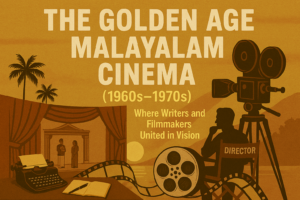
This period set the stage for the coming New Wave through:
- Realistic narratives based on Kerala’s social and emotional landscape
- Adaptations of works by MT Vasudevan Nair, Thakazhi Sivasankara Pillai, and Uroob
- A shift from theatrical melodrama to subtle, character-driven storytelling
These literary foundations paved the way for a cinematic transformation.
A Key Milestone in This Era
Chemmeen (1965) showcased that Malayalam cinema could compete nationally with powerful literary adaptations and rooted social themes.
–– ✦ ✦ ––
The New Wave — Adoor, Aravindan & the Rise of Parallel Cinema (1970s–1990s)
A movement unlike anything else in India took shape here.
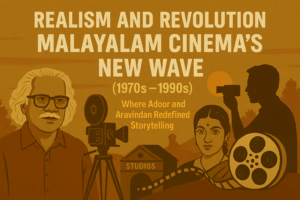
Pioneers:
- Adoor Gopalakrishnan — Swayamvaram, Elippathayam
- G. Aravindan — Kanchana Sita, Pokkuveyil
- John Abraham — experimental, socially reflective films
- K.G. George — psychological depth with films like Yavanika
Themes were grounded in realism, poetry, philosophy, and the rhythms of everyday Kerala.
Malayalam cinema became a festival favorite at home and abroad.
The influence of this New Wave tradition continued well beyond the movement itself, shaping later generations of filmmakers and playing an important role in the broader evolution of Malayalam cinema toward international recognition.
These developments also echoed the wider transformations taking place in global New Wave cinema, where filmmakers across continents were redefining realism and personal storytelling.
–– ✦ ✦ ––
The Commercial Golden Era (1980s–1990s)
This was one of the richest periods in Indian cinema history.
Key pillars:
- Mohanlal and Mammootty rose as legendary performers
- Directors like IV Sasi, Fazil, Sathyan Anthikad, and Priyadarshan shaped commercial cinema
- Strong emphasis on:
- family dramas
- crime thrillers
- political films
- emotional, character-driven stories
Films from this era continue to define Malayali popular culture.
–– ✦ ✦ ––
Reinvention & Transition (2000s–2010s)
The early 2000s brought:
- Digital filmmaking
- New commercial formulas
- Strong emotional dramas by directors like Blessy, Rosshan Andrrews, and Lal Jose
This created the bridge between old Malayalam cinema and the new generation.
–– ✦ ✦ ––
Malayalam New-Gen Renaissance (2010s–Present)
A world-wide Malayalam cinema renaissance began around 2010.
Defining films:
- Traffic (2011) — sparked the hyperlink cinema trend
- Drishyam (2013) — became a pan-India phenomenon
- Bangalore Days (2014) — redefined youth cinema
- Kumbalangi Nights (2019) — acclaimed globally
- Jallikattu (2019) — India’s official Oscar entry
- The Great Indian Kitchen (2021) — global feminist landmark
New-age directors like Lijo Jose Pellissery, Dileesh Pothan, Mahesh Narayanan, Aashiq Abu, and Madhu C. Narayanan contributed to global acclaim.
Malayalam cinema today is admired for:
- strong writing
- natural performances
- inventive filmmaking
- socially conscious themes
In the end, this new-gen wave has turned Malayalam cinema into a creative powerhouse—fearless, honest, and impossible to ignore.
Rooted in Kerala’s everyday life yet resonating across the world, these films remind us that great storytelling doesn’t need spectacle, just heart and truth.
Mollywood today isn’t merely evolving; it’s inspiring. And its best chapters are still being written.
–– ✦ ✦ ––
Conclusion: A Regional Industry with Global Vision
From Vigathakumaran (1930) to modern classics, Malayalam cinema has grown from a fragile regional experiment to a globally respected industry. Its strength has always been its storytelling — rooted, honest, emotional, and fearless.
🎞️ South Indian Cinema Series: Explore how each South Indian film industry shaped Indian cinema.
- Kollywood (Tamil Cinema)
- Mollywood (Malayalam Cinema)
- Tollywood (Telugu Cinema)
- Sandalwood (Kannada Cinema)
–– ✦ ✦ ––
FAQs On Malayalam Cinema
Q1. Which was the first Malayalam feature film?
A. Vigathakumaran (1930), directed by J.C. Daniel.
Q2. When was Balan, the first Malayalam talkie, released?
A. 1938.
Q3. Who is known as the father of Malayalam cinema?
A. J.C. Daniel.
Q4. Which director is associated with the Malayalam New Wave?
A. Adoor Gopalakrishnan.
Q5. Which film is considered a landmark in Malayalam parallel cinema?
A. Elippathayam (1981).
Q6. Which Malayalam film won the National Award for Best Feature Film in 2023?
A. 2018: Everyone is a Hero.
Q7. Which actor is often called the “Complete Actor” of Malayalam cinema?
A. Mohanlal.
Q8. Which Malayalam film movement is known for literary adaptations and realism?
A. The Golden Age (1960s–1970s).
Q9. Which is the major international festival representing Malayalam cinema globally?
A. International Film Festival of Kerala (IFFK).
Q10. Which modern Malayalam film brought global attention in the OTT era?
A. Kumbalangi Nights (2019).
📚 Explore More on Malayalam Cinema
Want to dive deeper into the history, evolution, and cultural influence of Malayalam cinema? Here are some trusted external resources that provide detailed insights, scholarly discussions, archival content, and rare information about Mollywood’s remarkable journey:
- Film Heritage Foundation – Malayalam Cinema Archives
- The Hindu – Articles & Deep Dives on Malayalam Cinema
- IMDb – Malayalam Films Database & Ratings
- National Film Archive of India (NFAI) – Archival material & film history.
- Kerala State Chalachitra Academy – Official updates, festivals & publications.
- Film Companion Malayalam – Reviews & filmmaker interviews.
🌐 Read in Hindi
Prefer reading this article in Hindi?
👉 हिंदी में पढ़ें:
मॉलीवुड: मलयालम फिल्म इंडस्ट्री — साहित्यिक शुरुआत से वैश्विक प्रशंसा तक
This version of the article offers the same depth, perspective, and storytelling.
🔖 External sources are referenced for educational and historical context. All rights and credits belong to their respective owners.