

The pioneers, landmark films, legendary personalities, and achievements that shaped Telugu cinema.
An artistic representation of Telugu cinema’s journey from its silent-era beginnings to modern international recognition.
Test your knowledge with 10 Telugu Cinema GK MCQs tracing the industry’s journey from its silent-era beginnings to international recognition.
Telugu cinema, popularly known as Tollywood, holds an important place in Indian film history. From pioneering silent films and early talkies to mythological classics, celebrated musical dramas, and internationally recognized productions, the industry has developed a distinctive cinematic heritage.
This Telugu Cinema GK quiz brings together 10 carefully selected multiple-choice questions exploring significant milestones, influential filmmakers, legendary performers, and notable achievements in the industry’s history.
The questions cover cinema-related general knowledge that may be relevant to UPSC, State PSC, SSC, Railway, and other competitive examinations in India. They also offer useful learning opportunities for students, quiz enthusiasts, and anyone interested in Indian cinema.
Each question includes four options, the correct answer, and a concise explanation to help readers understand and remember important facts about Telugu film history.
📑 In This Article
Telugu Cinema GK: Quick Facts
| Topic | Key Fact |
|---|---|
| Popular industry name | Tollywood |
| Primary language | Telugu |
| Early cinema pioneer | Raghupathi Venkaiah Naidu |
| Important silent-era film | Bhishma Pratigna (1921) |
| First Telugu talkie | Bhakta Prahlada |
| First talkie director | H. M. Reddy |
| Landmark mythological classic | Mayabazar (1957) |
| Landmark musical drama | Sankarabharanam (1980) |
| International achievement | Naatu Naatu from RRR won the 2023 Oscar for Best Original Song |
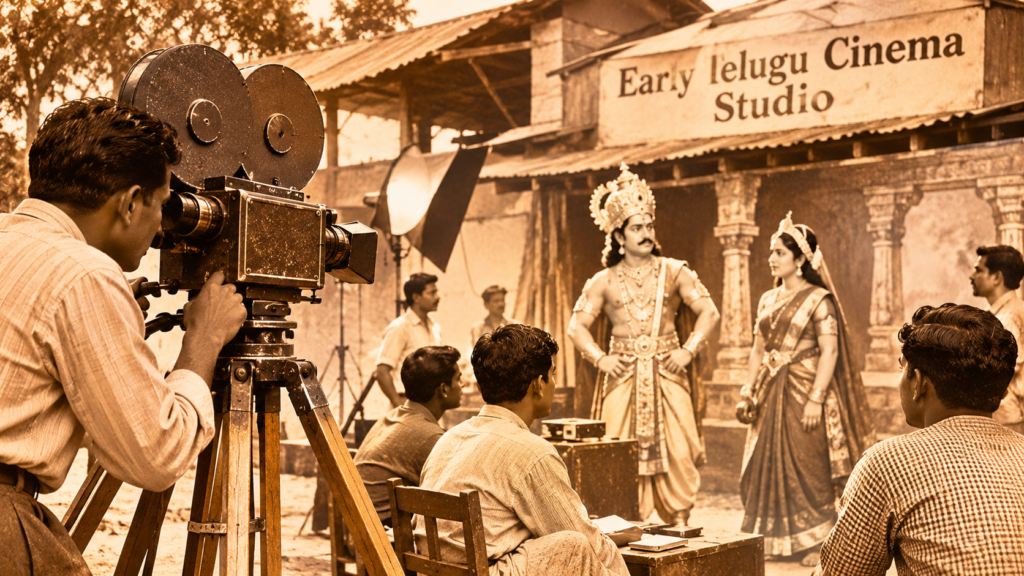
A symbolic recreation of the silent-film era that helped establish the foundations of Telugu cinema.
–– ✦ ✦ ––
Telugu Cinema GK MCQs: Questions and Answers
Test your understanding of Telugu cinema with these 10 multiple-choice questions covering its early pioneers, landmark films, influential filmmakers, memorable performances, and international achievements.
Choose an answer from the four options provided, then check the correct answer and brief explanation below each question.
Q1. Who is widely regarded as the father of Telugu cinema?
A) H. M. Reddy
B) Raghupathi Venkaiah Naidu
C) K. V. Reddy
D) B. N. Reddi
Correct Answer: B) Raghupathi Venkaiah Naidu
Explanation: Raghupathi Venkaiah Naidu was a pioneering figure in South Indian cinema, contributing to early film exhibition and production. He helped produce Bhishma Pratigna (1921), widely regarded as the first Telugu silent feature film, laying an important foundation for the Telugu film industry.
Q2. Which silent film, released in 1921, is widely associated with the beginnings of Telugu cinema?
A) Bhakta Prahlada
B) Lava Kusa
C) Bhishma Pratigna
D) Mayabazar
Correct Answer: C) Bhishma Pratigna
Explanation: Bhishma Pratigna (1921) was produced by Raghupathi Venkaiah Naidu and his son Raghupathi Surya Prakash, who also directed the film. This pioneering silent production marked an important milestone in the emergence of Telugu cinema.
To understand the wider historical context of early Telugu filmmaking, explore The Silent Era of Indian Cinema (1913–1931), which examines the development of silent films, pioneering filmmakers, and early storytelling traditions across India.
Q3. Which film is recognized as the first Telugu-language talkie?
A) Bhakta Prahlada
B) Mala Pilla
C) Gruhalakshmi
D) Vande Mataram
Correct Answer: A) Bhakta Prahlada
Explanation: Directed by H. M. Reddy, Bhakta Prahlada marked the beginning of Telugu-language sound cinema. Although some older accounts date the film to 1931, research based on contemporary exhibition records supports its release in 1932.
Q4. Who directed Bhakta Prahlada, the first Telugu talkie?
A) B. N. Reddi
B) L. V. Prasad
C) C. Pullaiah
D) H. M. Reddy
Correct Answer: D) H. M. Reddy
Explanation: H. M. Reddy was an important pioneer of South Indian sound cinema. Besides directing Bhakta Prahlada, he was associated with Kalidas (1931), recognized as the first Tamil-language talkie.
Q5. Who directed the celebrated Telugu mythological film Mayabazar (1957)?
A) K. V. Reddy
B) K. Viswanath
C) Bapu
D) S. S. Rajamouli
Correct Answer: A) K. V. Reddy
Explanation: K. V. Reddy directed Mayabazar (1957), a landmark Telugu mythological film celebrated for its imaginative storytelling, memorable performances, music, and innovative visual effects. Its narrative draws on characters and traditions associated with the Mahabharata.
Q6. Which actor portrayed Ghatotkacha in the 1957 Telugu film Mayabazar?
A) N. T. Rama Rao
B) Akkineni Nageswara Rao
C) S. V. Ranga Rao
D) Chittoor V. Nagaiah
Correct Answer: C) S. V. Ranga Rao
Explanation: S. V. Ranga Rao delivered a memorable performance as Ghatotkacha in Mayabazar (1957). His portrayal combined humour, dramatic expression, and a commanding screen presence, becoming one of the film’s most celebrated elements.
Q7. Who directed the Telugu musical drama Sankarabharanam (1980)?
A) Dasari Narayana Rao
B) K. Viswanath
C) B. N. Reddi
D) Singeetam Srinivasa Rao
Correct Answer: B) K. Viswanath
Explanation: K. Viswanath directed Sankarabharanam (1980), an acclaimed musical drama exploring Indian classical music, artistic devotion, and changing social attitudes. The film helped renew popular interest in classical musical traditions and became an important achievement in Telugu cinema.
Q8. Who directed the Telugu-language film RRR (2022)?
A) Sukumar
B) Trivikram Srinivas
C) Koratala Siva
D) S. S. Rajamouli
Correct Answer: D) S. S. Rajamouli
Explanation: S. S. Rajamouli directed RRR (2022), a period action drama featuring fictionalized portrayals of Indian revolutionary figures Alluri Sitarama Raju and Komaram Bheem. The film gained international recognition for its ambitious action sequences, storytelling, and music.
Q9. Who composed the music for the Oscar-winning song Naatu Naatu from RRR?
A) A. R. Rahman
B) Devi Sri Prasad
C) M. M. Keeravaani
D) Ilaiyaraaja
Correct Answer: C) M. M. Keeravaani
Explanation: M. M. Keeravaani composed Naatu Naatu, with lyrics written by Chandrabose. The song gained international recognition when it won the Academy Award for Best Original Song in 2023, marking a major achievement for Telugu cinema and Indian film music.
Q10. In which category did Naatu Naatu from RRR win an Academy Award in 2023?
A) Best Original Score
B) Best Original Song
C) Best International Feature Film
D) Best Picture
Correct Answer: B) Best Original Song
Explanation: Naatu Naatu won the Academy Award for Best Original Song at the 95th Academy Awards, held on 12 March 2023. The award recognized composer M. M. Keeravaani and lyricist Chandrabose, marking a significant international milestone for Indian cinema.

An artistic representation of Telugu cinema’s growing international recognition and achievements.
–– ✦ ✦ ––
Beyond the Quiz: Explore Telugu Cinema History
The ten questions above highlight important milestones in Telugu cinema, but the industry’s rich history extends far beyond these introductory facts.
From the pioneering contributions of Raghupathi Venkaiah Naidu and the arrival of sound films to the growth of studio filmmaking, mythological classics, musical dramas, and modern international achievements, Telugu cinema has undergone a remarkable evolution.
For a deeper understanding of this journey, readers can explore The Reel Retro’s Telugu cinema history articles, which trace the industry’s origins, major developments, influential personalities, and changing storytelling traditions across different eras.
Telugu cinema’s growing influence also forms part of a wider transformation in Indian filmmaking. Explore Regional Cinema Revolution: How South Indian Films Reshaped Indian Cinema to understand how Telugu and other South Indian film industries expanded their reach beyond regional audiences.
–– ✦ ✦ ––
Conclusion: Understanding Telugu Cinema Through GK
Telugu cinema’s journey reflects a rich legacy of pioneering filmmakers, legendary performers, landmark productions, musical traditions, and achievements that have earned recognition beyond India.
These 10 Telugu Cinema GK MCQs offer an introduction to important historical facts and milestones, helping readers strengthen their understanding of the industry’s evolution and contributions to Indian cinema.
Future question sets will explore Telugu cinema in greater depth, covering early studios, influential filmmakers, celebrated performances, national and international awards, and lesser-known historical developments.
Whether preparing for general-knowledge examinations, participating in quizzes, or exploring Indian film history, readers can use these questions and explanations to build a broader understanding of Telugu cinema.
–– ✦ ✦ ––
Frequently Asked Questions About Telugu Cinema GK
What is Telugu cinema popularly known as?
Telugu cinema is popularly known as Tollywood. It primarily produces Telugu-language films and is one of India’s major regional film industries, with a rich history of storytelling, music, and cinematic innovation.
Who is regarded as the father of Telugu cinema?
Raghupathi Venkaiah Naidu is widely regarded as the father of Telugu cinema for his pioneering contributions to film exhibition and production. He helped establish the industry’s early foundations and was associated with Bhishma Pratigna (1921), widely recognized as the first Telugu silent feature film.
What was the first Telugu talkie film?
Bhakta Prahlada, directed by H. M. Reddy, is recognizBhakta Prahlada, directed by H. M. Reddy, is recognized as the first Telugu-language talkie. Although some older accounts cite 1931, historical research based on contemporary exhibition records supports its release in 1932.ed as the first Telugu-language talkie. Historical research identifies its release in 1932, although some older accounts give 1931.
Are Telugu Cinema GK questions useful for competitive-exam preparation?
Telugu Cinema GK questions can help readers strengthen their knowledge of Indian film history, important personalities, landmark films, and major awards. Such topics may be relevant to the general-awareness or cultural-knowledge sections of some competitive examinations in India, depending on their syllabuses.
What topics will future Telugu Cinema GK sets cover?
Future question sets will explore the industry’s early studios, influential filmmakers, legendary actors, landmark films, music, national and international awards, and lesser-known historical milestones. They will provide opportunities to develop a broader understanding of Telugu cinema.


