

From a slow start at the box office to an enduring landmark of Indian popular culture.
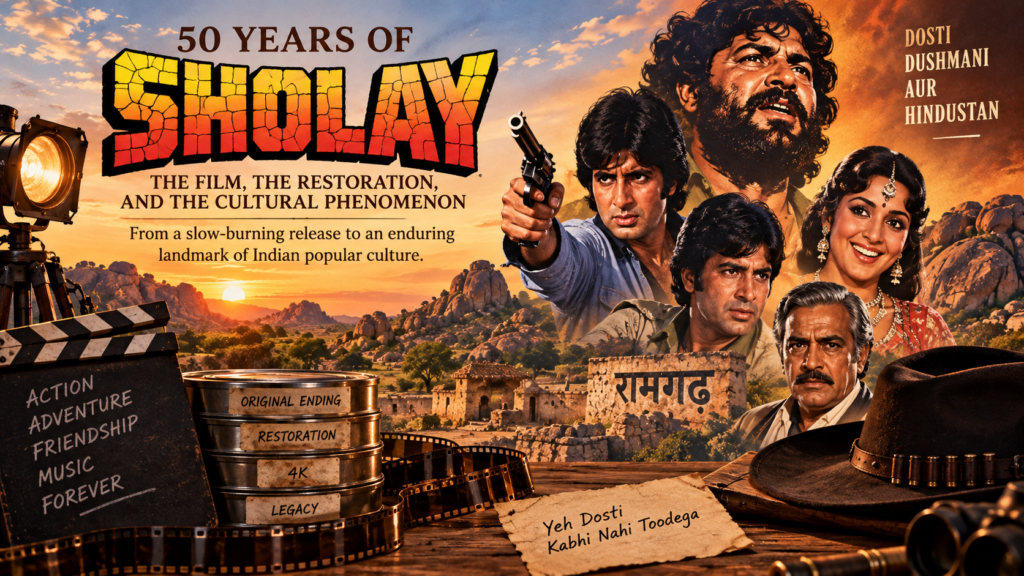
An editorial visual celebrating 50 years of Sholay, its enduring cultural legacy and the restoration that brought the 1975 classic to a new generation.
Fifty years after its release, Sholay remains alive through its unforgettable characters, dialogues, music and cultural influence—while a landmark restoration has brought Ramesh Sippy’s original vision to a new generation.
Few films in Indian cinema have crossed the boundary between screen entertainment and cultural memory as completely as Sholay.
Released on August 15, 1975, Ramesh Sippy’s ambitious action-adventure brought together a remarkable ensemble cast, the celebrated writing partnership of Salim–Javed, R. D. Burman’s music and a cinematic scale rarely attempted in Hindi filmmaking at the time.
Yet Sholay became far more than a successful film.
Jai and Veeru emerged as enduring symbols of friendship. Gabbar Singh redefined the Hindi film villain, while Basanti, Thakur and other characters became deeply embedded in popular memory. Its dialogues entered everyday conversation, and its blend of action, comedy, romance, tragedy and music helped expand the possibilities of mainstream Hindi cinema.
Five decades later, Sholay returned to international attention through an extensive 4K restoration that recovered its original ending and deleted scenes, allowing audiences to encounter the film closer to Ramesh Sippy’s original vision.
The story of Sholay, therefore, is not simply the story of a blockbuster. It is the story of how a 1975 film grew into a cultural phenomenon—and how, fifty years later, restoration and preservation are opening a new chapter in its remarkable journey.
📑 In This Article
🔍 Quick Facts & Insights: Sholay at 50
- Film: Sholay
- Release date: August 15, 1975
- Director: Ramesh Sippy
- Producer: G. P. Sippy
- Story & screenplay: Salim–Javed
- Music: R. D. Burman
- Cinematography: Dwarka Divecha
- Major cast: Dharmendra, Sanjeev Kumar, Hema Malini, Amitabh Bachchan, Jaya Bhaduri and Amjad Khan
- Principal filming location: Ramanagara, Karnataka
- Original filming format: Shot on 35mm and blown up to 70mm for release
- 50th anniversary: 2025
- 4K restoration: Film Heritage Foundation at L’Immagine Ritrovata, in association with Sippy Films
- Restored aspect ratio: 2.2:1, recreating the framing of the 70mm presentation
- Restored version: Includes Ramesh Sippy’s original ending and two deleted scenes
- Restored runtime: 204 minutes
Originally conceived as an ambitious action-adventure, Sholay grew into one of the defining landmarks of Indian popular cinema. Fifty years later, its restoration has added a new chapter to that history by recovering material that audiences did not see in the film’s original theatrical release.
–– ✦ ✦ ––
🎞️ Sholay 50 Years Later: Why Does the Film Still Matter?
Sholay still matters because it achieved something few films manage: it became both a landmark of popular filmmaking and a lasting part of cultural memory. Its characters, dialogues, music, emotional storytelling and cinematic scale continued to resonate long after its original theatrical success.
Many successful films define their moment and gradually become memories of a particular generation. Sholay followed a different path. Jai and Veeru remained symbols of friendship, Gabbar Singh became an enduring image of cinematic villainy, and characters such as Basanti and Thakur continued to be recognized decades after the film’s release.
Its longevity also comes from the breadth of its storytelling. Sholay moves naturally between friendship, revenge, action, comedy, romance and tragedy, creating an experience that could appeal to different audiences without losing its emotional centre. That combination helped the film remain accessible even as Hindi cinema itself changed around it.
Television broadcasts, home video and later digital viewing introduced Sholay to generations that had never experienced its original theatrical run. References, imitations and parodies further extended its presence beyond the film itself, turning scenes and characters into part of a shared popular vocabulary.
Its fiftieth anniversary has added another dimension to that legacy. The restoration of Sholay, including its original ending and previously deleted scenes, has allowed the film to be reconsidered not only as a beloved blockbuster but also as an important work of Indian cinematic heritage.
That continuing journey—from theatrical phenomenon to cultural memory and now restored film heritage—is why Sholay still matters half a century after its release.
–– ✦ ✦ ––
🎬 The Making of Sholay: Ramesh Sippy and Salim–Javed’s Vision
The story of Sholay began with a remarkably simple idea. Salim–Javed had initially pitched a brief concept elsewhere, but G. P. Sippy and Ramesh Sippy immediately recognized its potential. The central character was originally conceived as an army officer and was later changed to a police officer, while the basic premise became the foundation for a much larger cinematic vision.
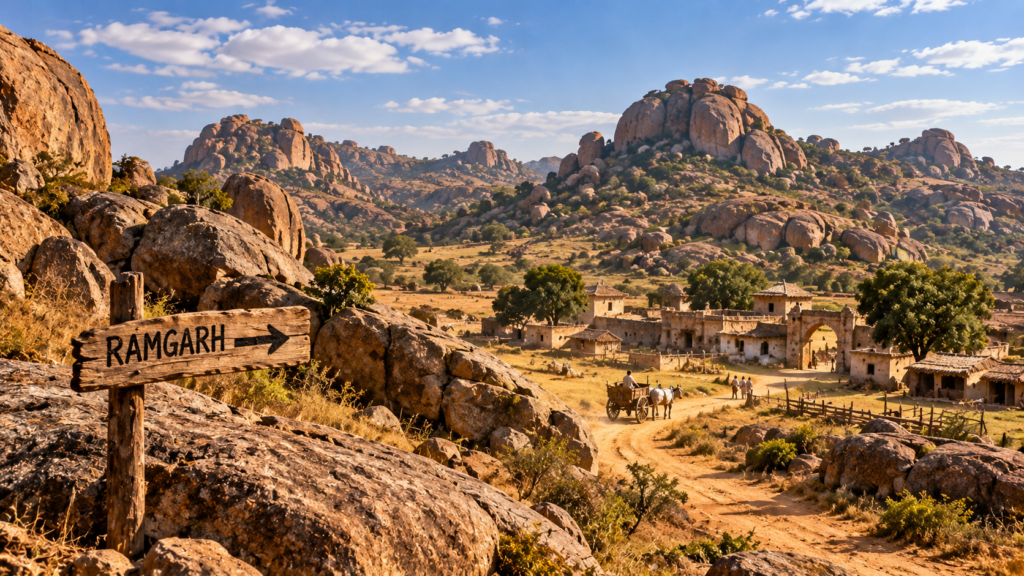
An editorial recreation of the fictional world of Ramgarh, inspired by the rocky Karnataka landscape associated with the filming of Sholay.
Ramesh Sippy saw the potential to turn that compact idea into an ambitious big-screen experience. Working with Salim Khan and Javed Akhtar, he developed a story in which friendship, revenge, sacrifice, humour and tragedy could exist within the same dramatic world. Salim–Javed’s screenplay gave the major characters sharply defined personalities, while Sippy approached the film with an unusual emphasis on visual scale, sound and atmosphere.
Finding the right landscape was crucial to that vision. Rather than relying on locations commonly associated with Hindi cinema’s earlier dacoit films, Sippy chose the rugged terrain around Ramanagara in Karnataka. Its massive rock formations and open landscape gave the fictional village of Ramgarh a distinctive visual identity.
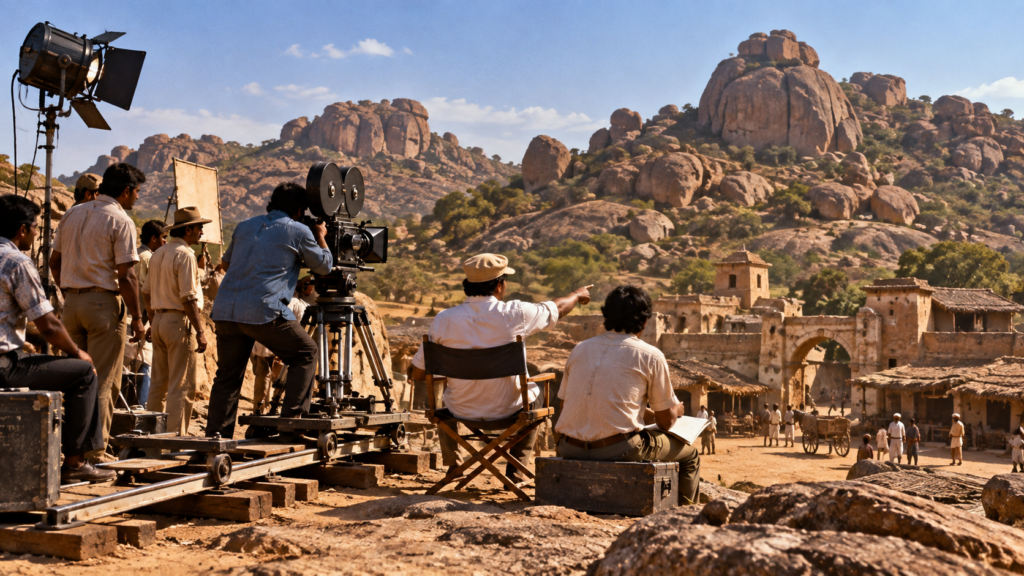
Editorial visual recreating the scale and location filmmaking associated with the production of Sholay around Ramanagara, Karnataka.
The setting became more than a backdrop. Cinematographer Dwarka Divecha used the rocky terrain, distance and open spaces to create a sense of isolation and danger, while Ramgarh itself was constructed within this landscape to make the fictional world feel physically convincing.
The production was equally ambitious. Sholay took roughly two and a half years to make, with Sippy and his team working on a scale that demanded considerable time and technical experimentation. Long before digital effects could simplify complex filmmaking, its action, expansive locations and carefully composed images had to be created largely through practical production methods.
What emerged from that process was not simply another dacoit adventure. Ramesh Sippy and Salim–Javed had created a cinematic world that was rooted in Hindi popular storytelling while drawing upon a much broader language of international filmmaking.
That fusion would become one of the defining qualities of Sholay—and the key to understanding why the film would later earn the description “Curry Western.”
–– ✦ ✦ ––
🏜️ The “Curry Western”: How Sholay Blended Genres
Sholay is often described as a “Curry Western” because it reworked the visual language and dramatic conventions of the Western within the world of Indian popular cinema.

The rocky landscape associated with the filming of Sholay in Karnataka helped give the film its distinctive Western-inspired visual character.
Image: Arun Katiyar / Wikimedia Commons — CC BY-SA 2.0
The resemblance is easy to see. Ramgarh is an isolated community threatened by armed outlaws. The surrounding rocky landscape creates a sense of danger and lawlessness, while gunfights, revenge, pursuit and confrontations between individuals and bandits recall familiar elements of Western filmmaking. The film’s expansive compositions and moments of heightened tension also invite comparisons with the epic scale of the Spaghetti Western.
Its cinematic influences, however, extended beyond a single genre or tradition. Film Heritage Foundation notes connections with works including Sergio Leone’s Once Upon a Time in the West, Akira Kurosawa’s Seven Samurai and John Sturges’ The Magnificent Seven. Rather than reproducing any one of these films, Sholay brought recognizable elements of international action, adventure and Western cinema into a distinctly Indian narrative framework.
That transformation is what makes the film particularly significant. Sholay is simultaneously an action adventure, a revenge drama, a friendship story, a comedy, a romance, a musical and a tragedy. Jai and Veeru move between danger and playful humour; Basanti brings energy and romance; Jai and Radha introduce a quieter emotional register; and Thakur’s pursuit of Gabbar gives the story its underlying drive of loss, justice and revenge.
Songs and music further distinguish Sholay from the Western traditions that influenced its visual world. R. D. Burman’s music is woven into friendship, romance, celebration and dramatic tension, allowing the film to retain the emotional and musical language of mainstream Hindi cinema even as it draws upon international genre conventions.
This ability to absorb different cinematic traditions and reshape them for Indian audiences places Sholay within the broader evolution of the Hindi masala film. Its achievement was not simply that it borrowed from several genres, but that it made those genres feel as though they belonged within the same cinematic world.
The result was neither a conventional Western nor a conventional dacoit film. It was a distinctive hybrid—global in its cinematic influences, unmistakably Indian in its storytelling, and ultimately powerful enough to become a genre landmark of its own.
–– ✦ ✦ ––
⭐ Jai, Veeru, Thakur and Basanti: Characters That Became Cultural Icons
One of Sholay’s greatest strengths is that its characters became memorable not merely as parts of a story, but as distinct personalities who continued to live in popular memory long after the film left cinemas.
At the emotional centre are Jai and Veeru, played by Amitabh Bachchan and Dharmendra. Their friendship combines humour, loyalty, risk and sacrifice, giving the film warmth even amid its darker themes. Their contrasting personalities also make the partnership memorable: Veeru is expressive and impulsive, while Jai is quieter, more restrained and often dryly humorous. Together, they became one of Hindi cinema’s most enduring symbols of friendship.
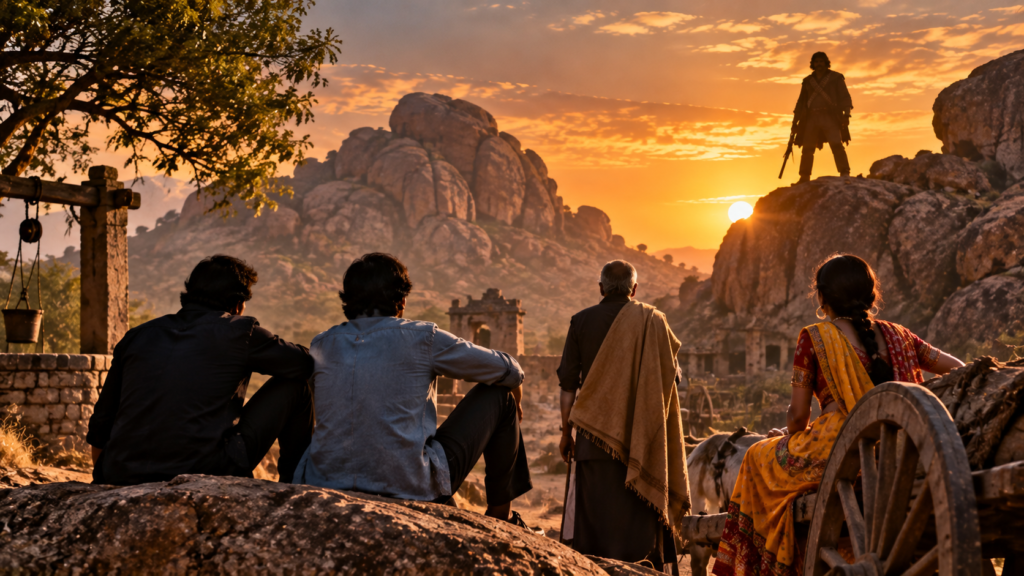
Editorial visual representing the iconic characters and conflicts of Sholay
Sanjeev Kumar’s Thakur Baldev Singh occupies a very different emotional space. Controlled, dignified and driven by a deeply personal pursuit of justice, Thakur gives the film’s revenge narrative its moral and emotional weight. His restraint provides a powerful counterpoint to Gabbar Singh’s unpredictability, turning their conflict into something more personal than a conventional battle between hero and villain.
Hema Malini’s Basanti brings another kind of energy to the film. Talkative, independent and full of personality, she is defined as much by her confidence and comic timing as by her romance with Veeru. Her distinctive manner of speaking and spirited presence helped make Basanti one of the film’s most instantly recognizable characters.
Jaya Bhaduri’s Radha works almost in reverse. Her character is built around silence, restraint and unspoken emotion. Against a film filled with action, humour, music and memorable dialogue, Radha’s quieter presence gives Sholay moments of stillness and melancholy, particularly in her understated relationship with Jai.
Even the film’s smaller roles acquired unusual staying power. Characters such as the jailer, Soorma Bhopali and Sambha remained recognizable far beyond their screen time, demonstrating how carefully Sholay gave individual identities to figures across its fictional world.
This is one reason the film became larger than its plot. Audiences did not remember only what happened in Sholay—they remembered the people who inhabited it. Over time, Jai and Veeru came to signify friendship, Basanti became a shorthand for exuberant talkativeness, and other characters entered the shared vocabulary of Indian popular culture.
Few films create one truly iconic character. Sholay created an entire gallery of them.
–– ✦ ✦ ––
😈 Gabbar Singh: How Sholay Redefined the Hindi Film Villain
Few villains in Indian cinema have achieved the cultural recognition of Gabbar Singh. Played by Amjad Khan, Gabbar became more than the antagonist of Sholay: he helped redefine how a villain could dominate the atmosphere of a mainstream Hindi film.
Much of Gabbar’s impact comes from the way Salim–Javed and Ramesh Sippy build his presence before the audience fully encounters him. His reputation travels ahead of him. The people of Ramgarh live under the threat of his violence, and the fear associated with his name establishes his power before his character takes control of the screen.
When Gabbar does appear, Amjad Khan gives that fear a distinctive personality. His unusual vocal delivery, deliberate pauses, sudden shifts in mood and unpredictable behaviour make the character difficult to anticipate. Rather than presenting a polished or sophisticated criminal mastermind, Sholay places him in a rugged world where intimidation and fear are the foundations of his authority.
Amjad Khan was not originally the first actor considered for the role. Danny Denzongpa had been considered for Gabbar but was unavailable, and Amjad Khan was subsequently recommended to the filmmakers. The casting proved decisive: Khan’s performance gave Gabbar a screen identity so distinctive that the role became inseparable from the actor who played him.
Gabbar also stood apart from many conventional Hindi-film villains because the screenplay gives him little need for elaborate explanation or emotional justification. His dramatic power comes instead from presence, unpredictability and the fear he creates around him. This makes his conflict with Thakur especially effective: Thakur represents restraint and determined purpose, while Gabbar embodies disorder and intimidation.
Yet Gabbar’s greatest achievement may be what happened beyond the narrative of Sholay. His mannerisms and dialogue became widely imitated, referenced and parodied across popular culture. The character remained recognizable to generations who had not experienced the film during its original theatrical run.
In the process, Gabbar crossed an unusual boundary. He was no longer remembered simply as the villain whom the heroes had to defeat; he became one of the defining characters through which Sholay itself was remembered.
That is why Gabbar Singh remains significant fifty years later. Sholay did not merely give Hindi cinema a memorable antagonist—it demonstrated that a villain could become as culturally recognizable as the heroes standing against him.
–– ✦ ✦ ––
🎵 Music, Dialogue and the Sound of Sholay
Sholay became memorable not only through its images and characters, but through a distinctive soundscape in which music, dialogue and dramatic sound were central to the film’s identity.
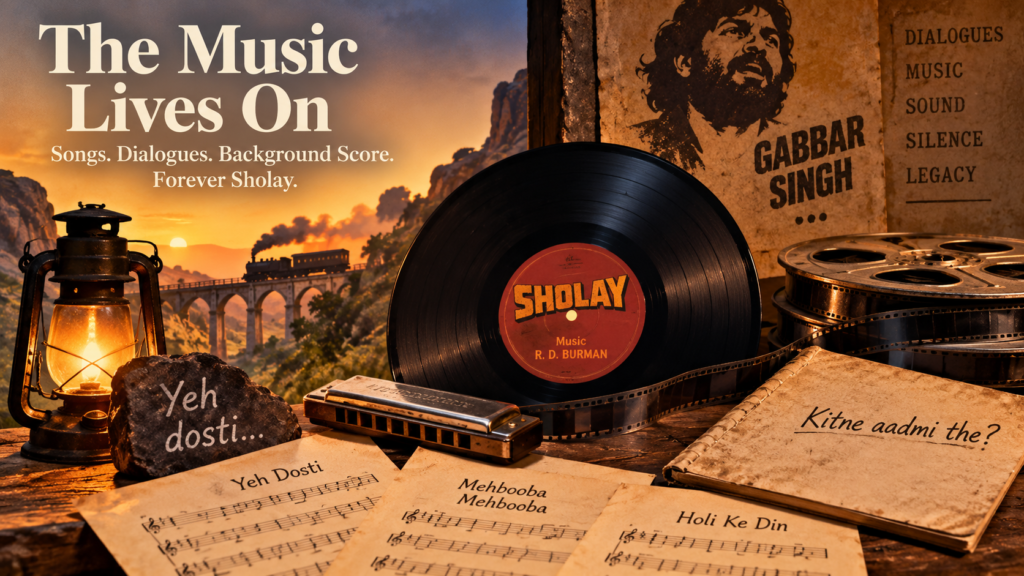
R. D. Burman’s music, Salim–Javed’s dialogue and the film’s ambitious sound presentation became central to the Sholay experience.
R. D. Burman’s music moves across the film’s changing emotional registers, reflecting the larger role of music in Bollywood as a storytelling force. Songs reinforce friendship, romance and celebration, while the background score helps build tension, danger and anticipation. Rather than functioning simply as musical interruptions, these elements contribute to the shifting moods that allow Sholay to move so naturally between humor, intimacy, action and tragedy.
The soundtrack also reflects the film’s genre-blending character. Burman drew upon the musical vocabulary of Hindi popular cinema while responding to the Western-inspired landscapes and action surrounding Ramgarh. The result is music that belongs unmistakably to a Hindi film yet complements the unusually expansive cinematic world Ramesh Sippy created.
Dialogue was equally important. Salim–Javed gave the principal characters sharply differentiated voices: Gabbar’s threatening unpredictability, Basanti’s rapid-fire talk, Veeru’s comic energy, Jai’s understated humour and Thakur’s controlled intensity all emerge partly through the way they speak.
Over time, these dialogues developed a cultural life beyond the film itself. Audiences repeated them, performers imitated them, and later films, television programmes, advertisements and comedy repeatedly referenced the characters and situations of Sholay. Dialogue recordings also circulated independently, allowing listeners to revisit the film through sound even without watching it on screen.
The theatrical experience added another dimension. Although Sholay was photographed on 35mm and later blown up for its 70mm presentation, the large-format release became closely associated with stereophonic sound. For Indian audiences accustomed to conventional theatrical presentation, the combination of a large screen and multi-channel sound helped give the film a sense of scale and immersion that matched its visual ambition.
This relationship between image and sound is central to understanding Sholay’s lasting appeal. R. D. Burman’s music gave the film an emotional pulse, Salim–Javed’s dialogue gave its characters unforgettable voices, and its ambitious sound presentation helped turn the theatrical experience into spectacle.
Decades later, audiences may remember individual scenes differently—but the sounds of Sholay remain inseparable from the film’s cultural memory.
–– ✦ ✦ ––
📈 From a Slow Start to a Historic Box-Office Run
It is easy to look back at Sholay as an inevitable blockbuster. Its journey at the box office, however, began with uncertainty.
The film opened in Mumbai on August 15, 1975, amid enormous expectations. Yet the initial response did not immediately match the scale of the production. Early reactions created concern among the filmmakers, and for a brief period there were even discussions about whether changes might be needed to improve the film’s prospects.
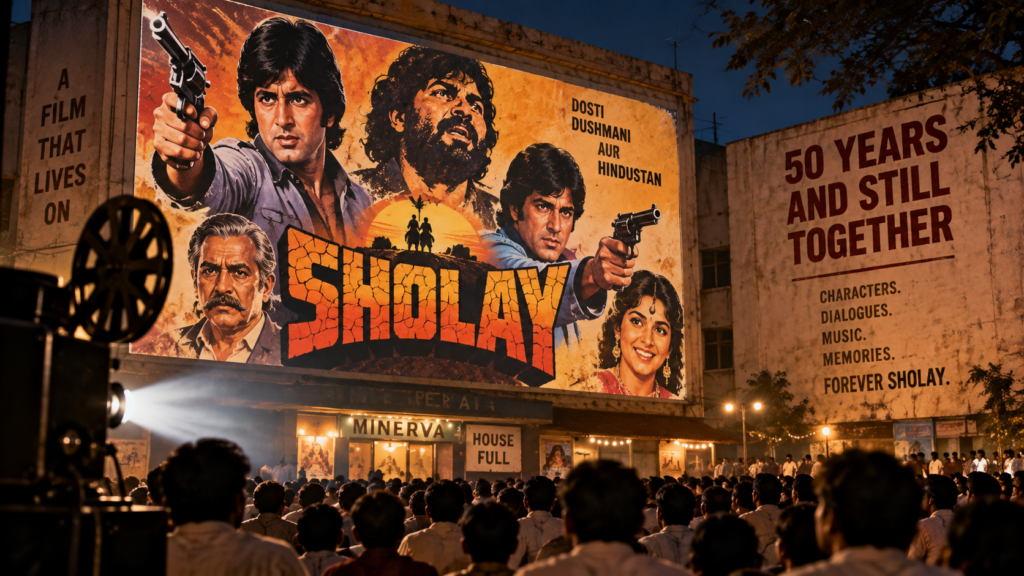
After an uncertain opening, Sholay grew through word of mouth and repeat viewing into an extraordinary theatrical and cultural phenomenon.
Then the audience response began to shift.
As word of mouth spread, viewers returned to the film and recommended it to others. Its friendship, humour, action, music, characters and emotional drama gradually drew larger audiences, transforming an uncertain opening into an extraordinary theatrical success.
The clearest symbol of that transformation was Mumbai’s Minerva cinema. Sholay went on to run there continuously for five years—an achievement that became inseparable from the film’s box-office legend. Its long theatrical life demonstrated something that opening-day reactions could not predict: audiences were not simply watching Sholay; many were returning to experience it again.
The film’s success also extended far beyond a single theatre. Over time, Sholay came to be regarded as one of the great commercial landmarks of Indian cinema, while its exceptionally long theatrical presence helped turn the film from a major release into a shared cultural experience.
Its box-office journey therefore matters for more than records and revenue. Sholay demonstrates how the historical reputation of a film can develop gradually through audience response, repeat viewing and longevity rather than being determined by its opening reception alone.
Sholay did not arrive in cinemas already carrying the status of a legend. Audiences helped make it one.
–– ✦ ✦ ––
🎭 How Sholay Became Part of Indian Popular Culture
Sholay became part of Indian popular culture because its characters, relationships, dialogues and situations continued to circulate long after audiences first encountered them in cinemas. The film was no longer simply something people watched—it became something they recognized, repeated and referenced.
Its characters provided an especially powerful cultural vocabulary. Jai and Veeru came to symbolize enduring friendship, while Gabbar Singh became shorthand for a terrifying and unpredictable villain. Basanti’s talkative personality remained instantly recognizable, and even supporting characters with limited screen time acquired a cultural visibility rarely achieved by minor roles.
Dialogue played an equally important part in this afterlife. Salim–Javed’s writing gave the film phrases, exchanges and verbal rhythms that audiences could easily remember and imitate. Recordings of Sholay’s dialogue circulated independently of the film, allowing listeners to revisit its characters and dramatic moments through sound alone.
As the years passed, references to Sholay appeared across films, television, comedy and advertising. Its characters and situations were repeatedly imitated, parodied and reinterpreted, reinforcing their familiarity even among people who had not experienced the film during its original theatrical run.
Television broadcasts helped extend that reach across generations. Home video and later digital viewing provided further opportunities for younger audiences to encounter the film, while its familiar references were already circulating throughout popular culture. In this way, Sholay was repeatedly rediscovered rather than confined to the generation that made it a blockbuster in 1975.
Its influence also crossed linguistic and regional boundaries. Although Sholay emerged from the Hindi film industry, its characters, music and dramatic imagery became recognizable far beyond the immediate context of mainstream Hindi cinema. The film gradually acquired the status of a shared cultural reference point within the broader evolution of Indian cinema.
That is what separates cultural permanence from box-office success. Commercial records can eventually be surpassed, but cultural memory works differently. When characters become archetypes, relationships become symbols and a film’s language continues to be recognized decades later, the film begins to belong to something larger than its original release.
Sholay achieved that transition. It began as a film audiences went to see—and became a film generations learned to recognize.
–– ✦ ✦ ––
🎥 How Sholay Changed Hindi Popular Cinema
Sholay changed Hindi popular cinema not by inventing a single new formula, but by bringing together many of the forces reshaping mainstream filmmaking in the 1970s—action, star power, genre blending, memorable dialogue, music and large-scale spectacle—and combining them with unusual confidence.
Its genre synthesis was especially influential. Action, comedy, romance, friendship, revenge, tragedy and music had all existed in Hindi cinema before Sholay, but the film demonstrated how these different elements could coexist within a tightly constructed popular narrative. The result became one of the defining examples of the expansive storytelling associated with the masala tradition.
The film also showed the dramatic possibilities of ensemble storytelling. Jai and Veeru may drive much of the narrative, but Thakur, Basanti, Radha and Gabbar are given sharply differentiated identities and emotional functions. Even supporting characters leave distinctive impressions. This helped create a cinematic world in which audiences could become attached to several characters rather than following a single conventional hero.
Gabbar Singh further demonstrated how much narrative power could be given to an antagonist. His presence, dialogue and personality allowed the villain to compete with the heroes for audience attention, reinforcing the importance of a strongly written antagonist within mainstream popular cinema.
Just as significant was the contribution of Salim–Javed. Their screenplay and dialogue were fundamental to the identities of the characters and to the film’s narrative rhythm. Sholay arrived during a period when the celebrated writing partnership was helping bring greater public visibility to the role of screenwriters in Hindi cinema, challenging the tendency to view stars and directors as the only major creative forces behind a commercial film.
Ramesh Sippy’s emphasis on scale strengthened that transformation. The rugged landscapes around Ramanagara, elaborate action sequences, ambitious sound presentation and 70mm theatrical experience gave Sholay the dimensions of an event film while keeping its emotional relationships at the centre of the story.
Its influence is therefore difficult to reduce to one innovation. Later Hindi popular cinema continued to explore many of the elements that Sholay brought together so effectively: multi-genre storytelling, powerful villains, friendship-driven narratives, quotable dialogue, spectacular action and clearly defined ensemble characters.
Seen in the context of the Masala Era of Bollywood, Sholay stands not as the beginning of every trend associated with 1970s Hindi cinema, but as one of their most influential and enduring expressions.
That may be its most important contribution to mainstream filmmaking: Sholay demonstrated how spectacle, character, emotion and genre could work together without any one of them having to carry the film alone.
–– ✦ ✦ ––
⚡ Boost FAQs: Quick Answers About Sholay
When was Sholay released?
Sholay was released on August 15, 1975. Directed by Ramesh Sippy, it went on to become one of the most celebrated films in the history of Hindi cinema.
Who directed Sholay?
Sholay was directed by Ramesh Sippy and produced by his father, G. P. Sippy.
Who wrote Sholay?
The story and screenplay were written by the celebrated screenwriting partnership Salim–Javed, comprising Salim Khan and Javed Akhtar.
Where was Sholay filmed?
Much of Sholay was filmed around Ramanagara in Karnataka, whose rocky landscape became the setting for the fictional village of Ramgarh.
Was Sholay an immediate box-office success?
No. Sholay had an uncertain initial response, but strong word of mouth transformed it into an extraordinary theatrical success. It eventually ran continuously for five years at Mumbai’s Minerva cinema.
Why is Sholay still famous after 50 years?
Sholay remains famous because its characters, friendships, villain, music, dialogues and genre-blending storytelling became deeply embedded in Indian popular culture, allowing the film to connect with generations far beyond its original 1975 audience.
–– ✦ ✦ ––
✂️ The Original Ending of Sholay: Why Was It Changed?
The original ending of Sholay was changed before its 1975 release after India’s film censors objected to the climax Ramesh Sippy had filmed. Their concern was not only the level of violence but also the idea that Thakur, a former police officer, would ultimately take justice into his own hands.
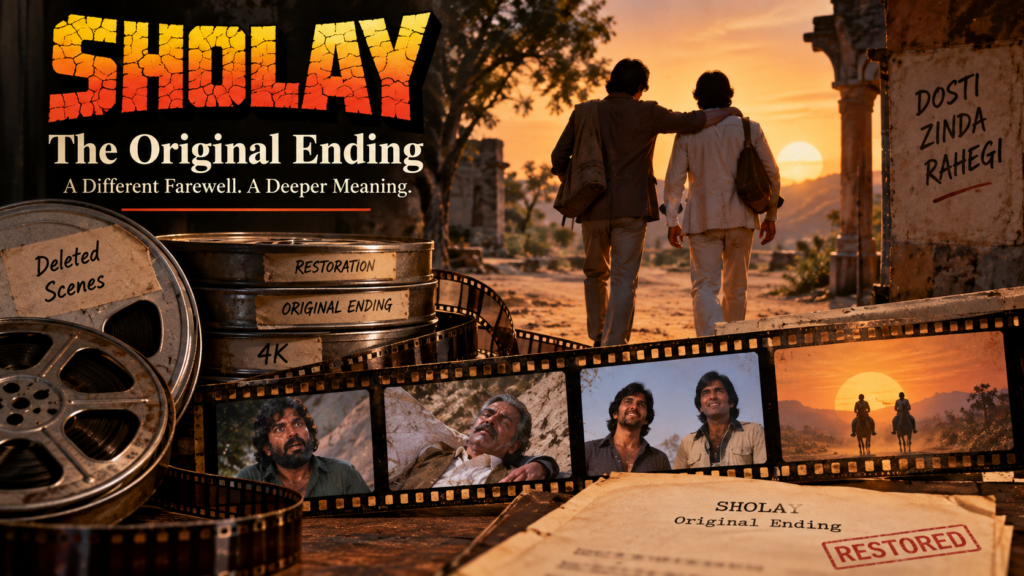
The original climax of Sholay was changed before its 1975 release, leaving audiences familiar with a different theatrical ending for decades.
The timing made the disagreement particularly significant. Sholay was preparing for release during the Emergency, when the filmmakers had little room to challenge a censorship decision. Sippy later recalled that although he was unhappy with the demand, the climax had to be altered before the film could reach cinemas.
As a result, generations of audiences came to know Sholay through the revised theatrical ending rather than the conclusion Sippy had originally filmed.
The difference is important because the two endings frame Thakur’s pursuit of Gabbar in different ways. The familiar theatrical version ultimately places greater emphasis on the authority of the law, while Sippy’s original conception brings Thakur’s personal quest for revenge to a darker and more direct conclusion.
For decades, the original ending remained part of Sholay’s production history rather than the version most audiences could experience. That changed when surviving film elements stored in the United Kingdom were examined during the restoration project. Among them was a colour-reversal intermediate containing the original ending as well as two deleted scenes.
Their recovery made it possible to reconstruct Sholay closer to Ramesh Sippy’s original vision. Fifty years after the film’s release, audiences could therefore encounter a conclusion that censorship had prevented from becoming part of its original theatrical history.
The rediscovered ending does not erase the Sholay generations grew up with. Instead, the two versions now reveal different chapters of the film’s history—one shaped by the circumstances of 1975, and the other preserved through the survival and restoration of its original material.
–– ✦ ✦ ––
🎞️ Restoring Sholay: Bringing Ramesh Sippy’s Original Vision Back
The restoration of Sholay demonstrates an important truth about film preservation: even one of Indian cinema’s most famous films can be at risk of losing parts of its original history.
The restoration journey began in 2022, when Sippy Films approached the Film Heritage Foundation about preserving surviving film materials stored in Mumbai. Among the elements discovered there were the original 35mm camera and sound negatives. Additional film materials were located in the United Kingdom and accessed with assistance from the British Film Institute before being sent, along with the Mumbai elements, to L’Immagine Ritrovata in Bologna.
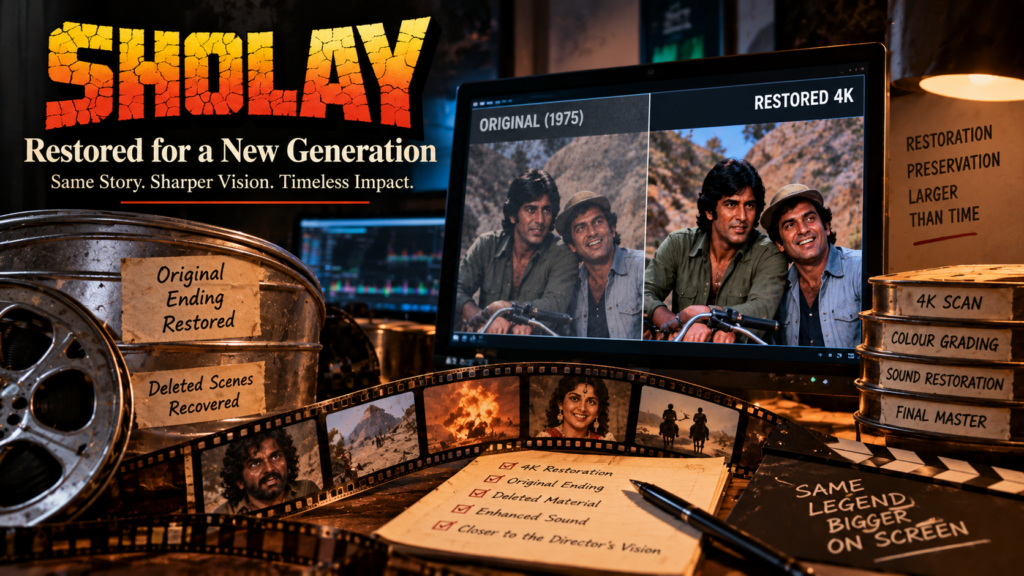
The landmark 4K restoration recovered missing material and brought Sholay closer to Ramesh Sippy’s original cinematic vision.
But restoring Sholay was far from straightforward. The original camera negative had deteriorated so severely that it could not serve as the principal source for the restoration. Instead, the team had to reconstruct the film from the best surviving materials, including interpositives and colour-reversal intermediates preserved in India and the UK.
One of those surviving elements produced an extraordinary discovery. A colour-reversal intermediate found in the UK contained Ramesh Sippy’s original ending as well as two deleted scenes, making it possible to restore material absent from the version audiences had known since 1975.
Reconstructing the film’s visual presentation posed another challenge. Sholay had originally been photographed on 35mm and blown up to 70mm for release, but no original 70mm release prints are known to survive. To determine the intended framing, the restoration team consulted veteran cinematographer Kamlakar Rao, who had worked on the film with cinematographer Dwarka Divecha. His recollections of how the 70mm frame had been marked during filming helped the restorers recreate the film in a 2.2:1 aspect ratio.
The soundtrack also benefited from surviving original material. The restoration team located magnetic sound elements at the Sippy Films office and restored the audio using these materials together with the original sound negative.
Carried out by Film Heritage Foundation at L’Immagine Ritrovata in association with Sippy Films, the complex 4K restoration took almost three years. The completed 204-minute version incorporates the original ending and two deleted scenes while reconstructing the visual and sonic experience as faithfully as the surviving materials allow.
The restored Sholay had its world premiere at the Il Cinema Ritrovato festival in Bologna on June 27, 2025, during the film’s fiftieth-anniversary year. It subsequently reached major international festival and repertory audiences, allowing the restoration to become not merely an archival achievement but a new chapter in the film’s public life.
What returned to the screen was therefore more than a cleaner or sharper version of a familiar classic. The restoration recovered missing material, reconstructed aspects of the film’s original presentation and brought Ramesh Sippy’s intended ending back into the historical record.
At the same time, it revealed something larger about cinema preservation. Films survive not simply because audiences remember them, but because their physical materials are located, protected, studied and restored. In the case of Sholay, that work has allowed one of Indian cinema’s most familiar films to reveal something new fifty years after its release.
–– ✦ ✦ ––
🏆 The Legacy of Sholay: Why the Film Still Matters
The legacy of Sholay lies not in a single record, performance or innovation, but in the way the film has continued to matter across different generations of Indian cinema.
As a work of popular filmmaking, Sholay brought together action, friendship, romance, comedy, tragedy, music and spectacle with remarkable confidence. Its genre-blending narrative, ensemble of strongly defined characters and ambitious cinematic scale helped make it one of the defining landmarks of 1970s Hindi cinema.
Its cultural legacy became even larger. Jai and Veeru grew into enduring symbols of friendship, Gabbar Singh became one of Indian cinema’s most recognizable villains, and the film’s characters, music and dialogue continued to circulate through everyday references, imitation and parody. In this way, Sholay survived not simply as a celebrated film but as part of India’s popular cultural memory.
Yet longevity alone does not fully explain its importance. Each generation has encountered Sholay differently. The audiences of 1975 experienced it as a major theatrical production; later generations discovered it through television and home video; digital platforms extended its reach further; and its fiftieth anniversary introduced another way of seeing the film—as an important work of cinematic heritage worthy of preservation and restoration.
The 4K restoration adds a particularly meaningful chapter to that legacy. By recovering Ramesh Sippy’s original ending and deleted scenes while reconstructing the film from surviving materials, the restoration has allowed audiences to reconsider a familiar classic through evidence that had remained outside its widely known theatrical history.
That process also changes what an anniversary can mean. Fifty years of Sholay is not simply an occasion to celebrate a successful film from the past. It is an opportunity to examine how films survive—through audiences who remember them, filmmakers who influence what follows, archives that preserve fragile materials and restoration work that makes those materials accessible again.
Perhaps that is why Sholay continues to resist becoming merely a period piece. Its filmmaking belongs unmistakably to the 1970s, yet its friendships, conflicts, humour, music and larger-than-life characters continue to invite rediscovery.
The story of Sholay therefore extends far beyond August 15, 1975. It stretches from a film whose early reception gave little indication of what would follow, to an extraordinary theatrical phenomenon, to a shared cultural reference point, and finally to a restored work of Indian film heritage.
Fifty years later, Sholay matters not because it has remained unchanged, but because every generation has found a new way to encounter it.
–– ✦ ✦ ––
❓ Frequently Asked Questions (FAQs)
What was the original ending of Sholay?
Ramesh Sippy originally filmed a darker conclusion in which Thakur’s confrontation with Gabbar ends differently from the version released in Indian cinemas in 1975. The original ending was changed after objections from the film censors, but the footage survived and was recovered for the film’s 4K restoration.
Why was the original ending of Sholay changed?
The censors objected to the violence in the original climax and to the idea of Thakur, a former police officer, taking justice into his own hands. Because Sholay was preparing for release during India’s Emergency, Ramesh Sippy had little room to challenge the decision, and the ending was altered before release.
Was Sholay shot in 70mm?
No. Sholay was photographed on 35mm film and later blown up to 70mm for its large-format theatrical presentation. The 70mm release, accompanied by stereophonic sound, became an important part of the film’s reputation as a large-scale cinematic experience.
Who restored Sholay in 4K?
The 4K restoration was carried out by the Film Heritage Foundation at L’Immagine Ritrovata in Bologna, in association with Sippy Films. The project began in 2022 and took almost three years to complete.
How was Sholay restored if the original camera negative was damaged?
The original 35mm camera negative had deteriorated too severely to serve as the principal restoration source. The restoration team therefore reconstructed the film using the best surviving elements, including interpositives and colour-reversal intermediates preserved in India and the United Kingdom.
What was discovered during the restoration of Sholay?
A colour-reversal intermediate preserved in the United Kingdom contained Ramesh Sippy’s original ending and two deleted scenes. These surviving materials allowed the restoration team to incorporate footage that had not formed part of the familiar 1975 theatrical version.
What is different about the restored version of Sholay?
The restored version presents Sholay in 4K with restored picture and sound, a reconstructed 2.2:1 aspect ratio, Ramesh Sippy’s original ending and two deleted scenes. The restored version runs for approximately 204 minutes.
When and where did the restored Sholay premiere?
The restored Sholay had its world premiere at Il Cinema Ritrovato in Bologna on June 27, 2025, during the film’s fiftieth-anniversary year. It was subsequently presented to audiences at other major international film festivals and repertory screenings.
Why is the restoration of Sholay historically important?
The restoration is important because it does more than improve the film’s picture and sound. It recovers previously unavailable material, reconstructs aspects of its original large-format presentation and preserves Sholay as an important work of Indian film heritage for future generations.
Why is Sholay considered a landmark of Indian cinema?
Sholay combined memorable characters, friendship, action, romance, comedy, tragedy, music and large-scale spectacle within an unusually ambitious popular film. Its extraordinary theatrical life and lasting presence in popular culture helped transform it from a major 1975 release into one of the most enduring landmarks of Indian cinema.
📚 Explore More Bollywood Cinema History
Want to explore how Sholay fits into the larger story of Hindi filmmaking? Continue through our Bollywood cinema history hub, tracing the journey from the early decades and Golden Era to the Masala Era and modern Bollywood.
🌐 Read in Hindi
Prefer reading this article in Hindi?
👉 हिंदी में पढ़ें:
शोले के 50 साल: बॉलीवुड की यह क्लासिक फ़िल्म कैसे एक सांस्कृतिक घटना बन गई
This version of the article offers the same depth, perspective, and storytelling.
🔖 External sources are referenced for educational and historical context. All content rights and credits belong to their respective owners.
