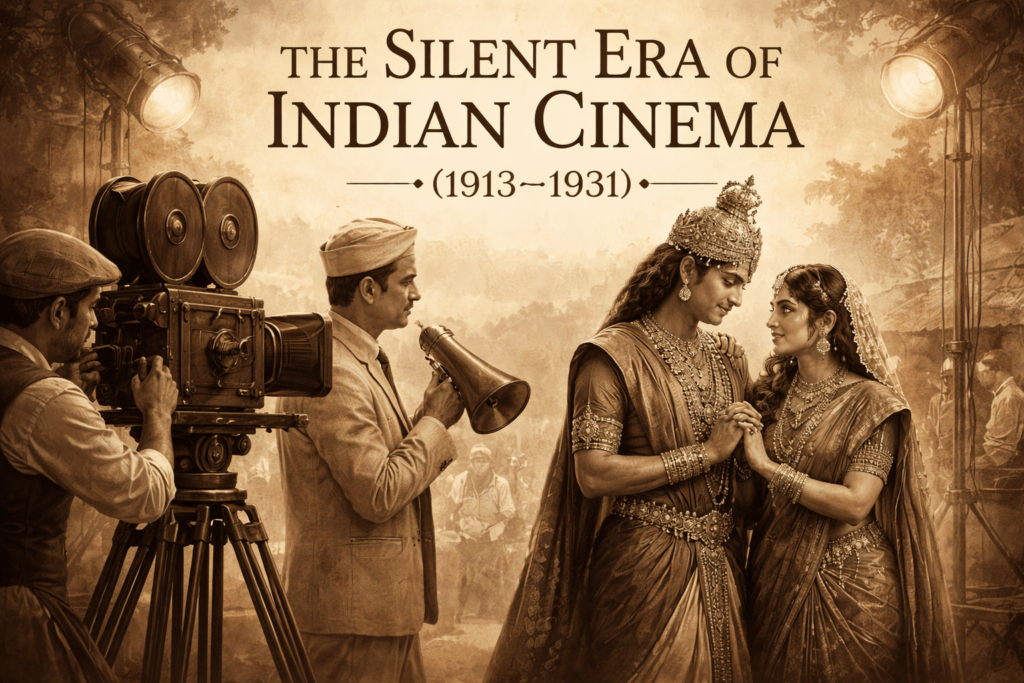

Tracing the evolution of India’s highest official film honors and their enduring celebration of excellence across Indian cinema.
ENG | हिंदी

The National Film Awards celebrate excellence in Indian cinema across languages, regions, and filmmaking disciplines.
For more than seven decades, the National Film Awards have celebrated the richness and diversity of Indian cinema. Unlike industry-based awards that primarily recognize commercial success, these honors acknowledge artistic excellence across languages, cultures, and filmmaking traditions—reflecting the remarkable journey of Indian cinema itself.
The history of the National Film Awards is closely intertwined with the story of independent India’s cultural identity. Established in 1954, these awards were created to recognize excellence in filmmaking while encouraging meaningful cinema that reflected the nation’s artistic, social, and cultural values. Over the decades, they have grown into India’s most prestigious official film honors, celebrating outstanding achievements in feature films, non-feature films, writing on cinema, and technical excellence.
Unlike many popular film awards that focus primarily on mainstream entertainment, the National Film Awards recognize films from every corner of India. Whether produced in Hindi, Tamil, Telugu, Malayalam, Bengali, Marathi, Kannada, Punjabi, Assamese, Odia, or numerous other Indian languages, exceptional cinema receives equal recognition through a transparent evaluation process conducted by independent juries.
This national perspective has made the awards an important bridge between Bollywood and India’s vibrant regional film industries. Many filmmakers, actors, writers, musicians, cinematographers, and technicians first gained nationwide recognition through these honors before becoming celebrated figures in Indian cinema.
The evolution of the National Film Awards also mirrors the transformation of Indian cinema itself. As filmmaking embraced new technologies, storytelling styles, and cultural perspectives, the awards expanded to recognize emerging artistic and technical achievements while continuing to preserve the country’s rich cinematic heritage.
For readers interested in understanding how Indian cinema evolved across different regions and traditions, explore our Reel Regional Cinema series, where we trace the remarkable histories of Tamil, Telugu, Malayalam, Kannada, Bengali, Punjabi, and other influential film industries that have shaped Indian cinema.
In this article, we explore how the National Film Awards began, why they were established after India’s independence, how their award categories evolved over time, and how they continue to celebrate excellence across one of the world’s most diverse film industries.
📑 In This Article
🎬 How the National Film Awards Began
When India gained independence in 1947, cinema had already become one of the country’s most influential forms of popular culture. Films entertained millions of people while also reflecting the hopes, traditions, and social changes of a newly independent nation. Yet despite the rapid growth of Indian filmmaking, there was no official national system to recognize cinematic excellence.
During the early years after independence, Indian cinema was expanding at an extraordinary pace. While Hindi films attracted large audiences across the country, regional film industries in Tamil, Telugu, Bengali, Marathi, Malayalam, Kannada, and several other languages were producing remarkable works that reflected their own cultures and storytelling traditions. Many of these films earned critical acclaim but remained largely unknown outside their respective regions.
Recognizing the importance of cinema as both an art form and a medium of national expression, the Government of India decided to establish a prestigious state-sponsored award system. The objective was not simply to honor commercial success but to encourage films that demonstrated artistic merit, technical excellence, educational value, and cultural significance.
This vision reflected India’s broader nation-building efforts during the 1950s. Literature, music, theatre, painting, and cinema were all regarded as essential components of the country’s cultural identity. By officially recognizing outstanding films from across the nation, the government hoped to promote higher standards of filmmaking while encouraging stories that celebrated India’s diversity and democratic ideals.
Unlike privately organized film awards, the National Film Awards were conceived as an impartial recognition of cinematic excellence. Independent juries comprising respected filmmakers, critics, scholars, writers, and other film professionals would evaluate entries based on artistic quality rather than commercial popularity. This principle remains one of the defining characteristics of the awards today.
The creation of the National Film Awards also demonstrated an important philosophy that continues to distinguish them from many other film honors. Instead of viewing Indian cinema through the lens of a single language or industry, the awards embraced the country’s extraordinary linguistic and cultural diversity. Every recognized language and regional film industry had an opportunity to compete on a national platform, reinforcing the idea that Indian cinema is a collective heritage built by many creative traditions.
Today, that founding vision remains at the heart of the National Film Awards. They continue to recognize films that entertain, educate, inspire, and preserve India’s rich cultural heritage while encouraging innovation across every aspect of filmmaking.
–– ✦ ✦ ––
🏛️ The First National Film Awards (1954)
The first National Film Awards ceremony was held in 1954, marking the beginning of India’s official recognition of excellence in cinema. At the time, the awards were known as the State Awards for Films, reflecting their role as a government initiative to encourage high-quality filmmaking throughout the country. The title National Film Awards was adopted in later years as the awards evolved into a permanent national institution.
Unlike today’s extensive list of award categories, the inaugural ceremony recognized only a small number of achievements. The highest honor, then called the President’s Gold Medal for the All India Best Feature Film, was awarded to Shyamchi Aai, the acclaimed Marathi film directed by P. K. Atre. Based on the autobiographical novel by Sane Guruji, the film was celebrated for its emotional storytelling, moral values, and cultural significance, reflecting the ideals that the awards sought to promote.
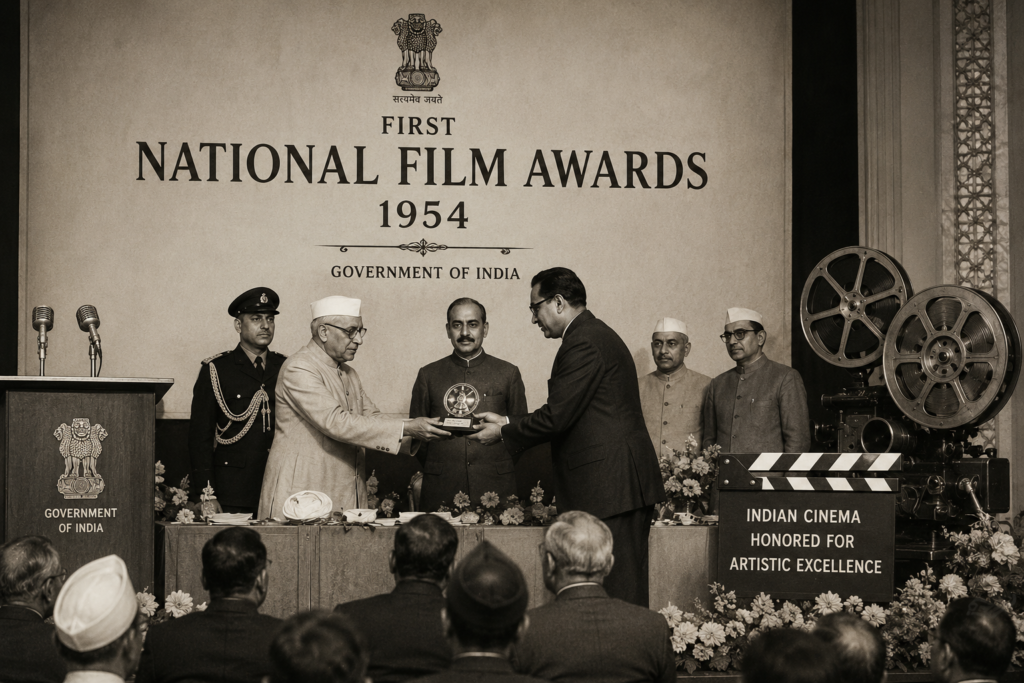
The first National Film Awards laid the foundation for India’s highest official recognition of cinematic excellence.
Alongside the top national honor, awards were presented to films from different regional languages, demonstrating from the very beginning that Indian cinema extended far beyond Hindi filmmaking. This inclusive approach acknowledged the creative contributions of regional film industries and laid the foundation for one of the defining principles of the National Film Awards—celebrating excellence wherever it emerged.
The early awards emphasized films that combined artistic merit with meaningful social themes. Rather than rewarding box-office performance alone, the jury recognized works that contributed to India’s cultural and educational development. This philosophy distinguished the National Film Awards from many later industry-sponsored awards and reinforced their reputation as the country’s highest official recognition for cinematic achievement.
As Indian cinema expanded over the following decades, the National Film Awards also evolved. New award categories were introduced to honor acting, direction, music, screenwriting, cinematography, editing, sound, children’s films, documentaries, and numerous technical disciplines. The awards gradually grew into a comprehensive celebration of every creative aspect of filmmaking, reflecting the increasing diversity and sophistication of Indian cinema.
More than seventy years after that first ceremony, the principles established in 1954 continue to define the National Film Awards. Their commitment to artistic excellence, cultural diversity, and national representation has made them one of the most respected institutions in Indian cinema and an enduring symbol of the country’s rich filmmaking heritage.
–– ✦ ✦ ––
🇮🇳 Why the National Film Awards Are Unique
Among India’s many film honors, the National Film Awards occupy a unique position. While several prestigious award ceremonies celebrate cinematic achievements, the National Film Awards remain the country’s highest official recognition for excellence in filmmaking, presented under the patronage of the Government of India.
One of the defining characteristics of the awards is their commitment to recognizing artistic merit rather than commercial success. Unlike awards that are often influenced by box-office performance, audience popularity, or public voting, the National Film Awards are decided by independent juries comprising filmmakers, writers, critics, scholars, technicians, and other respected members of the film community. Their evaluations focus on storytelling, direction, performances, technical craftsmanship, originality, and the overall contribution of a film to Indian cinema.
Another distinguishing feature is their truly national scope. Indian cinema is not represented by a single language or industry. Instead, it consists of dozens of vibrant film industries producing films in numerous languages, each with its own artistic traditions and cultural identity. The National Film Awards recognize this diversity by honoring excellence across the country rather than limiting recognition to any one regional or commercial industry.

Unlike commercial film awards, the National Film Awards recognize artistic excellence across India’s diverse cinematic traditions.
This inclusive philosophy has enabled films from regional industries to receive nationwide recognition alongside Hindi cinema. Over the decades, acclaimed works in Tamil, Telugu, Malayalam, Kannada, Bengali, Marathi, Assamese, Odia, Punjabi, and many other languages have stood on the same national platform, demonstrating that cinematic excellence knows no linguistic boundaries.
For readers interested in Bollywood’s leading popular film honors, our article on the History of the Filmfare Awards explores how India’s best-known industry awards evolved alongside the National Film Awards. Together, these two award systems highlight different yet complementary aspects of Indian cinema—one celebrating industry achievements and popular appeal, the other recognizing artistic excellence and national cultural contribution.
The National Film Awards have also earned a reputation for encouraging meaningful cinema. Many socially relevant films, literary adaptations, independent productions, documentaries, and experimental works that may not have achieved commercial success have nevertheless received national recognition for their artistic vision and cultural significance. This commitment has helped preserve the diversity of Indian filmmaking while encouraging directors and producers to explore new ideas and storytelling styles.
In many respects, the National Film Awards serve as a mirror of India’s cultural diversity. Every ceremony showcases the richness of the country’s languages, traditions, histories, and regional identities through cinema, reinforcing the idea that Indian filmmaking is a shared national heritage created by many creative voices.
–– ✦ ✦ ––
🏆 Major Award Categories
Since their establishment in 1954, the National Film Awards have expanded considerably to reflect the growing scale and diversity of Indian cinema. What began with only a handful of honors has evolved into a comprehensive recognition system celebrating excellence across virtually every aspect of filmmaking.

The National Film Awards honor excellence across feature films, documentaries, technical achievements, and film writing.
Although individual categories have changed over the years, the awards are generally organized into four broad groups.
🎬 Feature Film Awards
The Feature Film Awards form the heart of the National Film Awards. They recognize excellence in feature-length films produced across India’s many languages and film industries.
Some of the most prestigious honors include:
- Best Feature Film
- Best Direction
- Best Actor
- Best Actress
- Best Supporting Actor
- Best Supporting Actress
- Best Child Artist
- Best Screenplay
- Best Music Direction
- Best Lyrics
- Best Playback Singer
- Best Cinematography
- Best Editing
- Best Audiography (Sound)
- Best Production Design
- Best Costume Design
- Best Choreography
- Best Special Effects (Visual Effects)
These categories acknowledge not only performers and directors but also the many creative and technical professionals whose work brings films to life.
🎥 Non-Feature Film Awards
Indian cinema extends beyond commercial feature films. Documentaries, short films, educational films, environmental films, and experimental productions have long played an important role in preserving history, promoting social awareness, and encouraging artistic innovation.
The Non-Feature Film Awards recognize these contributions by honoring outstanding achievements in documentary filmmaking and other short-form cinematic works.
Many acclaimed documentary filmmakers have gained national recognition through these awards, helping audiences appreciate forms of cinema that often receive less commercial exposure.
🖋️ Best Writing on Cinema
One of the most distinctive aspects of the National Film Awards is their recognition of film criticism, scholarship, and journalism.
Through the Best Writing on Cinema categories, the awards acknowledge authors, historians, critics, and journalists who contribute to a deeper understanding of Indian cinema.
This reflects an important principle: cinema is not only created by filmmakers but also preserved, interpreted, and documented by those who write about it. Their work helps future generations understand the artistic, historical, and cultural significance of Indian films.
For a cinema history website like The Reel Retro, this category is particularly meaningful because it highlights the value of documenting cinema’s journey—not just celebrating its stars and films.
🌟 Special Honors and Lifetime Recognition
Beyond competitive categories, the National Film Awards have also celebrated extraordinary lifetime contributions to Indian cinema.
Among the most prestigious recognitions is the Dadasaheb Phalke Award, India’s highest honor in cinema. Named after Dadasaheb Phalke, widely regarded as the Father of Indian Cinema, this award recognizes individuals whose lifetime achievements have had a profound and lasting impact on Indian filmmaking.
Although administered alongside the National Film Awards ceremony, the Dadasaheb Phalke Award occupies a unique place in Indian cinema, honoring careers that have shaped the nation’s cinematic heritage across generations.
Its inclusion further reinforces the broader mission of the National Film Awards—not merely to celebrate annual achievements but also to preserve the legacy of those who transformed Indian cinema.
–– ✦ ✦ ––
🎥 Celebrating Regional Cinema
Perhaps no aspect of the National Film Awards has had a greater impact on Indian cinema than their unwavering support for regional filmmaking.
India is home to one of the world’s most diverse cinematic landscapes. Alongside Bollywood, major film industries have flourished in Tamil, Telugu, Malayalam, Kannada, Bengali, Marathi, Punjabi, Assamese, Odia, Gujarati, and several other languages. Each has developed its own storytelling traditions, artistic styles, music, and cultural identity.
From the very beginning, the National Film Awards recognized that Indian cinema could not be represented by a single language alone. Outstanding films from every recognized language were given the opportunity to compete on a national stage, ensuring that excellence—not geography or commercial influence—determined recognition.

The National Film Awards showcase India’s rich cinematic diversity by honoring films from every region and language.
This philosophy has introduced countless audiences to remarkable regional films that might otherwise have remained known only within their home states. Many celebrated directors, actors, cinematographers, writers, and composers first gained nationwide recognition after receiving National Film Awards for their work.
The awards have also encouraged filmmakers to explore local histories, literature, folklore, social issues, and cultural traditions. As a result, the National Film Awards have helped preserve India’s extraordinary cultural diversity while promoting mutual appreciation among audiences from different linguistic and regional backgrounds.
Today, this commitment to regional cinema remains one of the defining strengths of the National Film Awards. By honoring films from every corner of the country, the awards continue to demonstrate that Indian cinema is not the story of one industry but the collective achievement of many vibrant cinematic traditions.
–– ✦ ✦ ––
🌍 International Recognition and Cultural Impact
Although the National Film Awards primarily celebrate Indian cinema, their influence extends far beyond the country’s borders. Over the decades, many award-winning films have introduced international audiences to the richness, diversity, and artistic depth of Indian filmmaking.
Unlike the common perception that Indian cinema is represented solely by Bollywood, the National Film Awards have consistently highlighted the remarkable achievements of regional film industries. Many acclaimed films in Bengali, Malayalam, Tamil, Marathi, Assamese, Kannada, and other languages have gone on to receive recognition at major international film festivals, helping global audiences discover the breadth of India’s cinematic traditions.

The National Film Awards reflect the growing international recognition and cultural influence of Indian cinema.
The awards have also encouraged filmmakers to tell stories rooted in local cultures while addressing universal human experiences. Themes such as family, identity, social justice, gender equality, rural life, history, literature, and cultural heritage have resonated with audiences around the world, demonstrating that authentic regional storytelling can possess universal appeal.
Beyond celebrating individual films, the National Film Awards have contributed to preserving India’s cultural diversity through cinema. They have recognized works based on regional literature, folklore, historical events, indigenous traditions, and social movements, ensuring that cinema remains an important medium for documenting India’s evolving cultural landscape.
As Indian cinema gained greater visibility internationally during the late twentieth and early twenty-first centuries, the National Film Awards also strengthened India’s reputation as a nation capable of producing cinema that combined artistic excellence with cultural authenticity. Today, many internationally respected filmmakers proudly regard National Film Awards among the most meaningful recognitions of their careers.
–– ✦ ✦ ––
💻 The National Film Awards in the Modern Era
Indian cinema has undergone extraordinary transformation since the National Film Awards were first introduced in 1954. Advances in digital filmmaking, computer-generated imagery, streaming platforms, and changing audience preferences have reshaped how films are produced, distributed, and experienced. Throughout these changes, the National Film Awards have continued to evolve while remaining faithful to their original purpose—recognizing excellence in filmmaking.
Modern Indian cinema now encompasses a wide range of storytelling styles. Alongside mainstream commercial productions, independent cinema, documentary filmmaking, experimental films, and regional productions have flourished. The National Film Awards have responded by continually refining award categories to acknowledge new creative and technical achievements while maintaining high standards of artistic evaluation.
The awards have also adapted to India’s increasingly interconnected film industries. Today, collaborations among artists, technicians, composers, cinematographers, editors, and writers frequently cross linguistic boundaries. Talent moves freely between Bollywood and regional cinema, enriching the country’s filmmaking landscape. The National Film Awards reflect this collaborative spirit by recognizing excellence wherever it emerges, regardless of language or commercial scale.

Digital technology and streaming platforms continue to reshape Indian cinema while the National Film Awards evolve with the industry.
Streaming platforms have further expanded the reach of Indian cinema by introducing regional films to audiences across India and around the world. Productions that might once have remained confined to their home states can now reach millions of viewers globally. In this changing environment, the National Film Awards continue to serve as an important benchmark of quality, helping audiences discover films that combine artistic merit with meaningful storytelling.
More than seven decades after their inception, the awards remain a trusted symbol of excellence. For filmmakers, receiving a National Film Award represents recognition from peers and experts who evaluate cinema on the basis of creativity, craftsmanship, and cultural contribution rather than commercial performance alone.
While the National Film Awards recognize excellence across all Indian languages, Bollywood has remained one of their most visible contributors through its evolving storytelling, performances, and technical achievements. To understand how Hindi cinema reached this modern phase, explore our Reel Bollywood series, which traces the history of Bollywood from its early foundations to the streaming era.
The National Film Awards reflect the growth of Indian cinema while recognizing excellence across changing filmmaking styles and technologies. In much the same way, the Academy Awards have documented Hollywood’s own evolution by honoring the films, artists, and innovations that shaped the industry. If you’d like to explore this journey further, discover the history of the Academy Awards, which have long honored excellence in Hollywood filmmaking, and explore our Reel Hollywood series to see how the industry evolved from its silent beginnings into today’s global cinema.
–– ✦ ✦ ––
📅 Timeline: Key Milestones in National Film Awards History
The journey of the National Film Awards reflects the remarkable evolution of Indian cinema over the past seven decades.

Major milestones trace the evolution of the National Film Awards from their beginnings in 1954 to the present day.
| Year | Milestone |
|---|---|
| 1954 | The Government of India presents the first State Awards for Films, later known as the National Film Awards. |
| 1954 | Shyamchi Aai receives the President’s Gold Medal for the All India Best Feature Film. |
| 1960s | Award categories expand as Indian cinema grows in scale and diversity. |
| Late 1960s | The Dadasaheb Phalke Award is introduced to honor lifetime contributions to Indian cinema. |
| 1970s–1990s | Regional cinema receives increasing national recognition through expanded language and technical categories. |
| 1990s–2000s | Technical awards continue to evolve alongside advances in filmmaking technology. |
| 2010s | Digital filmmaking, independent cinema, and regional productions receive greater national visibility. |
| Present Day | The National Film Awards continue to celebrate excellence across India’s diverse cinematic traditions while recognizing artistic, technical, and cultural achievements. |
–– ✦ ✦ ––
🕊️ Legacy of the National Film Awards
For more than seventy years, the National Film Awards have stood as one of the most respected institutions in Indian cinema. They have celebrated not only outstanding films and performances but also the extraordinary diversity that defines India’s cinematic heritage.
Unlike awards centered on commercial popularity, the National Film Awards have consistently emphasized artistic excellence, cultural significance, and creative innovation. By recognizing filmmakers from every region and language, they have reinforced the idea that Indian cinema is a shared national achievement shaped by many distinct traditions.
Their influence extends beyond annual ceremonies. Award-winning films often gain wider audiences, renewed appreciation, and lasting historical significance. Many productions that initially reached only limited viewers have gone on to become classics because of the national recognition they received.
The National Film Awards have also helped preserve India’s cinematic legacy for future generations. By honoring exceptional storytelling, technical craftsmanship, documentary filmmaking, children’s cinema, and contributions to film scholarship, they celebrate every dimension of the filmmaking process while encouraging continued artistic growth.
Today, the National Film Awards remain more than a symbol of achievement—they represent the enduring belief that cinema can entertain, educate, inspire, and strengthen cultural understanding across one of the world’s most diverse nations.
The history of the National Film Awards is ultimately the story of India’s enduring commitment to recognizing cinematic excellence. Whether recognizing a small independent production, a landmark regional film, or a remarkable contribution to mainstream Indian cinema, the awards continue to uphold the vision established in 1954: celebrating excellence wherever it is found and preserving the rich legacy of Indian cinema for generations to come.
–– ✦ ✦ ––
❓ Frequently Asked Questions (FAQs)
What are the National Film Awards?
The National Film Awards are India’s highest official film honors, established by the Government of India in 1954 to recognize excellence in filmmaking. They celebrate outstanding achievements in feature films, non-feature films, writing on cinema, acting, direction, music, and technical craftsmanship across India’s diverse film industries.
When were the National Film Awards established?
The National Film Awards were first presented in 1954. Initially known as the State Awards for Films, they were created to encourage high-quality filmmaking and recognize artistic excellence throughout Indian cinema.
How are the National Film Awards different from the Filmfare Awards?
The National Film Awards are official government honors judged by independent expert juries and recognize excellence across all Indian film industries and languages. The Filmfare Awards, while highly prestigious, are industry awards primarily associated with Bollywood and popular Hindi cinema. Together, they represent two important but distinct traditions of recognizing cinematic achievement in India.
Which was the first film to win the National Film Award for Best Feature Film?
The Marathi film Shyamchi Aai won the highest honor at the inaugural awards in 1954, receiving the President’s Gold Medal for the All India Best Feature Film.
Who organizes the National Film Awards?
The National Film Awards are administered by the Directorate of Film Festivals (DFF) under the Ministry of Information and Broadcasting, Government of India. (Administrative responsibilities may evolve over time, but the awards remain official Government of India honors.)
Do the National Film Awards recognize regional cinema?
Yes. One of the defining features of the National Film Awards is their commitment to recognizing excellence across India’s many regional film industries. Films in languages such as Tamil, Telugu, Malayalam, Kannada, Bengali, Marathi, Punjabi, Assamese, Odia, and several others have received national recognition over the decades.
Why are the National Film Awards important?
The National Film Awards recognize artistic excellence, preserve India’s rich cinematic heritage, and encourage high standards of filmmaking across every region and language. They also provide national recognition to filmmakers whose work has made significant artistic, technical, educational, or cultural contributions to Indian cinema.
This article explores the history of the National Film Awards, their evolution, and their lasting cultural significance in Indian cinema. For readers interested in the latest award announcements, current regulations, recent winners, and official updates, the official Government of India National Film Awards website provides the most up-to-date information.
🌐 Read in Hindi
Prefer reading this article in Hindi?
👉 हिंदी में पढ़ें:
राष्ट्रीय फ़िल्म पुरस्कार का इतिहास: भारतीय सिनेमा में उत्कृष्टता का सम्मान
This version of the article offers the same depth, perspective, and storytelling.
🔖 External sources are referenced for educational and historical context. All content rights and credits belong to their respective owners.