
How the Malayalam New Wave transformed regional filmmaking and paved the way for a cinema celebrated around the world.

Malayalam cinema’s journey from the New Wave of the 1970s to international recognition.
From the radical filmmakers of the 1970s to today’s globally acclaimed storytellers, the evolution of Malayalam cinema has unfolded without losing the cultural identity that made it distinctive.
Malayalam cinema has long been known for its literary depth, strong performances, and willingness to look beyond conventional storytelling. But its transformation into one of India’s most critically respected film cultures was not simply the result of a few acclaimed directors or award-winning films.
A major turning point came with the Malayalam New Wave of the 1970s. Filmmakers such as Adoor Gopalakrishnan, G. Aravindan, John Abraham, K. G. George and others began treating cinema not merely as entertainment, but as a serious artistic language capable of examining society, politics, identity and everyday life.
What makes the story especially fascinating is what happened afterward. The ideas introduced by the New Wave did not remain confined to so-called art cinema. They gradually influenced mainstream filmmaking, acting, writing, cinematography and audience expectations. Decades later, a new generation of Malayalam filmmakers would build upon that foundation and take the industry to audiences far beyond Kerala.
This is therefore not simply a history of Malayalam cinema. It is the story of how one cinematic movement changed the way Malayalam films could be imagined—and how that change eventually helped create a globally recognized film culture.
Table of Contents
1. The New Wave Was More Than a Film Movement
The Malayalam New Wave emerged during a period when Kerala was experiencing significant cultural and intellectual change.
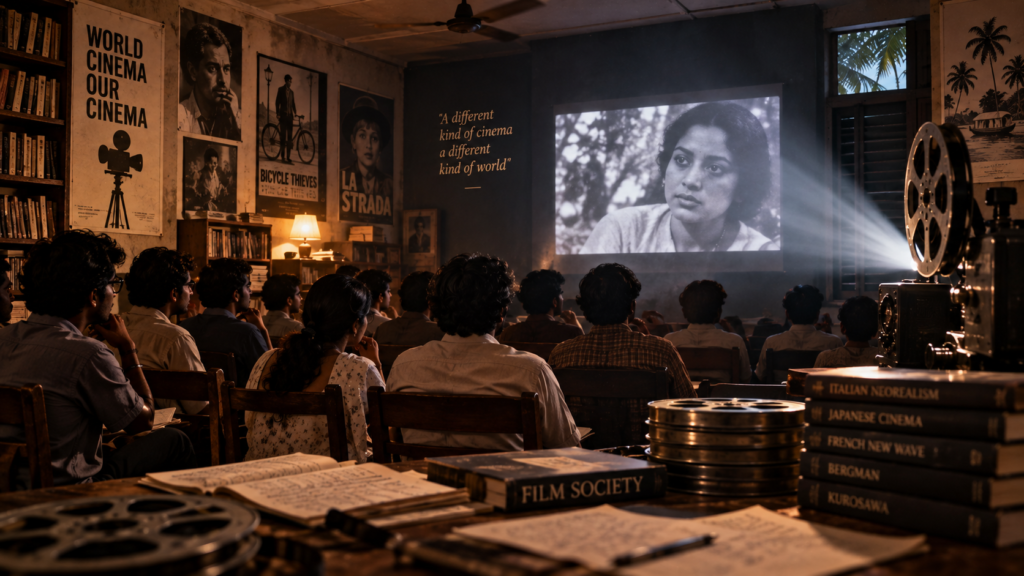
Film societies helped introduce world cinema to Kerala audiences and foster the cultural environment from which the Malayalam New Wave emerged.
The growth of film societies exposed audiences to international cinema, while Kerala’s strong literary culture provided filmmakers with a tradition of serious storytelling. Political discussion, theatre, modernist literature and an increasingly engaged educated audience all contributed to an environment in which cinema could be viewed as an intellectual and artistic medium.
The film-society movement was particularly important. Chitralekha Film Cooperative Limited helped introduce serious film enthusiasts to world cinema and foster a culture of film appreciation in Kerala, creating an audience prepared to engage with forms of storytelling that differed from conventional commercial cinema.
This meant the New Wave did not emerge in isolation. It grew out of the history of Malayalam cinema that had been developing for decades.
It was shaped by an ecosystem in which literature, politics, theatre, film appreciation and new filmmaking techniques were beginning to intersect.
That convergence of ideas, influences and institutions would provide the foundation for the Malayalam New Wave.
2. Adoor Gopalakrishnan and the New Language of Malayalam Cinema
If one film can be identified as a decisive starting point for the Malayalam New Wave, it is Adoor Gopalakrishnan’s Swayamvaram (1972).
Adoor had studied at the Film Institute of India in Pune and subsequently became involved in building a serious film culture in Kerala. His work with film societies and cooperative filmmaking helped establish an alternative environment for filmmakers who wanted to move beyond conventional commercial formulas.
Swayamvaram was radically different in its approach.
Rather than constructing its story around spectacle, songs or conventional melodrama, it followed an ordinary young couple confronting unemployment, financial uncertainty and the pressures of independent life.
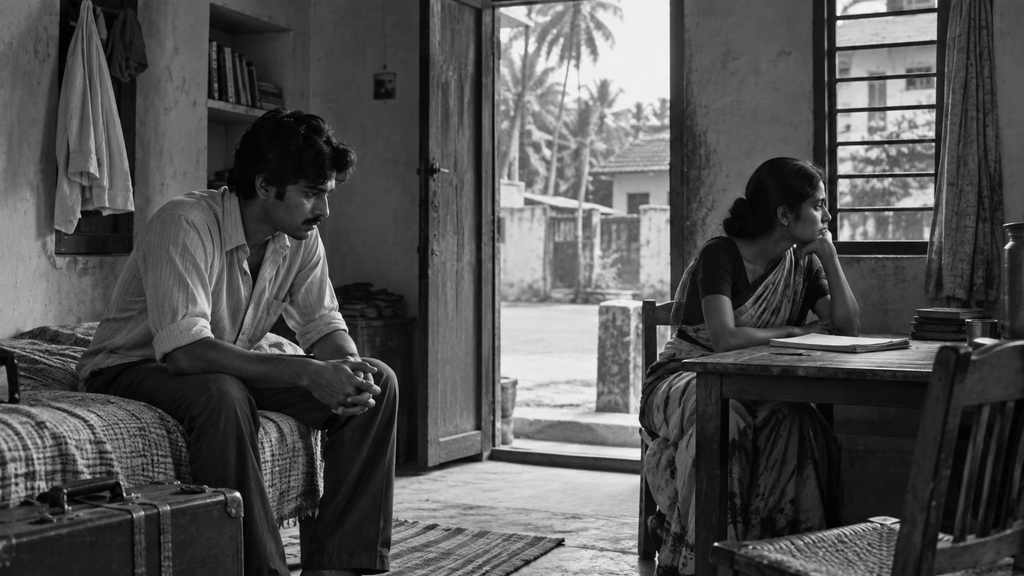
A conceptual visual evoking the social realism of Swayamvaram (1972), Adoor Gopalakrishnan’s landmark film of the Malayalam New Wave.
The film’s realism was not merely a matter of subject matter. Its visual language, location shooting, sound design and restrained performances helped create a different cinematic experience.
It demonstrated that everyday life itself could provide compelling drama.
The film subsequently won four National Film Awards—for Best Film, Best Director, Best Actress and Best Cinematography—giving the emerging New Wave national recognition.
That recognition mattered enormously.
Malayalam cinema had demonstrated that a film could be deeply rooted in Kerala while simultaneously participating in a much wider conversation about Indian cinema.
3. From Individual Stories to a Portrait of Kerala
One of the defining characteristics of New Wave Malayalam cinema was its ability to make individual lives reflect larger social changes. The filmmakers were interested in people, but they were also interested in the structures surrounding those people.
Family relationships could reveal changing social values, while a decaying house could represent the decline of an older social order. Political disillusionment could become a story about memory and identity, while economic hardship could reveal the gap between personal aspirations and social reality.
This approach made Malayalam cinema unusually attentive to the relationship between the private and the political.
Adoor’s Elippathayam, for example, used the decline of a feudal household to explore a society in transition. The film subsequently won the Sutherland Award at the 1982 London Film Festival.
The importance of such films was therefore not restricted to awards. They showed filmmakers that social transformation could be communicated through atmosphere, character and visual storytelling rather than explicit exposition.
4. Aravindan and the Poetic Possibilities of Cinema
Alongside Adoor, G. Aravindan developed an entirely different cinematic vocabulary.
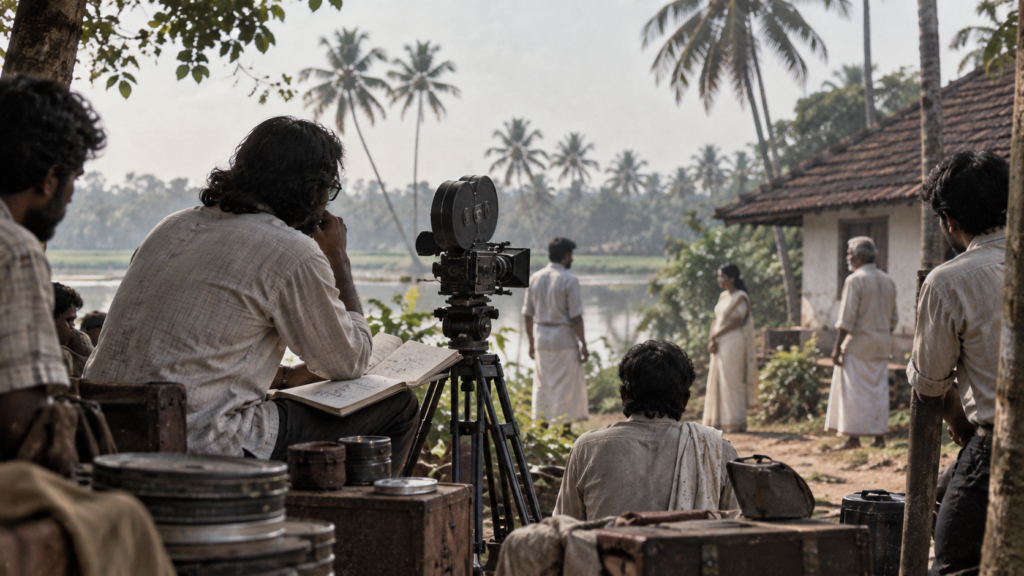
A conceptual visual evoking the poetic, observational filmmaking associated with G. Aravindan and the Malayalam New Wave
Where Adoor often approached his subjects through careful observation and psychological realism, Aravindan frequently embraced a more poetic, philosophical and visually expressive style.
His films demonstrated that Malayalam cinema did not have to choose between realism and artistic experimentation.
Works such as Uttarayanam, Kanchana Sita, Thampu, Kummatty, Chidambaram and Vasthuhara expanded the possibilities of what a Malayalam film could communicate.
Aravindan’s background as a cartoonist and his interest in Kerala’s cultural traditions contributed to a distinctive visual sensibility. His cinema could move between folklore, politics, philosophy and ordinary human experience without fitting comfortably into a single genre.
This was one of the New Wave’s greatest achievements:
there was no single New Wave formula.
Adoor, Aravindan and their contemporaries demonstrated different ways of making serious cinema.
5. John Abraham and the Idea of Cinema as Collective Expression
The New Wave also contained a more radical and politically charged strand.
John Abraham became an important figure in this tradition, particularly through his unconventional approach to filmmaking and his interest in politics, social inequality and collective participation.
His work challenged conventional ideas about who controlled a film and how films should be produced.
This was significant because the New Wave was not only changing what appeared on screen. It was also questioning how cinema itself should be created.
The broader movement included filmmakers who came through institutions such as the Film Institute of India and who brought new technical knowledge and international cinematic influences back to Kerala. Adoor, Aravindan and John Abraham became especially prominent representatives of this transformation.
6. When New Wave Ideas Met Popular Cinema
The most important legacy of the New Wave may actually be found outside strictly parallel cinema.
By the 1980s, Malayalam filmmaking increasingly found ways to combine realistic characterization with popular entertainment.
This helped produce a form of middle-stream cinema that could appeal to wider audiences without abandoning serious themes.
Directors such as K. G. George, Bharathan and Padmarajan helped develop this space.
Their films could contain romance, humour, family drama or suspense while still dealing with complicated psychological and social questions.
This was an important development.
The New Wave had initially challenged the assumption that commercially successful cinema needed simplistic storytelling. The following generation began demonstrating that artistic ambition and audience accessibility did not have to be opposites.
That idea would become one of Malayalam cinema’s most enduring characteristics.
7. The Writer Became as Important as the Star
Another major consequence of this transformation was the growing importance of the screenwriter. Malayalam cinema had always maintained a strong relationship with literature, but the New Wave period intensified the connection between literary thinking and filmmaking.
Writers and filmmakers increasingly explored characters with contradictions, moral uncertainty and psychological depth. This helped create a cinema in which dialogue mattered, but what characters did—and why they did it—mattered just as much.
The result was a richer form of characterization. Heroes could be flawed, villains could be sympathetic, and families could be loving and oppressive at the same time. Relationships could end without a neat moral resolution.
These qualities helped Malayalam cinema develop a reputation for sophisticated storytelling that would later become one of the defining features of its international appeal.
8. From National Recognition to International Festivals
The New Wave also expanded the geographical reach of Malayalam cinema. Films that emerged from this tradition began appearing at major international festivals, exposing critics and cinephiles around the world to Malayalam filmmaking.
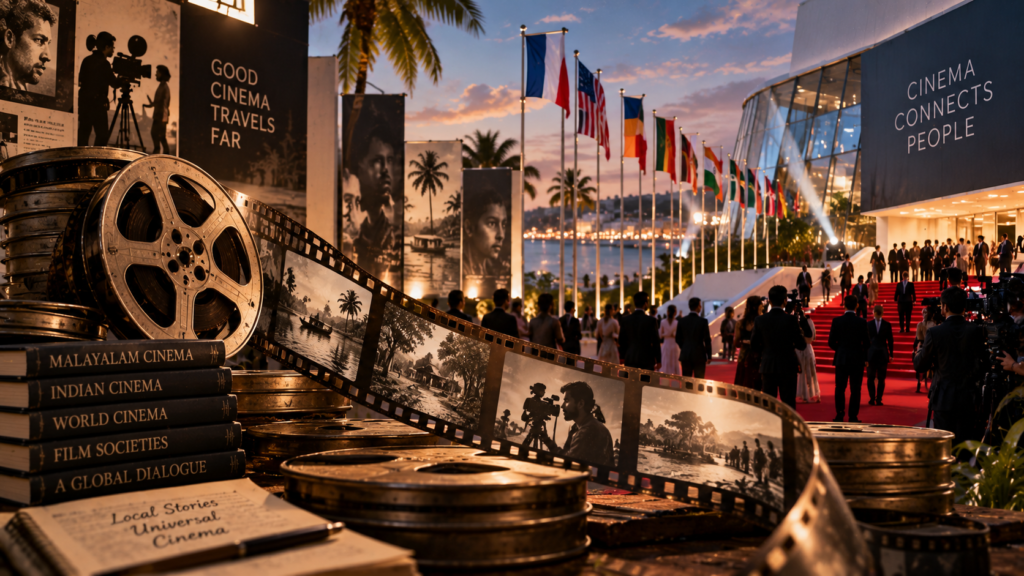
International film festivals helped bring Malayalam cinema to critics and audiences far beyond India.
Adoor’s films became particularly important in this process. His work received recognition at international festivals and institutions including Venice, Berlin, Toronto, London and Rotterdam, while his growing international reputation was reflected in an extensive record of awards and nominations. He received the International Film Critics Prize (FIPRESCI) six times consecutively for Mukhamukham, Anantaram, Mathilukal, Vidheyan, Kathapurushan and Nizhalkkuthu. He also won the UNICEF Film Prize at the Venice Film Festival in 1990 for Mathilukal (The Walls).
Elippathayam was an especially significant milestone. Its international recognition helped establish Adoor as a filmmaker whose work could engage audiences and critics well beyond India.
Later, Murali Nair’s Marana Simhasanam won the Caméra d’Or at the 1999 Cannes Film Festival, adding another landmark to Malayalam cinema’s international history.
These achievements gradually changed the perception of Malayalam cinema outside India. It was no longer simply a regional industry producing films primarily for Malayalam-speaking audiences; it had become a source of cinema that international audiences could actively seek out.
9. The New Wave’s Influence Survived the Movement Itself
Movements eventually end.
The Malayalam New Wave of the 1970s and 1980s did not remain the dominant filmmaking model forever. Commercial cinema, star culture and changing production economics altered the industry. But the ideas introduced by the movement survived.
Realistic characterization became more common, while naturalistic performances became increasingly valued. Regional settings stopped being viewed as limitations, and literary adaptations continued to flourish.
Filmmakers became more comfortable experimenting with narrative structure, and audiences became more receptive to films that did not follow conventional formulas.
This is why describing the New Wave merely as a historical period misses its larger importance. It changed the expectations surrounding Malayalam cinema.
10. The New Generation Finds Its Own New Wave
After the turn of the century, Malayalam cinema went through another period of experimentation.

A new generation of filmmakers brought fresh narratives, visual styles and production approaches to Malayalam cinema.
The transformation became particularly visible after 2010, when a younger generation of filmmakers began experimenting with simpler narratives, unconventional characters, new visual styles and different production approaches. Recent scholarship on Malayalam cinema’s new wave has described this development as a kind of “new” New Wave.
Filmmakers such as Lijo Jose Pellissery, Aashiq Abu, Amal Neerad, Anjali Menon, Alphonse Puthren, Dileesh Pothan and Mahesh Narayanan became associated with this new wave of experimentation.
The similarities with the earlier movement are striking.
Once again, filmmakers were:
- prioritizing character over formula;
- experimenting with structure and visual language;
- drawing inspiration from global cinema;
- using local settings as creative strengths;
- challenging conventional ideas about heroes and storytelling;
- and trusting audiences to engage with more complex narratives.
But this generation had something its predecessors did not have:
a global digital audience.
11. From Kerala to the World
Digital distribution, streaming platforms and social media fundamentally changed how regional Indian cinema could travel, allowing films from industries such as Malayalam, Kannada, Tamil and Telugu cinema to reach audiences far beyond their traditional markets. A Malayalam film no longer needed to depend entirely on a theatrical release in Kerala—or even on a conventional overseas distribution network—to find an audience.

Digital distribution and streaming have helped Malayalam films reach audiences far beyond Kerala.
Subtitles could bring Malayalam-language stories to viewers who did not speak Malayalam, while online film communities could turn a regional release into a wider international conversation. Filmmakers could also draw simultaneously from Kerala’s cultural traditions and a worldwide cinematic vocabulary.
This helped accelerate something the New Wave had begun decades earlier:
the idea that a film could be deeply local and still be universal.
The international appreciation of Malayalam cinema, however, cannot be attributed to streaming alone. Digital distribution amplified a reputation that had been built over decades through strong writing, distinctive filmmaking, memorable performances, festival recognition and critical acclaim.
12. Why Malayalam Cinema Travels So Well
What makes Malayalam cinema particularly accessible to international audiences? One answer is its emphasis on human experience rather than cultural explanation.
A film may be rooted in Kerala’s politics, family structures, landscapes or social history, yet its emotional questions can remain immediately understandable.
How does a person deal with failure? What happens when family expectations conflict with individual freedom? How does power change relationships? What happens when old social structures begin to disappear? How do ordinary people respond to extraordinary circumstances?
These questions cross linguistic and geographical boundaries.
Many of Malayalam cinema’s most distinctive films do not attempt to erase their regional identity in order to become ‘global.’ Instead, they make that identity part of their strength.
13. The Global Recognition of Malayalam Cinema
The international reputation of Malayalam cinema today rests on several generations of filmmaking. The New Wave established the foundations, while the filmmakers of the 1980s and 1990s expanded the possibilities of realistic and middle-stream cinema.
Later generations experimented with genre, technology and narrative structure, while contemporary filmmakers have benefited from a global audience increasingly willing to explore cinema beyond the traditional Hindi, English and European-language circuits.
The result is a fascinating paradox:
Malayalam cinema became more global without becoming less Malayalam.
Its international recognition has largely come from its willingness to remain culturally specific while telling stories with universal emotional and dramatic appeal.
14. The Lasting Legacy of the Malayalam New Wave
The most important legacy of the New Wave is not a particular film.

The Malayalam New Wave continues to influence contemporary filmmakers while connecting Kerala’s cinematic traditions with a global audience.
It is a way of thinking about cinema.
The movement demonstrated that:
- ordinary people could be compelling protagonists
- regional stories could have international significance
- serious cinema did not require abandoning audiences
- literature and cinema could enrich one another
- visual storytelling could communicate what dialogue could not
- filmmakers could challenge established industrial conventions
- and a small linguistic industry could produce work of international artistic importance
Adoor Gopalakrishnan’s career illustrates that legacy particularly clearly. His official filmography records decades of international festival recognition, FIPRESCI awards and National Awards, showing how the ideas introduced with Swayamvaram continued to develop throughout his career.
15. From New Wave to a Global Stage
The evolution of Malayalam cinema is ultimately a story of continuity rather than replacement. The contemporary industry did not simply abandon the cinema of the New Wave and start again. It inherited its confidence.
The confidence to tell regional stories. The confidence to experiment. The confidence to trust viewers. And, perhaps most importantly, the confidence to believe that Malayalam cinema could speak to the world without first having to stop being Malayalam cinema.
From the radical filmmaking culture of the 1970s to the internationally celebrated work of later generations, the journey has been remarkable.
The Malayalam New Wave opened the door. Successive generations widened it. And today’s filmmakers are carrying Malayalam cinema through that doorway onto an increasingly global stage.
FAQs About the Evolution of Malayalam Cinema
What was the Malayalam New Wave?
The Malayalam New Wave was a major filmmaking movement that emerged during the 1970s, characterized by realistic storytelling, artistic experimentation, social observation and a move away from conventional commercial formulas. Adoor Gopalakrishnan, G. Aravindan and John Abraham were among its important figures.
Which film is considered a landmark of the Malayalam New Wave?
Adoor Gopalakrishnan’s Swayamvaram (1972) is widely regarded as a landmark film of the movement. It introduced a distinctive new cinematic language and won four National Film Awards.
Why was Adoor Gopalakrishnan important to Malayalam cinema?
Adoor helped establish a new approach to filmmaking through his films, film-society activities and cooperative filmmaking initiatives. His work brought Malayalam cinema significant national and international recognition.
What did G. Aravindan contribute to Malayalam cinema?
G. Aravindan developed a highly individual poetic and philosophical style, demonstrating that Malayalam cinema could explore folklore, politics, spirituality and everyday life through unconventional visual storytelling.
How did the New Wave influence mainstream Malayalam cinema?
Its influence helped normalize realistic characterization, serious themes, literary storytelling and unconventional narrative approaches. By the 1980s, middle-stream cinema increasingly combined artistic qualities with wider audience appeal.
When did Malayalam cinema begin receiving international recognition?
The process developed strongly from the New Wave era onward. Films by Adoor and other filmmakers appeared at major international festivals, while works such as Elippathayam and Marana Simhasanam achieved notable international recognition.
Is contemporary Malayalam cinema connected to the New Wave?
Yes. Although contemporary filmmakers work in a very different technological and industrial environment, many continue the New Wave tradition of experimentation, realistic characters, strong writing and unconventional storytelling. Some scholars describe the post-2010 transformation as a “new” New Wave.
Why has Malayalam cinema gained such a strong international audience?
Its combination of culturally specific storytelling, complex characters, strong writing, artistic experimentation and universal human themes has made Malayalam films increasingly accessible to audiences beyond Kerala. Digital distribution and subtitles have further expanded that reach.
What is the greatest legacy of the Malayalam New Wave?
Its greatest legacy is the belief that regional cinema can be simultaneously local in identity and universal in appeal. That principle remains central to the international reputation Malayalam cinema enjoys today.
🌐 Read in Hindi
Prefer reading this article in Hindi?
👉 हिंदी में पढ़ें:
मलयालम सिनेमा का विकास: ‘न्यू वेव’ से वैश्विक पहचान तक (जल्द आ रहा है)
This version of the article offers the same depth, perspective, and storytelling.
🔖 External sources are referenced for educational and historical context. All content rights and credits belong to their respective owners.