
Exploring the rise, influence, and legacy of the censorship code that defined Hollywood’s Golden Age.
ENG | हिंदी
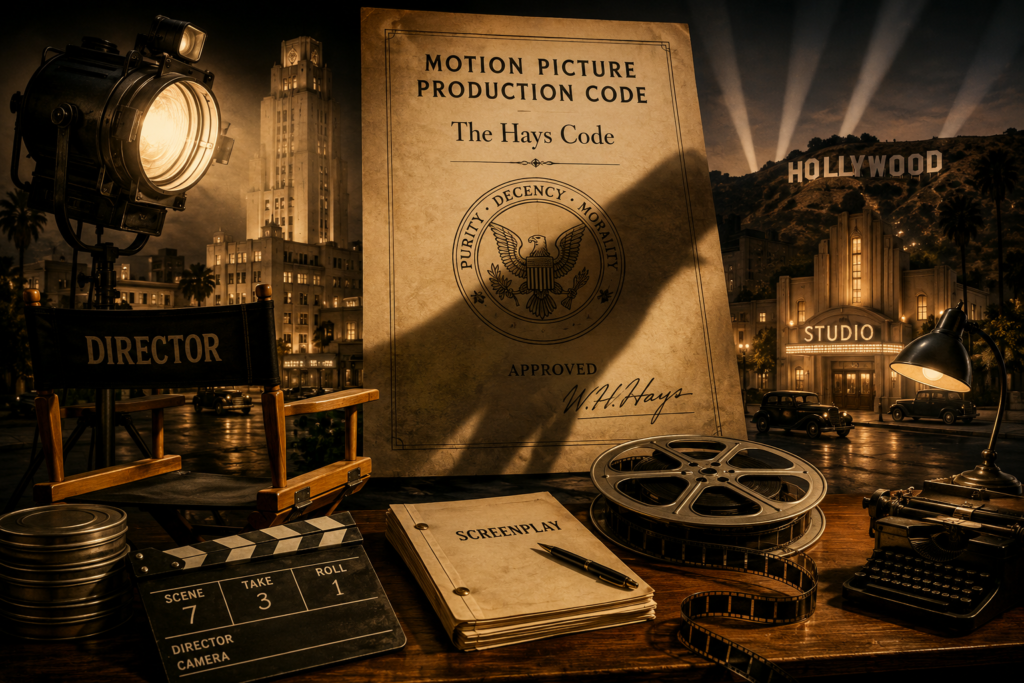
The Hays Code profoundly influenced the themes, storytelling, and creative expression of Hollywood films for nearly four decades.
Before movie ratings, Hollywood followed a strict moral rulebook that shaped every script, every kiss, and every ending. Discover how the Hays Code transformed American cinema for more than three decades.
Even today, the Golden Age of Hollywood continues to captivate audiences with its timeless stories, memorable characters, and enduring films. Yet behind the glamour and creativity was an invisible framework of rules that determined what filmmakers could—and could not—show on screen.
Officially known as the Motion Picture Production Code and popularly referred to as the Hays Code, this system of voluntary censorship profoundly influenced American cinema from the 1930s through the late 1960s. Its impact could be seen in almost every aspect of filmmaking, from romance and crime stories to dialogue, costumes, and even the eventual fate of villains. Rather than presenting everything openly, directors and screenwriters increasingly developed ways to express complex ideas through suggestion, symbolism, implication, and subtle visual storytelling.
This article traces why the Hays Code emerged in Hollywood, why its enforcement became necessary, how it influenced filmmaking and storytelling during the Classical Hollywood era, and how its eventual decline helped pave the way for the creative revolution of New Hollywood.
The Hays Code in Hollywood was more than a system of censorship rules; it was also part of a larger story about how the American film industry tried to negotiate changing social values with the demands of creative freedom. Understanding its influence reveals that censorship did more than restrict filmmakers—it also shaped the ways in which they expressed their stories, characters, and ideas on screen.
📑 In This Article
📌 Key Takeaways
- 🎬 The Hays Code, officially known as the Motion Picture Production Code, governed Hollywood filmmaking from 1930 to 1968, with strict enforcement beginning in 1934.
- 👤 Although named after Will H. Hays, the Code was primarily written by Martin Quigley and Father Daniel A. Lord, and later rigorously enforced by Joseph Breen.
- 🚫 The Code regulated depictions of crime, violence, romance, sexuality, language, and other sensitive subjects, shaping the content of thousands of Hollywood films.
- 🎥 Rather than limiting creativity alone, the Code inspired filmmakers to master visual storytelling, symbolism, clever dialogue, and emotional restraint, leaving a lasting mark on Classical Hollywood cinema.
- ⚖️ Changing social values, legal developments, foreign cinema, television, and bold filmmakers gradually weakened the Code, leading to its replacement in 1968 by the MPAA (now MPA) film rating system.
- 🌟 The legacy of the Hays Code extends beyond censorship—it offers valuable insight into how Hollywood, society, and cinematic storytelling evolved together.
–– ✦ ✦ ––
🎭 Why Hollywood Faced Calls for Censorship
By the early 1920s, Hollywood had become the heart of the American film industry. Lavish productions, charismatic movie stars, and grand premieres captivated audiences around the world, turning cinema into one of the most popular forms of entertainment. As the industry’s influence grew, however, so did concerns about the values films were promoting.
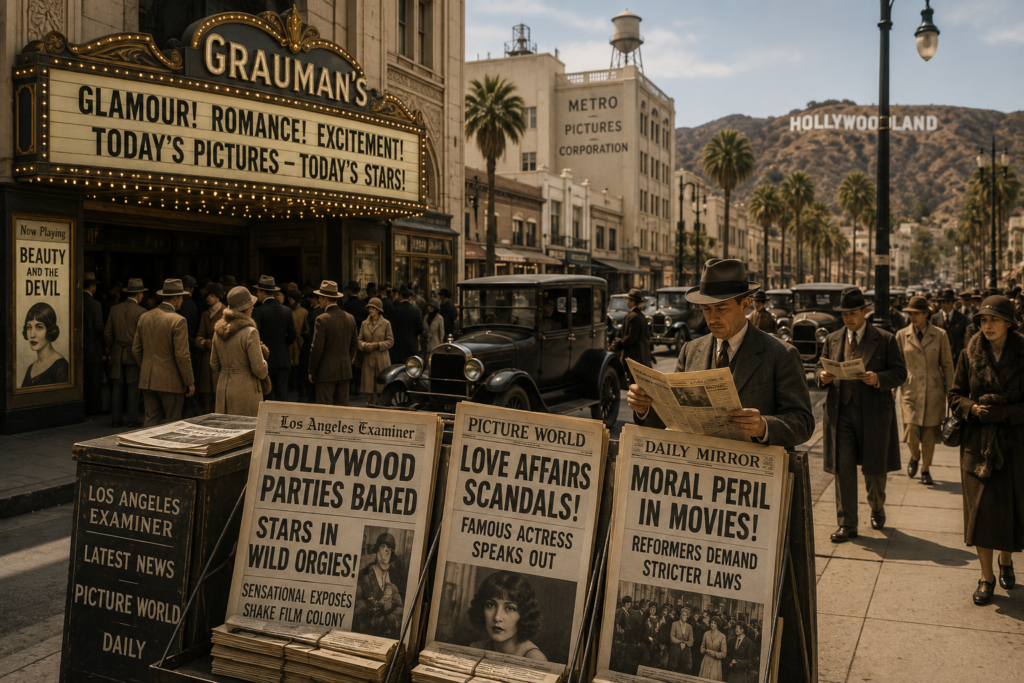
Public controversies of the early 1920s prompted Hollywood to adopt self-regulation.
Many silent-era movies explored themes such as crime, romance, violence, and social rebellion with increasing boldness. At the same time, sensational scandals involving a few Hollywood celebrities dominated newspaper headlines, creating the perception that the film industry lacked moral responsibility. Although these incidents involved only a handful of individuals, they damaged Hollywood’s public image and fueled widespread criticism.
Religious organizations, civic groups, and community leaders began demanding stricter oversight of motion pictures. They argued that films had a powerful influence on audiences—especially children—and should uphold higher moral standards. Several U.S. states and cities even established local censorship boards, each enforcing its own rules about what could be shown on screen. As a result, filmmakers often had to produce different versions of the same film to satisfy varying regional regulations.
Faced with growing public pressure and the possibility of direct government censorship, Hollywood’s major studios realized that a unified, industry-led solution was necessary. Rather than allowing state and federal authorities to impose different censorship laws, they chose to regulate themselves.
This decision led to the formation of the Motion Picture Producers and Distributors of America (MPPDA) in 1922, a trade association established to improve the industry’s public image, promote cooperation among studios, and help the film industry avoid direct government censorship. To lead this effort, the studios appointed Will H. Hays as the first president of the MPPDA. A respected political figure and former U.S. Postmaster General, Hays brought administrative experience and public credibility to an industry eager to restore its reputation.
Although the formal Motion Picture Production Code, later known as the Hays Code, would not be introduced until 1930, its origins lay in Hollywood’s determination to protect its growing industry while preserving the public’s trust. The Code was not merely a list of restrictions—it was a response to a changing society, increasing scrutiny, and the belief that cinema carried significant cultural influence.
–– ✦ ✦ ––
📜 What Was the Hays Code?
The Hays Code, officially known as the Motion Picture Production Code (MPC), was a set of self-imposed guidelines adopted by the American film industry to regulate the moral content of motion pictures. Although first introduced in 1930, it was not rigorously enforced until 1934, when studios were required to obtain approval before releasing their films.
Contrary to a common misconception, the Hays Code was not a law passed by the U.S. government. Instead, it was an industry-wide agreement created by Hollywood’s major studios. By regulating themselves, filmmakers hoped to avoid stricter censorship laws that individual states—or even the federal government—might otherwise impose.
The Code sought to ensure that films entertained audiences without, in its view, encouraging behavior considered immoral or socially harmful. It established detailed rules governing how crime, violence, romance, sexuality, religion, language, and other sensitive subjects could be portrayed on screen. The guiding principle was that audiences should never leave a cinema believing that wrongdoing was admirable or that immoral actions carried no consequences.
Because Will H. Hays became the public face of Hollywood’s campaign to improve its reputation, the Production Code gradually became known simply as the Hays Code. Although Hays did not write the Code himself, his leadership made his name permanently associated with Hollywood’s censorship era.
At its core, the Code rested on three broad principles:
- Motion pictures should uphold moral standards and avoid lowering the audience’s ethical values.
- Respect for law, religion, and social institutions should be maintained, without ridiculing or undermining them.
- Crime, vice, and immoral behavior could be shown only if they were not presented as attractive, justified, or ultimately rewarding.
These principles shaped nearly every aspect of Classical Hollywood filmmaking. Romantic relationships had to be portrayed within carefully defined limits, criminals were expected to face punishment, explicit violence was restricted, and many controversial topics—including certain forms of sexuality and social issues—were either heavily modified or excluded altogether.
Yet the Hays Code did more than restrict filmmakers. It also encouraged many directors, screenwriters, and actors to communicate emotions and complex ideas through suggestion rather than explicit depiction. Clever dialogue, visual symbolism, and subtle storytelling became hallmarks of numerous Hollywood classics, allowing filmmakers to work creatively within the Code’s limitations.
For more than three decades, the Hays Code influenced not only what audiences saw on screen but also how Hollywood told its stories. Its impact can still be felt today in discussions about censorship, artistic freedom, and the balance between creative expression and social responsibility.
–– ✦ ✦ ––
👤 Who Was Will H. Hays? Hollywood’s First Image Reformer
Long before his name became synonymous with Hollywood censorship, Will Harrison Hays was a prominent American politician and businessman. Born in 1879 in Indiana, Hays built a reputation as a skilled lawyer and influential leader within the Republican Party. He served as Chairman of the Republican National Committee and later as Postmaster General of the United States under President Warren G. Harding.
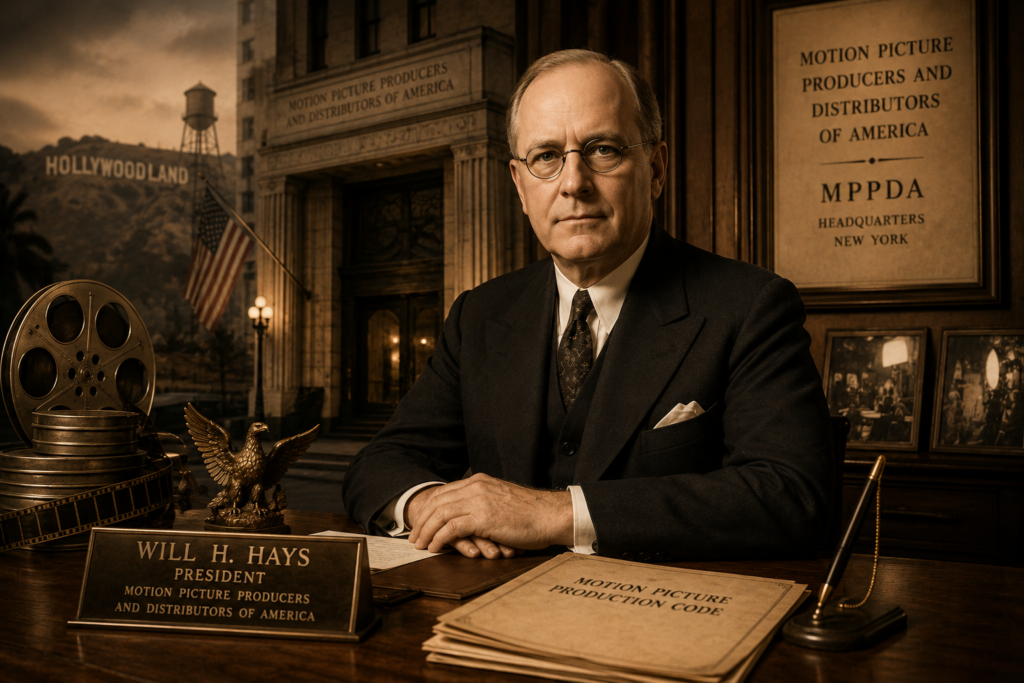
Will H. Hays became the public face of Hollywood’s campaign for industry self-regulation.
Although Hays had no background in filmmaking, he was widely respected for his administrative abilities and public credibility. At a time when Hollywood’s reputation had been shaken by scandals and increasing calls for government regulation, the major film studios believed that an experienced public figure could help restore confidence in the industry.
In 1922, the leading Hollywood studios established the Motion Picture Producers and Distributors of America (MPPDA) and appointed Will H. Hays as its first president. His appointment marked the beginning of Hollywood’s organized effort to improve its public image while protecting the industry’s independence from government censorship.
Hays immediately began promoting higher professional standards across the industry. He encouraged studios to cooperate on ethical guidelines, improve working relationships with community and religious organizations, and present Hollywood as a responsible cultural institution rather than a source of controversy. His role extended far beyond reviewing films; he became the industry’s chief spokesperson, mediator, and advocate during a period of rapid growth.
One of Hays’s most significant achievements was persuading competing studios to support a common system of self-regulation. Instead of allowing dozens of state and local censorship boards to impose different rules, the MPPDA worked toward creating a single set of standards that all member studios could follow. This strategy helped simplify film distribution while demonstrating that Hollywood was willing to regulate itself responsibly.
Although the Motion Picture Production Code was officially adopted during Hays’s tenure, it is important to recognize that Will H. Hays was not its principal author. His greatest contribution was providing the leadership and institutional framework that allowed the Code to become an industry-wide policy. Under his guidance, the MPPDA evolved into the central organization responsible for protecting Hollywood’s public image and coordinating its self-regulatory efforts.
Because Hays remained the public face of these reforms for more than two decades, journalists and audiences gradually began referring to the Motion Picture Production Code simply as the Hays Code. The name endured even after others assumed responsibility for enforcing the rules, reflecting the lasting association between Hays and Hollywood’s censorship era.
By appointing a respected political leader rather than waiting for government intervention, Hollywood demonstrated its determination to govern itself. That decision would shape American filmmaking for decades and lay the foundation for one of the most influential systems of self-regulation in entertainment history.
–– ✦ ✦ ––
📝 How the Motion Picture Production Code Was Written
Although the Hays Code bears the name of Will H. Hays, the document itself was primarily written by Martin Quigley, a respected film trade publisher, and Father Daniel A. Lord, a Jesuit priest and educator. Their collaboration reflected a shared belief that motion pictures should entertain audiences while promoting moral responsibility and social values.
During the late 1920s, Hollywood faced mounting criticism from religious organizations, civic groups, educators, and politicians. Many believed that films had become increasingly sensational, portraying crime, romance, and violence in ways that could negatively influence audiences. At the same time, the major studios wanted to preserve their creative independence by preventing direct government censorship.
To address these concerns, Quigley and Father Lord drafted a comprehensive set of ethical principles for filmmakers. Rather than banning cinema or limiting artistic expression altogether, they sought to establish a common moral framework that would guide the production of motion pictures across the industry.
In 1930, the Motion Picture Producers and Distributors of America (MPPDA) formally adopted the Motion Picture Production Code. The Code outlined broad principles alongside specific rules governing what could—and could not—appear on screen.
At its heart were three General Principles:
- No picture should lower the moral standards of its audience.
- Correct standards of life should be presented, subject only to the demands of drama and entertainment.
- Law, natural or human, should not be ridiculed, nor should audiences be encouraged to sympathize with its violation.
Beyond these guiding principles, the Code included detailed provisions covering a wide range of subjects. It discouraged explicit depictions of sexual relationships, restricted excessive violence, required respectful portrayals of religion, prohibited profanity and obscenity, and insisted that criminals should not appear to profit from their actions. Even seemingly minor details—such as costumes, dance sequences, and methods of committing crimes—were carefully considered.
Despite its comprehensive language, the Production Code initially had limited practical authority. During the early 1930s, many studios interpreted its rules loosely, and filmmakers continued producing movies that featured bold themes, provocative dialogue, and morally ambiguous characters. This period, now known as Pre-Code Hollywood, demonstrated that simply adopting a code was not enough to guarantee compliance.
As public criticism continued, industry leaders concluded that stronger oversight was necessary. The result would fundamentally change American filmmaking, transforming the Production Code from a set of recommended guidelines into a mandatory system that every major Hollywood studio had to follow.
–– ✦ ✦ ––
⚖️ Joseph Breen and the Era of Strict Enforcement (1934)
Although the Motion Picture Production Code was adopted in 1930, it initially had little impact on the films Hollywood produced. Many studios treated the Code as a set of recommendations rather than binding rules, and filmmakers continued to release movies featuring provocative themes, suggestive dialogue, sexual innuendo, and morally ambiguous characters.
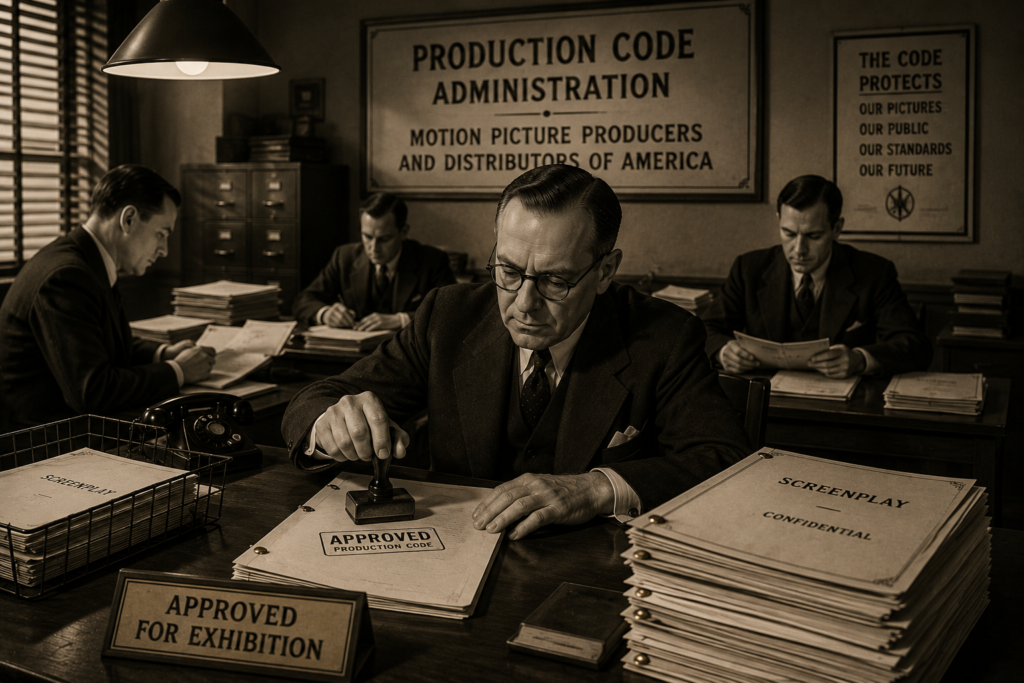
From 1934 onward, the Production Code Administration strictly reviewed Hollywood films before release.
This brief period, commonly known as Pre-Code Hollywood (1930–1934), produced some of the boldest and most controversial films in early American cinema. Stories often featured independent female protagonists, charismatic gangsters, social criticism, and complex relationships that would soon become difficult—or impossible—to portray under stricter censorship.
However, increasing pressure from religious organizations, particularly the Catholic Church, along with growing public concern about the influence of motion pictures, convinced Hollywood’s major studios that stronger enforcement was unavoidable. They feared that failure to regulate themselves could lead to stricter government censorship and declining public confidence in the film industry.
The decisive change came in July 1934, when the Production Code Administration (PCA) was established to enforce the Code with far greater authority. Joseph Ignatius Breen, an experienced journalist and administrator who had long advocated stricter standards for motion pictures, was appointed to lead the new organization.
Under Breen’s leadership, the Production Code became more than a moral guideline—it became an industry requirement.
From 1934 onward, every film produced by a major Hollywood studio had to receive a Certificate of Approval from the PCA before it could be released in American theaters. Without this certificate, most major distributors and cinema chains refused to exhibit a film, making approval essential for commercial success.
Unlike local censorship boards, which reviewed completed films, Breen’s office became involved throughout the filmmaking process. Producers frequently submitted story ideas, screenplay drafts, revised scripts, and even dialogue changes before cameras began rolling. The PCA also reviewed completed films and could require scenes to be rewritten, reshot, shortened, or removed before granting approval.
This system transformed the relationship between filmmakers and censors. Directors, producers, and screenwriters increasingly learned to anticipate the Code’s requirements while developing their stories. Instead of openly challenging the rules, many adapted their creative techniques to work within them, using implication, symbolism, and carefully crafted dialogue to communicate ideas that could not be expressed directly.
Breen’s administration remained influential for more than three decades, overseeing thousands of Hollywood productions during what is now regarded as the Classical Hollywood era. Although many filmmakers privately criticized the restrictions, others acknowledged that the Code challenged them to find more imaginative ways of telling stories.
By the mid-1930s, the Motion Picture Production Code had evolved from a largely symbolic document into one of the most influential systems of self-regulation in entertainment history. Its impact extended far beyond censorship, shaping the style, themes, and storytelling techniques of Hollywood for an entire generation.
–– ✦ ✦ ––
🚫 What the Hays Code Allowed—and Forbade
The Motion Picture Production Code did not prohibit filmmakers from telling dramatic or controversial stories. Instead, it regulated how those stories could be presented. Its purpose was to ensure that audiences would not view crime, immorality, or controversial behavior as attractive, glamorous, or without consequences.
As a result, nearly every Hollywood screenplay produced between 1934 and the late 1960s was reviewed against a detailed set of moral guidelines.
❤️ Romance and Sexuality
The Hays Code placed some of its strictest restrictions on romance and sexuality.
Scenes involving excessive physical intimacy were discouraged, and prolonged passionate kissing, explicit embraces, or sexually suggestive situations were often shortened or rewritten. Adultery, extramarital affairs, and other intimate relationships could appear in films only if they were not presented as acceptable or desirable. In most cases, characters involved in such relationships were expected to face emotional, social, or moral consequences by the end of the story.
The Code also prohibited nudity and required costumes to meet standards of modesty. Camera angles, choreography, and costume design were frequently adjusted to comply with these rules.
🔫 Crime and Justice
Crime was a popular subject in Hollywood films, but the Code insisted that criminals should never become role models.
Gangsters, thieves, and murderers could be central characters, yet they were rarely allowed to escape punishment. Stories generally concluded with criminals being arrested, imprisoned, or killed, reinforcing the principle that crime should not appear profitable.
The Code also discouraged detailed demonstrations of criminal methods, fearing that audiences might imitate them. Techniques for safecracking, counterfeiting, burglary, or other crimes were therefore shown only in limited or carefully modified ways.
⚔️ Violence
Violence was permitted when necessary for the story, but graphic or excessively brutal scenes were discouraged.
Filmmakers were expected to avoid lingering images of suffering, torture, or gruesome injuries. Murders could be shown, but the emphasis was usually placed on the dramatic consequences rather than explicit visual detail.
This encouraged directors to rely on editing, music, lighting, and audience imagination rather than graphic imagery—a storytelling approach that became a hallmark of many Hollywood classics.
🗣️ Language and Profanity
The Code required dialogue to maintain what it considered acceptable standards of public decency.
Profanity, vulgar expressions, blasphemy, and offensive language were either prohibited or heavily restricted. Words considered shocking at the time were routinely removed from scripts before filming.
Writers responded by developing witty dialogue, clever wordplay, and subtle humor that conveyed meaning without violating the Code’s standards.
⛪ Religion and Social Institutions
Respect for religion, the legal system, marriage, and public institutions formed another key principle of the Code.
Religious leaders were expected to be portrayed with dignity, and sacred rituals could not be mocked or treated irreverently. Likewise, judges, police officers, and other public officials were generally presented as deserving of respect, even when individual characters displayed flaws.
The Code reflected the belief that cinema should reinforce public confidence in important social institutions rather than undermine them.
🚭 Drugs and Alcohol
Illegal drug use was effectively prohibited from being depicted in a positive or instructional manner.
Excessive alcohol consumption could appear in films, but habitual drunkenness was discouraged from being portrayed as humorous, glamorous, or admirable. Characters struggling with addiction were typically shown experiencing serious personal consequences.
🌍 Race and Sensitive Social Issues
Some provisions of the Hays Code reflected the social attitudes and prejudices of the era in which it was written.
Among its most controversial rules was a prohibition on portraying miscegenation, a term then used to describe interracial romantic or marital relationships, particularly between Black and White individuals. This restriction severely limited the representation of interracial relationships and racial diversity on screen, making it one of the most criticized aspects of the Code.
The Code also discouraged open discussion of subjects such as prostitution, abortion, and what it referred to as “sexual perversion”—a phrase historically used to censor depictions of homosexuality and other LGBTQ+ identities. As a result, many characters and stories involving these communities were either omitted entirely or presented only through indirect suggestion.
Today, historians widely recognize these provisions as reflecting the cultural biases and discriminatory norms of early twentieth-century America rather than universal moral principles.
🎬 Creativity Within the Rules
Although the Hays Code imposed significant limitations, it did not eliminate creativity. Instead, it challenged filmmakers to communicate ideas through implication rather than explicit depiction.
Directors relied on expressive cinematography, symbolic imagery, carefully crafted dialogue, and nuanced performances to convey romance, danger, humor, and emotional complexity. Audiences often understood meanings that could not be spoken directly, making subtle storytelling one of the defining characteristics of Classical Hollywood cinema.
Ironically, many of the era’s most celebrated films are admired today not despite the Code, but because filmmakers found inventive ways to work within its restrictions.
–– ✦ ✦ ––
🎥 How Filmmakers Turned Restrictions into Creative Storytelling
While the Hays Code imposed strict limitations on what could be shown on screen, it also challenged Hollywood’s greatest filmmakers to become more inventive. Instead of relying on explicit dialogue or graphic imagery, directors, writers, cinematographers, and actors developed subtle storytelling techniques that allowed audiences to understand far more than what was actually shown.
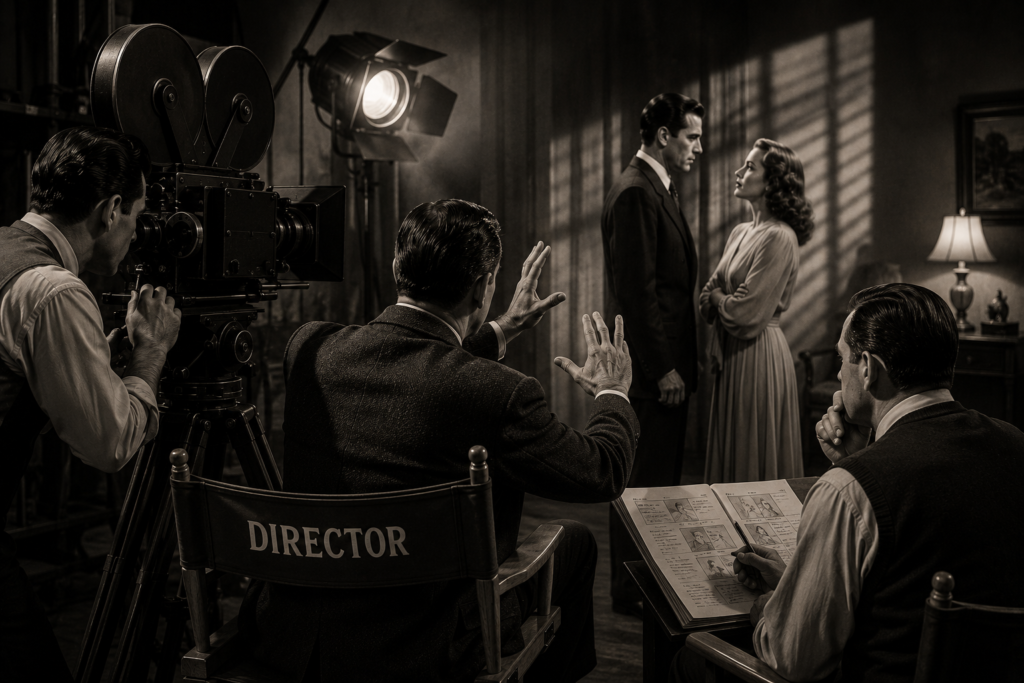
Hollywood filmmakers transformed censorship into opportunities for visual and narrative creativity.
This approach transformed censorship into an unexpected catalyst for creativity. Rather than telling viewers everything directly, filmmakers invited them to read between the lines, making imagination an essential part of the cinematic experience.
💬 Suggestive Dialogue and Double Meanings
One of the most effective ways filmmakers worked within the Hays Code was through carefully written dialogue.
Screenwriters became masters of subtext—conveying emotions, romantic attraction, or hidden intentions without stating them openly. Characters often spoke in ways that carried multiple meanings, allowing adult audiences to recognize implications that remained acceptable under the Code.
This clever use of language gave many Hollywood classics a sophistication that continues to be admired today. Instead of explicit conversations, audiences encountered witty exchanges filled with irony, humor, and emotional nuance.
🎭 Visual Symbolism and Implied Emotion
When filmmakers could not show certain events directly, they often suggested them through visual symbolism.
A closing door, a fading light, a train entering a tunnel, waves crashing against the shore, or two characters simply holding hands could communicate emotional or romantic developments without violating censorship rules.
Likewise, directors relied on facial expressions, lighting, music, and camera movement to convey tension, intimacy, or heartbreak. These visual cues encouraged audiences to interpret the story themselves, creating a more participatory viewing experience.
🎬 Smarter Screenwriting
Because many subjects could not be depicted openly, Hollywood writers learned to build drama through character development and carefully structured narratives.
Romantic relationships were often driven by meaningful conversations rather than explicit physical intimacy. Suspense grew from psychological conflict instead of graphic violence, while moral dilemmas became central to many films as characters struggled with difficult choices.
The result was storytelling that frequently emphasized wit, emotion, and character over spectacle.
🎥 Cinematic Techniques That Strengthened Storytelling
Directors also discovered that technical filmmaking choices could communicate ideas more powerfully than explicit scenes.
Creative editing suggested events occurring off-screen, while carefully composed shots directed viewers’ attention toward symbolic details rather than direct action. Lighting and shadows became especially important, particularly in film noir, where mystery and moral ambiguity were often expressed visually instead of verbally.
Music also played a crucial role. A dramatic musical score could heighten romance, suspense, or tragedy, allowing audiences to feel emotions that censorship rules prevented filmmakers from depicting directly.
🌟 Creativity Behind Some of Hollywood’s Greatest Classics
Many of the most celebrated films of Classical Hollywood demonstrate how artistic ingenuity flourished within the Code’s limitations.
In Casablanca (1942), emotional restraint and subtle dialogue deepen the relationship between Rick Blaine and Ilsa Lund, making their sacrifices even more powerful. Rather than relying on overt romance, the film communicates longing, regret, and devotion through glances, conversations, and unforgettable performances.
Alfred Hitchcock also became a master of suggestion. Films such as Notorious (1946) and Rear Window (1954) created suspense through camera angles, editing, and psychological tension rather than explicit violence or sensational imagery. Hitchcock repeatedly demonstrated that what audiences imagined could be more powerful than what they actually saw.
Film noir classics including Double Indemnity (1944) and The Big Sleep (1946) likewise used layered dialogue, shadows, and moral complexity to explore themes that could not always be addressed openly. Their sophisticated storytelling continues to influence filmmakers around the world.
🎞️ A Lasting Legacy of Creative Restraint
Ironically, the restrictions imposed by the Hays Code helped define the distinctive style of Classical Hollywood cinema.
Unable to rely on explicit content, filmmakers refined the art of suggestion, symbolism, and visual storytelling. Many techniques developed during this period—including subtle performances, carefully crafted dialogue, expressive cinematography, and psychological suspense—remain fundamental tools of filmmaking today.
While later generations would challenge the Code’s limitations, its influence on cinematic language endured long after the rules themselves disappeared. In many ways, the Hays Code shaped not only what audiences saw but also how Hollywood learned to tell stories with elegance, imagination, and emotional depth.
–– ✦ ✦ ––
🌟 Hollywood Classics That Worked Within the Hays Code
The influence of the Hays Code can be seen in hundreds of Hollywood productions, but some films stand out for the remarkable ways they balanced artistic ambition with strict censorship. Rather than allowing the Code to limit their creativity, many filmmakers transformed its restrictions into opportunities for more imaginative storytelling.
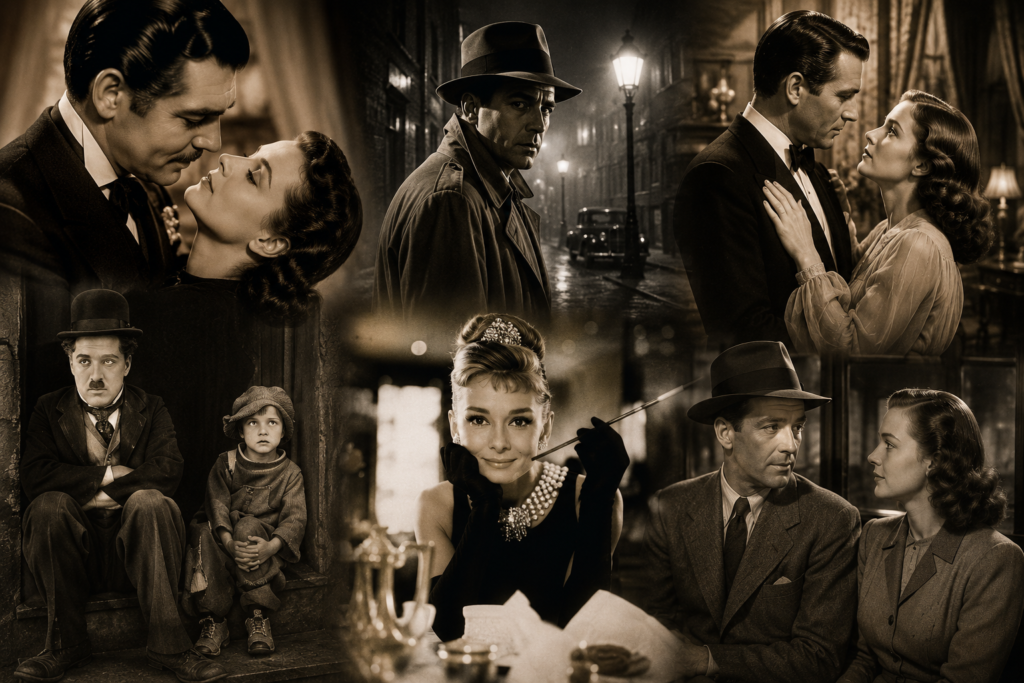
Many Hollywood classics found creative ways to tell powerful stories within the limits of the Production Code.
These classics continue to demonstrate how subtlety, symbolism, and emotional restraint often created a deeper impact than explicit content.
🎞️ Casablanca (1942): Love Through Restraint
Among the finest examples of Hays Code-era storytelling is Casablanca (1942).
The romantic relationship between Rick Blaine and Ilsa Lund unfolds through meaningful conversations, lingering glances, and emotional sacrifice rather than physical intimacy. Because the Production Code discouraged explicit depictions of adultery and romantic relationships outside marriage, the filmmakers relied on atmosphere, dialogue, and powerful performances to communicate the characters’ unresolved feelings.
Far from weakening the story, these limitations heightened its emotional impact. The famous farewell at the airport remains one of cinema’s most memorable scenes precisely because it emphasizes love, duty, and personal sacrifice instead of melodrama.
🕵️ Notorious (1946): Alfred Hitchcock Outsmarts the Code
Director Alfred Hitchcock repeatedly demonstrated that imagination could be more powerful than explicit depiction.
One of the most famous examples appears in Notorious (1946), where the Hays Code limited the length of on-screen kisses. Hitchcock responded by creating a sequence in which the two lead characters exchange a series of brief kisses while continuing their conversation and moving around the room.
Because no individual kiss exceeded the permitted duration, the scene technically complied with the Code while conveying remarkable intimacy. The result is widely regarded as one of the most inventive romantic sequences in Hollywood history.
Hitchcock’s solution perfectly illustrates how filmmakers learned to satisfy censors without sacrificing emotional authenticity.
🕶️ Double Indemnity (1944): Suggestion Over Sensation
Film noir offered another opportunity for directors and writers to work creatively within censorship rules.
In Double Indemnity (1944), themes of murder, greed, and betrayal are central to the story, yet the film avoids graphic violence and explicit sexuality. Instead, director Billy Wilder and screenwriter Raymond Chandler built suspense through carefully crafted dialogue, expressive lighting, and psychological tension.
The Code also required that wrongdoing should not ultimately be rewarded. As a result, the film’s conclusion reinforces moral accountability while preserving the dramatic power of the narrative.
This balance between artistic freedom and censorship became one of the defining characteristics of film noir.
👠 Some Like It Hot (1959): Comedy at the Edge of the Rules
By the late 1950s, some filmmakers had begun testing the limits of the Hays Code.
Billy Wilder’s Some Like It Hot (1959) explored themes of disguise, gender identity, romance, and sexuality with a boldness that would have been difficult to imagine twenty years earlier. Although the film remained within the Code’s formal requirements, its playful treatment of social conventions demonstrated that censorship was gradually losing its grip on Hollywood.
Its famous closing line—
“Nobody’s perfect.”
became one of the most celebrated endings in film history and symbolized the growing willingness of filmmakers to challenge traditional expectations with humor and sophistication.
🎬 Lessons from the Classics
These films reveal that the Hays Code did not simply restrict Hollywood—it also reshaped the language of cinema.
Unable to depend on explicit content, filmmakers refined the use of visual storytelling, layered dialogue, symbolic imagery, expressive performances, and carefully constructed narratives. Many of these techniques remain influential today, proving that creative limitations can sometimes inspire artistic innovation.
At the same time, these classics also illustrate the gradual weakening of the Code. By the late 1950s and early 1960s, directors increasingly explored subjects that would once have been considered unacceptable, signaling that Hollywood was entering a period of profound cultural change.
–– ✦ ✦ ––
📺 Why the Hays Code Began to Collapse
For more than three decades, the Hays Code shaped the stories Hollywood chose to tell and the way filmmakers told them. Yet as society evolved after World War II, audiences began seeking films that reflected changing attitudes toward culture, politics, and personal freedom. The Code, once regarded as the industry’s moral compass, increasingly appeared outdated in a rapidly changing world.
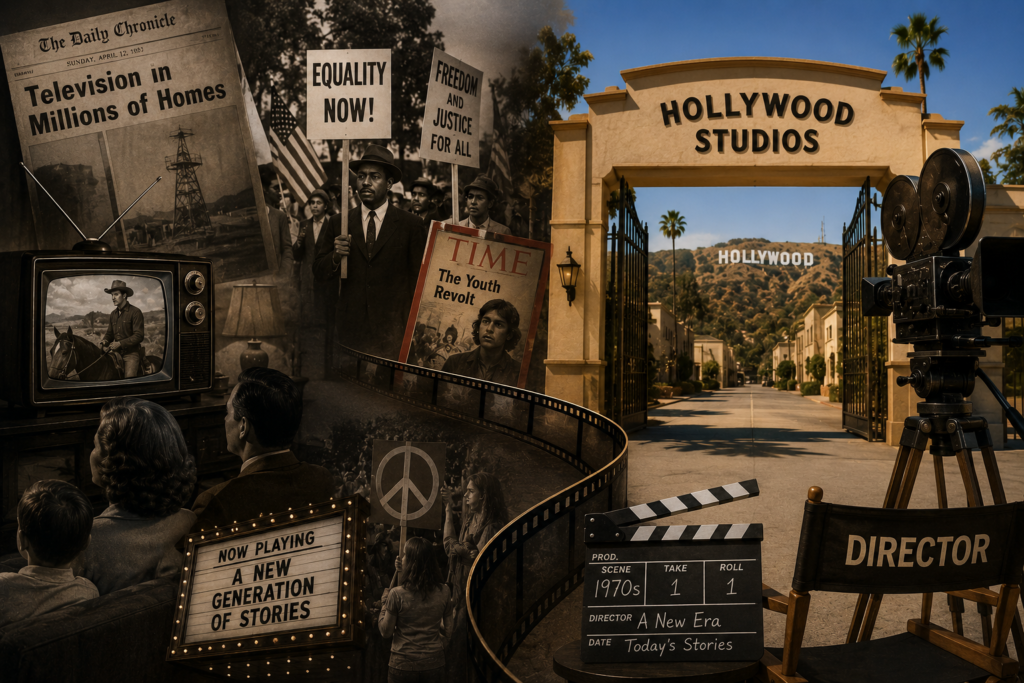
Changing audiences, television, legal decisions, and social change gradually weakened the Hays Code.
The stage was set for a dramatic transformation. The decline of the Hays Code would not happen overnight, but a series of legal decisions, social changes, and creative challenges gradually weakened its authority, leading Hollywood into a bold new era of filmmaking.
📺 Television Changed Entertainment
One of the biggest challenges came from the rapid rise of television during the 1950s.
As millions of American families began spending more evenings at home, movie attendance declined sharply. Hollywood studios responded by experimenting with widescreen formats, stereoscopic films, spectacular historical epics, and more ambitious storytelling to attract audiences back to theaters.
Many filmmakers believed the strict limitations of the Hays Code prevented them from exploring mature subjects that adult audiences increasingly wanted to see. The demand for more realistic stories slowly began to outweigh the industry’s commitment to rigid censorship.
🌍 Foreign Films Expanded Audience Expectations
At the same time, American audiences gained greater access to films from Europe and other parts of the world.
Italian Neorealist cinema, the French New Wave, and other international movements often dealt openly with themes such as war, poverty, relationships, and social change. Compared with many Hollywood productions, these films appeared more realistic and emotionally complex.
Their growing popularity demonstrated that audiences were willing to engage with challenging subjects, encouraging American filmmakers to question whether the Production Code still reflected contemporary society.
⚖️ Legal Decisions Weakened the Code’s Authority
Several important court rulings also reduced the influence of film censorship.
A major turning point came in 1952, when the United States Supreme Court, in the landmark case Joseph Burstyn, Inc. v. Wilson, ruled that motion pictures were protected by the First Amendment as a form of free expression.
The decision overturned the long-standing view that films were merely commercial products with limited constitutional protection. Although the ruling did not abolish the Hays Code, it significantly strengthened the legal position of filmmakers and made broad censorship increasingly difficult to justify.
🎬 Filmmakers Began Challenging the Rules
During the late 1950s and early 1960s, many directors and producers deliberately explored subjects that had previously been considered unacceptable.
Films addressed racial prejudice, political conflict, complex relationships, psychological trauma, and other mature themes with increasing confidence. Some productions were released without full Production Code approval, while others negotiated exceptions that would have been unthinkable a decade earlier.
As more successful films tested the boundaries of censorship, the authority of the Code continued to erode.
🌎 A Changing Society
Hollywood was also responding to profound cultural changes across American society.
The Civil Rights Movement, changing attitudes toward gender roles, the growth of youth culture, and wider discussions about individual freedom all influenced audience expectations. Viewers increasingly wanted films that reflected contemporary life rather than the moral assumptions of an earlier generation.
The social transformations of the 1960s made it increasingly difficult for a single set of censorship rules, written decades earlier, to represent the diversity of modern audiences.
🎞️ The End of an Era
By the mid-1960s, the Motion Picture Production Code had become increasingly inconsistent. Some films continued to follow its guidelines, while others received exceptions or challenged its restrictions directly.
Recognizing that the existing system could no longer meet the needs of filmmakers or audiences, Hollywood began searching for a new approach—one that would guide viewers without dictating creative content.
That solution arrived in 1968, when the long-standing Production Code was officially replaced by the Motion Picture Association of America (MPAA) film rating system. Rather than censoring films before release, the new system classified movies according to their suitability for different age groups, giving audiences and parents more information while allowing filmmakers far greater creative freedom.
The replacement of the Hays Code marked more than the end of a censorship system. It signaled the beginning of a new chapter in American cinema—one that paved the way for the bold storytelling, artistic experimentation, and cultural realism that would define the New Hollywood movement of the late 1960s and 1970s.
–– ✦ ✦ ––
🎞️ From the Hays Code to the Modern Film Rating System
The replacement of the Hays Code in 1968 marked one of the most significant turning points in Hollywood history. For nearly four decades, the Motion Picture Production Code had attempted to regulate what filmmakers could show on screen. The new system adopted a very different approach—not by censoring films before release, but by classifying them according to the age and maturity of their intended audience.
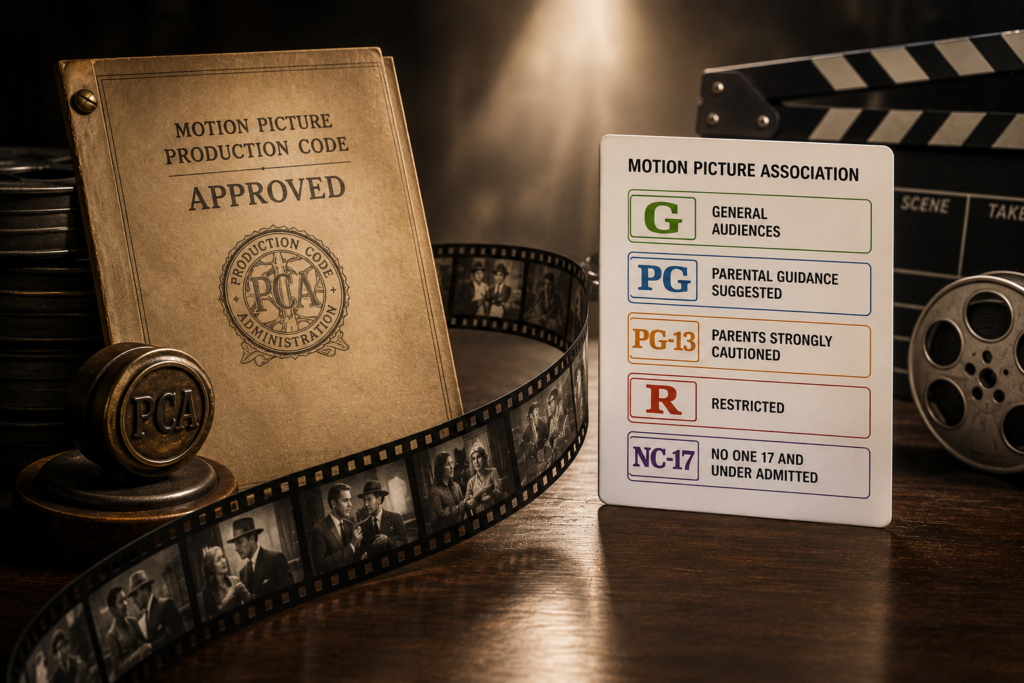
Hollywood replaced censorship with age-based film classification in 1968.
This change reflected a broader transformation in American society. Rather than expecting one set of moral guidelines to apply to every film and every viewer, Hollywood recognized that audiences had diverse expectations and that parents should play a central role in deciding what their children watched.
🎬 The Birth of the MPAA Rating System
In 1968, the Motion Picture Association of America (MPAA)—now known as the Motion Picture Association (MPA)—introduced a voluntary film rating system under the leadership of Jack Valenti, who had become president of the organization in 1966.
Instead of approving or rejecting films before release, the new system provided age-based guidance for audiences.
The original ratings included:
- G (General Audiences) – Suitable for viewers of all ages.
- M (Mature Audiences) – Suggested parental discretion for younger viewers. This rating was later revised and eventually became PG (Parental Guidance Suggested).
- R (Restricted) – Viewers under a specified age required a parent or guardian.
- X (Adults Only) – Intended for adult audiences and later replaced by the NC-17 rating in 1990 to distinguish mainstream adult films from pornography.
Although the categories have evolved over time, the central idea remains unchanged: to inform audiences rather than censor filmmakers.
⚖️ Censorship vs. Classification
The transition from the Hays Code to the rating system represented a fundamental philosophical shift.
Under the Hays Code, filmmakers often had to alter scripts, remove scenes, or rewrite endings before a movie could be released. The emphasis was on preventing audiences from seeing material considered morally objectionable.
The rating system adopted a different principle. Rather than determining what stories could be told, it focused on providing viewers—especially parents—with information about the nature of a film’s content. Directors and producers gained far greater creative freedom, while audiences were given the responsibility of choosing films appropriate for their age and preferences.
This approach allowed Hollywood to explore a wider range of themes, including complex social issues, psychological realism, political conflict, and mature relationships, without being bound by a single set of universal moral standards.
🌍 A Lasting Influence Beyond Hollywood
The success of the American rating system influenced film industries around the world.
Many countries gradually moved away from broad censorship models and adopted age-based classification systems of their own. While the details vary from nation to nation, the underlying principle is similar: provide guidance to audiences instead of imposing blanket restrictions on artistic expression.
Today, film classification boards continue to balance creative freedom with public concerns, reflecting changing social values while helping viewers make informed choices.
🎥 From Regulation to Creative Freedom
The end of the Hays Code opened the door to a new generation of filmmakers.
Directors such as Martin Scorsese, Francis Ford Coppola, Steven Spielberg, George Lucas, and many others emerged during the New Hollywood era with greater freedom to explore mature characters, moral ambiguity, realistic violence, and contemporary social issues. Films became more diverse in style, subject matter, and artistic expression than had been possible under the Production Code.
Yet many storytelling techniques refined during the Hays Code era—subtle dialogue, visual symbolism, and emotional restraint—continued to influence filmmakers long after censorship had ended.
In this way, the Hays Code left behind a complex legacy. Although its rules disappeared, its impact on cinematic storytelling remained woven into the language of Hollywood itself.
📊 Hays Code vs. Modern Film Rating System
| Hays Code (1930–1968) | Modern Film Rating System (1968–Present) |
|---|---|
| Regulated film content before release | Classifies films by audience suitability |
| One moral standard for all viewers | Different ratings for different age groups |
| Studios often modified films to obtain approval | Filmmakers retain greater creative freedom |
| Focused on restricting objectionable content | Focuses on informing audiences and parents |
| Approval was expected for wide theatrical release | Ratings help viewers make informed choices |
–– ✦ ✦ ––
🕰️ The Legacy of the Hays Code
The Hays Code remains one of the most influential—and most debated—chapters in the history of Hollywood. For nearly four decades, it shaped not only what audiences saw on screen but also how filmmakers approached storytelling, character development, and visual expression.
To some, the Code represented an era of excessive censorship that limited artistic freedom and prevented Hollywood from addressing important social issues openly. Its restrictions affected the portrayal of romance, race, gender, crime, and many aspects of human experience, reflecting the cultural attitudes and prejudices of its time. From today’s perspective, several of its provisions are rightly viewed as outdated and discriminatory.
At the same time, many film historians argue that the Code also encouraged remarkable creativity. Unable to rely on explicit content, directors and screenwriters developed sophisticated techniques of visual storytelling, subtle dialogue, symbolic imagery, and emotional restraint. These methods helped define the distinctive style of Classical Hollywood cinema and continue to influence filmmakers around the world.
Perhaps the Hays Code’s greatest historical significance lies in what it reveals about the relationship between cinema and society. Films do not exist in isolation; they are shaped by the cultural values, political debates, and public expectations of their time. As society changed, Hollywood changed with it. The transition from the Hays Code to the modern rating system reflected not only a transformation within the film industry but also a broader shift in how audiences viewed artistic expression, personal responsibility, and freedom of choice.
Today, discussions about film content, age ratings, streaming platforms, and creative freedom continue around the world. Although the Production Code itself disappeared decades ago, the questions it raised—about censorship, artistic responsibility, and the influence of cinema—remain as relevant as ever.
Understanding the Hays Code is therefore about more than studying an old rulebook. It offers a window into the evolution of Hollywood, the changing values of society, and the enduring power of cinema to reflect, challenge, and inspire audiences across generations.
The story of the Hays Code is ultimately not just one of censorship, but of adaptation. It reminds us that some of Hollywood’s greatest filmmakers transformed limitations into opportunities, proving that creativity often flourishes even within the strictest boundaries. Their legacy continues to shape the art of filmmaking long after the Code itself became history.
–– ✦ ✦ ––
❓ Frequently Asked Questions (FAQs)
What Was the Hays Code?
The Hays Code, officially known as the Motion Picture Production Code, was a set of self-imposed guidelines that governed the content of Hollywood films from 1930 to 1968. It regulated how topics such as crime, violence, romance, sexuality, and morality could be portrayed on screen, with strict enforcement beginning in 1934.
Why was it called the Hays Code?
The Code was named after Will H. Hays, the president of the Motion Picture Producers and Distributors of America (MPPDA). Although Hays did not write the Code himself, he played a key role in promoting Hollywood’s self-regulation to improve the industry’s public image and avoid direct government censorship.
Who actually wrote the Motion Picture Production Code?
The Production Code was primarily drafted by Martin Quigley, a film publisher, and Father Daniel A. Lord, a Jesuit priest. Their work formed the basis of the censorship guidelines adopted by the Hollywood film industry in 1930.
Why did Hollywood create the Hays Code?
Hollywood introduced the Hays Code in response to growing public criticism, high-profile scandals involving film personalities, pressure from religious and civic organizations, and the threat of government censorship. The industry chose self-regulation as a way to maintain public confidence while preserving creative independence.
When did the Hays Code end, and what replaced it?
The Hays Code was officially replaced in 1968 by the MPAA film rating system (now administered by the Motion Picture Association (MPA)). Unlike the Production Code, the rating system classifies films according to their suitability for different age groups instead of censoring their content before release.
Did the Hays Code stop filmmakers from being creative?
Not entirely. While the Code imposed significant restrictions, many directors and screenwriters responded with remarkable creativity. They used symbolism, visual storytelling, witty dialogue, and implied meaning to tell compelling stories, producing many classics of Hollywood’s Golden Age despite the limitations.
Why is the Hays Code still important today?
The Hays Code remains an important part of film history because it influenced nearly four decades of Hollywood filmmaking and shaped the evolution of cinematic storytelling. It also provides valuable insight into how changing social values, censorship, and artistic freedom have influenced the development of the modern film industry.
–– ✦ ✦ ––
🎬 Final Thoughts
The Hays Code profoundly influenced the course of American cinema, leaving its mark on thousands of films produced between the 1930s and the late 1960s. While its restrictions reflected the moral standards of its era, its legacy extends far beyond censorship. It shaped the language of cinematic storytelling, challenged filmmakers to innovate within constraints, and contributed to the transition that eventually led to the modern film rating system that continues to guide audiences today.
Whether viewed as a safeguard of public values or a constraint on artistic freedom, the Hays Code in Hollywood remains essential to understanding the history of American cinema. Its rise, influence, and eventual decline reveal how cinema evolves alongside society—continually negotiating the relationship between creativity, social responsibility, and changing audience expectations.
As you revisit the timeless classics of Classical Hollywood, you’ll notice that many of their most memorable moments were created not simply in spite of the Hays Code, but by filmmakers working creatively within its limitations. That enduring dialogue between restriction and imagination is one of the reasons these films continue to captivate audiences around the world.
The history of the Hays Code still helps us understand how the relationship between censorship, social values, and creative freedom has evolved over time.
📖 Sources & Further Reading
- Motion Picture Association (official website)
- Library of Congress – National Film Registry & American film history resources
📚 Continue Your Journey Through Hollywood History
If you enjoyed learning about the Hays Code, continue your journey through Hollywood’s evolution with these related articles:
- 🎥 Hollywood’s Silent Era & The Rise of the Studio System (1910s–1920s) – Discover how the studio system laid the foundation for Hollywood’s Golden Age.
- ⭐ The Golden Age of Hollywood (1930s–1950s) – Explore the era in which the Hays Code had its greatest influence.
- 🎞️ Casablanca (1942): Where Every Goodbye Is a Beginning – See how one of Hollywood’s greatest classics balanced romance and restraint under the Production Code.
- 🎬 History of the Academy Awards: From 1929 to the Present – Learn how Hollywood’s most prestigious awards evolved alongside the industry’s changing values.
- 🎭 New Hollywood & Counterculture Cinema: The Director’s Era (1960s–1980s) – Discover how the decline of the Hays Code opened the door to a new generation of filmmakers.
🌐 Prefer reading this article in Hindi?
👉 Read:
हेज़ कोड का इतिहास: कैसे सेंसरशिप ने क्लासिकल हॉलीवुड को आकार दिया
🔖 External sources are referenced for educational and historical context. All content rights and credits belong to their respective owners.