
The evolution of a regional powerhouse—from New Wave experimentation to global recognition.
ENG | हिंदी
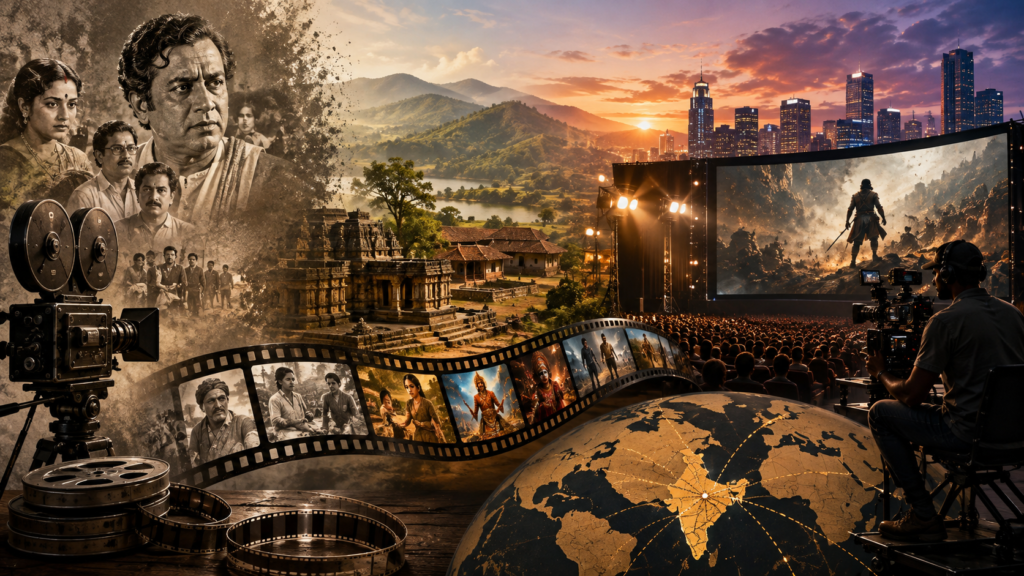
Kannada cinema’s journey from the experimental New Wave of the 1970s to its contemporary national and global reach.
When Kannada cinema broke away from formula, it discovered a new cinematic language—and eventually found an audience far beyond Karnataka.
Kannada cinema has never been only about entertainment. Over the decades, it has reflected the language, literature, social realities, cultural identity, and changing aspirations of Karnataka. But one of its most significant transformations came with the Kannada New Wave of the 1970s, when filmmakers began challenging conventional storytelling and bringing a more personal, realistic, and intellectually ambitious approach to the screen.
This movement did more than produce acclaimed films. It changed the way Kannada stories could be told. For the broader story of Kannada cinema—from its early foundations and studio culture to its modern revival—see our Kannada Cinema History.
From the radical experiments of the 1970s to the new generation of filmmakers working in the 2000s and the nationwide success of films such as KGF, Kantara, and 777 Charlie, Kannada cinema has repeatedly reinvented itself. Its journey shows how a regional film industry can preserve its cultural identity while reaching audiences far beyond its linguistic boundaries.
📑 In This Article
🔍 Quick Facts: Kannada Cinema’s New Wave to Global Era
- Major turning point: The 1970s Kannada New Wave
- Key creative forces: Girish Karnad, B. V. Karanth, Pattabhirama Reddy, Girish Kasaravalli, Puttanna Kanagal, and others
- Landmark early New Wave film: Samskara (1970)
- Important literary connection: Kannada novels, short stories, and plays became important sources for serious cinema.
- New Wave characteristics: Realism, social observation, experimentation, literary adaptation, and unconventional characters
- Later transformation: New generations of filmmakers blended artistic ambition with popular storytelling.
- Modern breakthrough: Films such as KGF, Kantara, and 777 Charlie helped Kannada cinema reach audiences across India and internationally.
- Cultural strength: Kannada cinema continues to combine local stories and traditions with themes that can travel across languages and borders.
–– ✦ ✦ ––
🎬 The Kannada New Wave: When Cinema Found a New Voice
The transformation of Kannada cinema in the 1970s did not happen in isolation. Across India, filmmakers were exploring alternatives to formula-driven commercial cinema. The emerging Indian New Wave, also associated with parallel cinema, encouraged directors to experiment with realism, social themes, literary material, and new cinematic forms. The Kannada movement emerged as one of the most distinctive regional expressions of this wider transformation in Indian filmmaking, when New Wave cinema and parallel films began challenging conventional storytelling across the country.
The arrival of Samskara in 1970 is widely regarded as a landmark in the Kannada New Wave. Directed by Pattabhirama Reddy and based on U. R. Ananthamurthy’s celebrated novel, the film confronted questions of caste, orthodoxy, morality, and social change rather than relying on conventional commercial formulas. It won the President’s Golden Lotus Award, bringing major national recognition to Kannada cinema.
What followed was not simply a collection of art films. It was a change in cinematic thinking.
Filmmakers increasingly asked different questions:
Could cinema examine society rather than merely entertain it? Could a regional film be deeply rooted in Kannada culture while also speaking to universal human concerns?
The Kannada New Wave answered both questions with confidence.
–– ✦ ✦ ––
🌱 Samskara: The Film That Changed Kannada Cinema
The success and influence of Samskara helped create an environment in which filmmakers could experiment with form and subject matter.
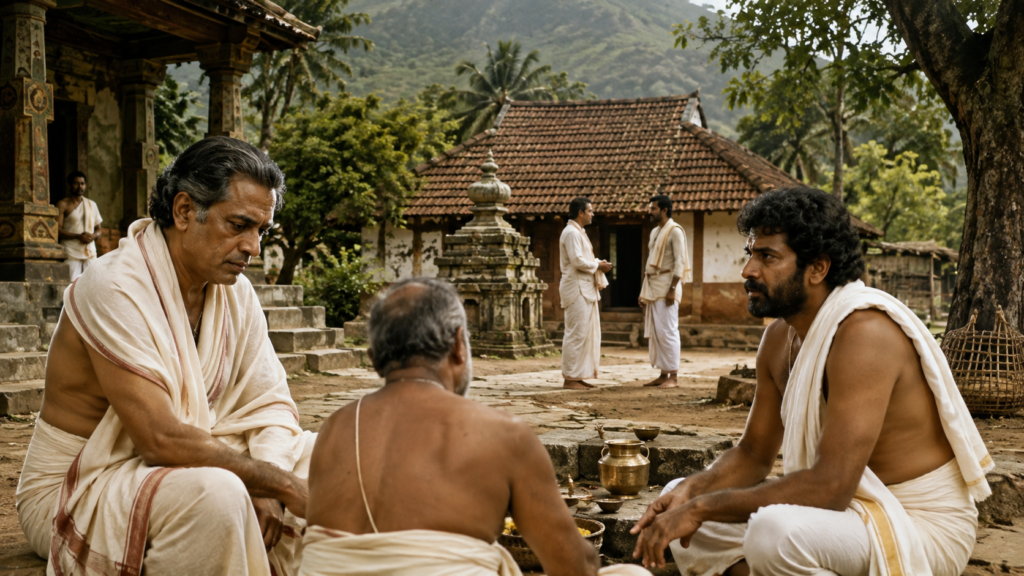
“Samskara” became a landmark of the Kannada New Wave and a turning point in regional Indian cinema.
Samskara was significant not simply because it was based on a literary work. Its strength also lay in the way it presented serious social and moral questions through its characters, relationships, and social environment rather than as direct commentary. The tensions between tradition and change, individual belief and social pressure, and personal choice and moral responsibility became part of the film’s dramatic fabric. This approach demonstrated that Kannada cinema could remain deeply rooted in its own social and cultural realities while addressing profound human questions with universal relevance.
Vamsha Vriksha (1971), directed by Girish Karnad and B. V. Karanth and based on S. L. Bhyrappa’s novel, continued the movement toward literary and psychologically complex storytelling. The film explored family, tradition, morality, and generational conflict while demonstrating how a literary adaptation could become genuinely cinematic rather than simply transferring a novel to the screen.
Other films of the period expanded the possibilities further.
The New Wave filmmakers were interested in ordinary people, social structures, rural life, personal conflicts, and moral ambiguity. Their protagonists did not always fit the traditional image of the larger-than-life film hero.
This was a cinema of observation rather than exaggeration.
The camera could linger on a face, a landscape, a village, a household, or a moment of silence. The absence of conventional spectacle itself became a creative choice.
–– ✦ ✦ ––
🎭 New Wave Filmmakers and a New Cinematic Language
The 1970s became one of the most important creative decades in Kannada cinema.
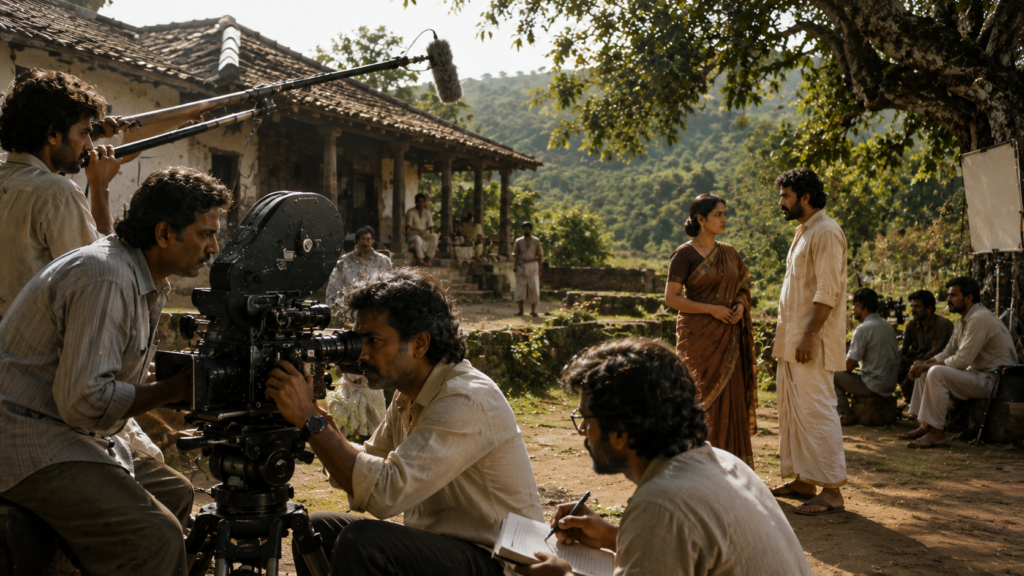
The Kannada New Wave brought realism, social observation, literary influence, and experimentation to the screen.
Girish Karnad, B. V. Karanth, Girish Kasaravalli, Pattabhirama Reddy, and other filmmakers helped establish a cinema that could be intellectually demanding without losing its connection to Karnataka’s cultural landscape.
Girish Kasaravalli became particularly important to the development of Kannada art cinema. His Ghatashraddha (1977), for example, explored social exclusion and tradition through a deeply human story. The film became another important landmark in the New Wave tradition.
The movement also demonstrated that Kannada cinema could engage with serious themes without abandoning visual storytelling.
Caste, class, gender, tradition, modernity, family structures, rural life, and individual freedom could all become subjects of cinema.
This gave Kannada filmmaking a distinctive identity within India’s wider parallel cinema movement.
–– ✦ ✦ ––
📚 When Kannada Literature Met the Camera
One of the defining characteristics of the Kannada New Wave was its close relationship with literature.
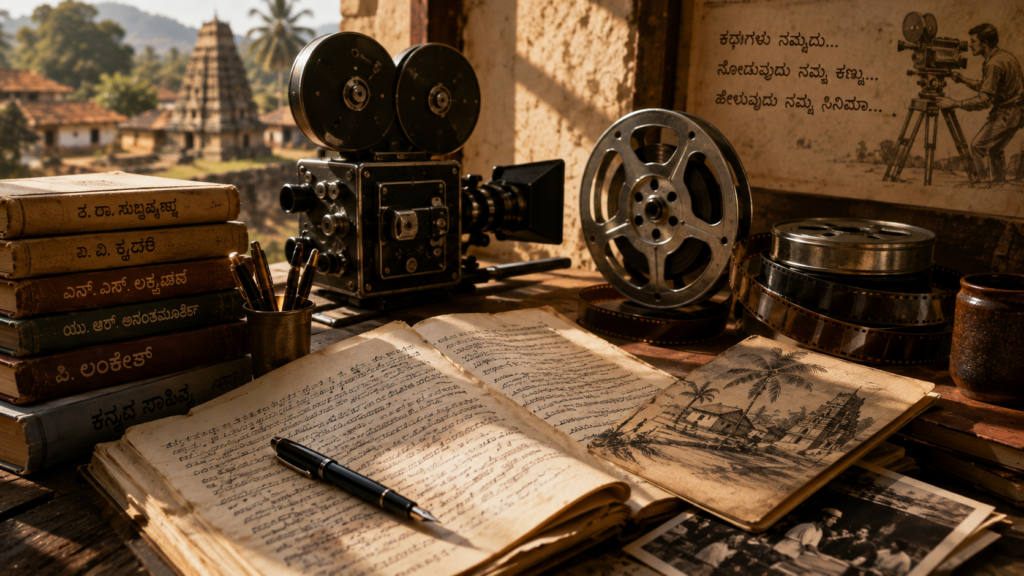
Kannada literature provided New Wave filmmakers with complex stories, characters, and social themes.
Kannada literature had a rich tradition of novels, short stories, theatre, poetry, and social commentary. Filmmakers drew upon this literary culture to create stories with greater psychological and social depth.
This relationship worked in both directions.
Literature provided filmmakers with complex characters and ideas, while cinema introduced those ideas to audiences through a different visual language.
Films such as Samskara and Vamsha Vriksha demonstrated how Kannada literature could become the foundation for ambitious filmmaking.
The result was a distinctive cinematic culture in which the boundary between literary storytelling and visual storytelling became increasingly fluid.
–– ✦ ✦ ––
🌾From Parallel Cinema to a Broader Kannada Film Culture
Kannada cinema’s evolution cannot be understood only through its New Wave.
While art-house filmmakers were experimenting with realism and literary narratives, mainstream Kannada cinema continued to develop its own traditions of stars, music, romance, action, comedy, family drama, and popular storytelling.
This created an interesting duality.
On one side was cinema driven by experimentation and social observation.
On the other was a popular film culture capable of creating enormous stars and deeply devoted audiences.
Rather than remaining permanently separate, these traditions increasingly influenced each other.
The result was a Kannada film industry in which filmmakers could move between intimate storytelling and large-scale popular cinema.
That flexibility would become especially important in the decades that followed.
–– ✦ ✦ ––
🔄 Kannada Cinema in Transition: The 1990s and Early 2000s
After the extraordinary creative energy of the 1970s and 1980s, Kannada cinema entered periods of uncertainty and transition.
The industry faced changing audience expectations, competition from films in other Indian languages, shifts in theatrical culture, and changing patterns of film production and distribution.
Yet the creative tradition established by earlier filmmakers did not disappear.
Instead, it remained part of the industry’s cultural memory.
A younger generation began looking for new ways to tell Kannada stories—sometimes rejecting older formulas, sometimes reworking them, and often combining local identity with contemporary urban experiences.
The transformation became particularly visible in the 2000s.
–– ✦ ✦ ––
🚀 The New Wave of the New Millennium
The phrase New Wave can also be applied to a later generation of Kannada filmmakers who began challenging established commercial formulas in the 2000s.
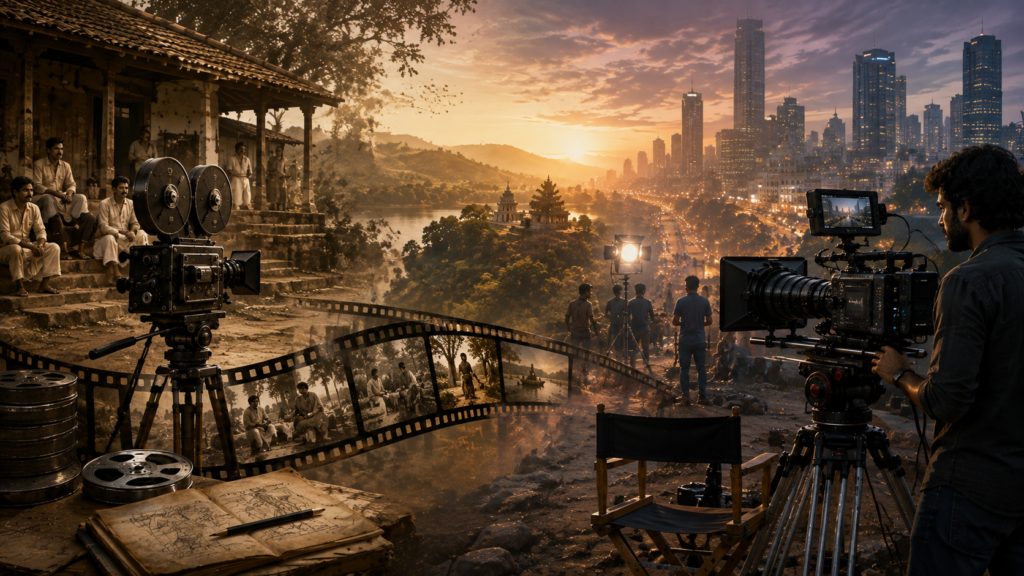
New generations of Kannada filmmakers blended contemporary storytelling with the industry’s distinctive cultural identity.
This newer movement was different from the 1970s parallel cinema.
The filmmakers were working in a changed media environment. Audiences were increasingly exposed to cinema from across India and the world, while new technologies and changing production methods opened additional creative possibilities.
Films could be experimental and accessible at the same time.
A notable example was Mungaru Male (2006), directed by Yogaraj Bhat. Its success demonstrated that Kannada cinema could achieve major popular appeal through contemporary storytelling without simply copying the formulas of other industries.
The film also became an important milestone in the careers of a new generation of Kannada performers and filmmakers.
The broader significance of this period was the renewed confidence it gave the industry: Kannada stories could succeed on their own terms.
–– ✦ ✦ ––
🌆 New Stories, New Filmmakers, New Audiences
The Kannada cinema of the 2000s and 2010s increasingly reflected a changing Karnataka.
Urbanization, youth culture, relationships, migration, technology, regional identity, and changing social attitudes became part of contemporary storytelling.
At the same time, filmmakers continued to draw upon Karnataka’s landscapes, folklore, history, traditions, and local communities.
This combination of local specificity and contemporary storytelling became one of the industry’s greatest strengths.
Kannada cinema no longer needed to choose between being deeply regional and being modern.
It could be both.
–– ✦ ✦ ––
🌍 KGF and the Rise of Pan-Indian Kannada Cinema
The biggest transformation came when Kannada films began reaching audiences well beyond Karnataka on an unprecedented scale.
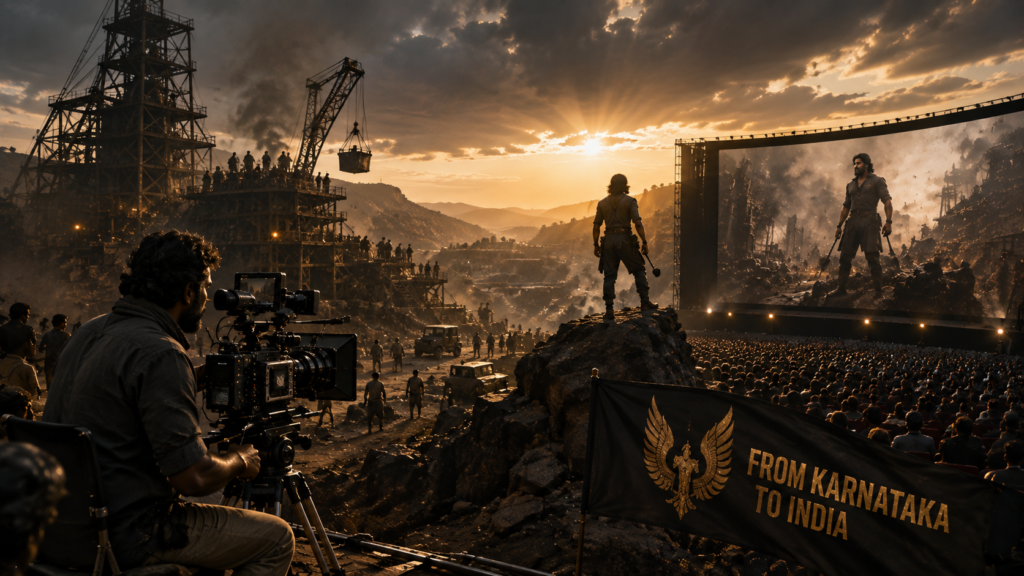
“KGF” helped demonstrate the potential of Kannada cinema to reach audiences far beyond Karnataka.
The success of KGF: Chapter 1 (2018) and KGF: Chapter 2 (2022) demonstrated the commercial possibilities of a Kannada-language film built as a large-scale cinematic event. The films were also part of the broader transformation of Indian cinema, as blockbuster filmmaking increasingly embraced scale, spectacle, and nationwide audiences.
The films’ nationwide reach helped place Kannada cinema more prominently in India’s pan-Indian film conversation. More importantly, they showed that language was not necessarily a barrier when a film combined compelling characters, strong visual storytelling, scale, and an easily communicable emotional core.
The success of Kantara (2022) added another dimension.
Instead of depending primarily on an urban or cosmopolitan identity, the film drew heavily upon Karnataka’s regional traditions and folklore while connecting with audiences far beyond the state.
This was an important lesson in the evolution of regional cinema:
Local culture could become a source of global appeal rather than a limitation.
–– ✦ ✦ ––
🔥 Kantara, 777 Charlie, and the Power of Local Stories
The contemporary Kannada film movement cannot be reduced to a few successful blockbusters, but films such as KGF and Kantara became important cultural markers.
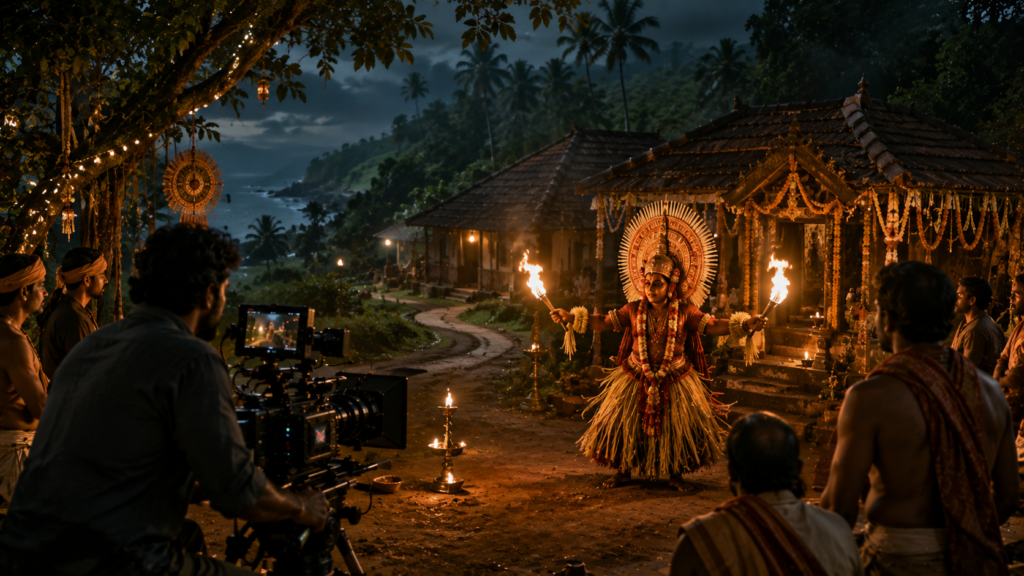
“Kantara” showed how deeply local culture and traditions could become the foundation of a film with nationwide appeal.
KGF demonstrated the power of scale and cinematic spectacle.
Kantara demonstrated the power of cultural specificity.
777 Charlie showed another path, combining an emotional human-animal relationship with a contemporary road-story format and reaching audiences outside Karnataka.
Together, such films contributed to a broader perception of Kannada cinema as an industry capable of producing different kinds of nationally visible films. Contemporary reporting has highlighted how films including KGF 2, Kantara, 777 Charlie, and other recent Kannada productions have helped carry Kannada storytelling to audiences beyond the traditional regional market.
The transformation was therefore not simply commercial.
It was also about confidence.
Kannada cinema increasingly began presenting itself not as a smaller version of another Indian industry, but as a distinctive cinematic culture with its own stories, aesthetics, stars, filmmakers, and traditions.
–– ✦ ✦ ––
🌐 From Regional Roots to a Global Audience
The international journey of Kannada cinema did not begin with the recent blockbuster era.
The New Wave had already demonstrated that Kannada films could receive national and international critical attention. The movement’s literary depth, realism, and formal experimentation helped establish Kannada cinema as an important part of India’s serious film culture.
What changed in the contemporary era was the scale of visibility.
Streaming platforms, digital distribution, subtitles, dubbed versions, social media, and pan-Indian theatrical releases have made regional films much easier for audiences outside Karnataka to discover.
A viewer who might once have encountered Kannada cinema only through a festival or specialist screening can now discover a Kannada film through a streaming platform or a nationwide theatrical release. This transformation is part of the larger story of India’s regional film industries, each shaped by its own language, culture, and storytelling traditions.
That has fundamentally changed the relationship between regional cinema and the world.
–– ✦ ✦ ––
🧭 Two Waves, One Continuing Tradition
To see how the evolution of Kannada cinema fits into the larger story of Indian filmmaking, explore our Indian Cinema Timeline, which traces the journey from silent films and parallel cinema to regional cinema, pan-Indian films, and streaming.
The 1970s Kannada New Wave and the contemporary Kannada revival are separated by decades, technologies, audiences, and filmmaking styles.
Yet they share an important idea:
Kannada cinema becomes strongest when it trusts its own identity.
The filmmakers of the 1970s looked inward—to Kannada literature, society, rural life, moral questions, and cultural traditions—to create cinema that could stand alongside the best of India’s parallel cinema.
The newer generation has often looked both inward and outward, combining Karnataka’s cultural landscape with genres and storytelling techniques that can travel across India and beyond.
The methods changed.
The ambition remained.
–– ✦ ✦ ––
⭐ Why the Kannada New Wave Still Matters Today
The importance of the Kannada New Wave goes beyond the films of a particular decade.
It helped establish several principles that remain relevant today:
- Regional stories can have universal emotional power.
- Literature can enrich cinematic storytelling.
- Realism and experimentation can coexist with audience appeal.
- Local culture can become a cinematic strength.
- A regional industry does not have to imitate larger industries to gain recognition.
These ideas can be seen in different forms throughout contemporary Kannada cinema.
The connection between the past and present is therefore more than historical.
It is creative.
–– ✦ ✦ ––
🏆 Kannada Cinema: A Regional Powerhouse on the Global Stage
Kannada cinema’s journey from the New Wave to the global stage is ultimately a story of reinvention.
The filmmakers of the 1970s challenged conventions and expanded the artistic possibilities of Kannada storytelling. Later generations adapted those lessons to changing audiences, technologies, and commercial realities.
Today, Kannada cinema can move confidently between intimate dramas, literary adaptations, experimental films, folklore-based stories, contemporary urban narratives, action spectacles, and large-scale pan-Indian productions.
Its greatest achievement may be that these different traditions can coexist.
From Samskara to Vamsha Vriksha, from the New Wave filmmakers to the contemporary generation, and from regional audiences to viewers around the world, Kannada cinema has repeatedly shown that a story does not have to lose its roots in order to travel far.
Its evolution is not a journey away from regional identity.
It is a journey in which regional identity became one of its greatest cinematic assets.
–– ✦ ✦ ––
⚡ Boost FAQs: Quick Answers
What was the Kannada New Wave?
The Kannada New Wave was a major movement, particularly associated with the 1970s, that brought greater realism, literary influence, social commentary, and experimentation to Kannada filmmaking.
Which film is considered a landmark of the Kannada New Wave?
Samskara (1970), directed by Pattabhirama Reddy and based on U. R. Ananthamurthy’s novel, is widely regarded as one of the movement’s foundational films.
Who were important Kannada New Wave filmmakers?
Important figures included Pattabhirama Reddy, Girish Karnad, B. V. Karanth, Girish Kasaravalli, and other filmmakers who helped establish Kannada cinema’s parallel and art-film tradition.
How did literature influence Kannada cinema?
Kannada novels, short stories, and plays provided filmmakers with complex characters, social themes, and narratives that could be adapted into serious and innovative cinema.
When did Kannada cinema begin gaining major pan-Indian attention?
Kannada cinema had received national and international recognition much earlier, but the large-scale pan-Indian success of films such as KGF and Kantara significantly expanded its contemporary visibility.
Why is Kantara important to Kannada cinema?
Kantara demonstrated that a story deeply rooted in Karnataka’s traditions and cultural landscape could connect with audiences far beyond the state.
What makes modern Kannada cinema different?
Modern Kannada cinema combines regional identity with diverse genres, contemporary storytelling, technological innovation, and increasingly ambitious national and international distribution.
–– ✦ ✦ ––
🎯 Conclusion
Kannada cinema’s story is not simply a journey from regional filmmaking to global success.
It is a story of continuous reinvention.
The New Wave of the 1970s changed what Kannada cinema could say and how it could say it. Later filmmakers inherited that spirit of experimentation while responding to new audiences and new technologies. The contemporary era has taken that confidence further, proving that films rooted in Karnataka can reach audiences across India and around the world.
The real achievement is not that Kannada cinema has become more visible.
It is that Kannada cinema has become more visible without becoming less Kannada.
And perhaps that is the most important lesson of its evolution: in cinema, the strongest journey to the world often begins by telling your own story with conviction.
–– ✦ ✦ ––
❓ Key Questions & Insights
From the Kannada New Wave to KGF and Kantara, the evolution of Kannada cinema reveals a fascinating continuity: innovation changes with every generation, but cultural identity remains at its core.
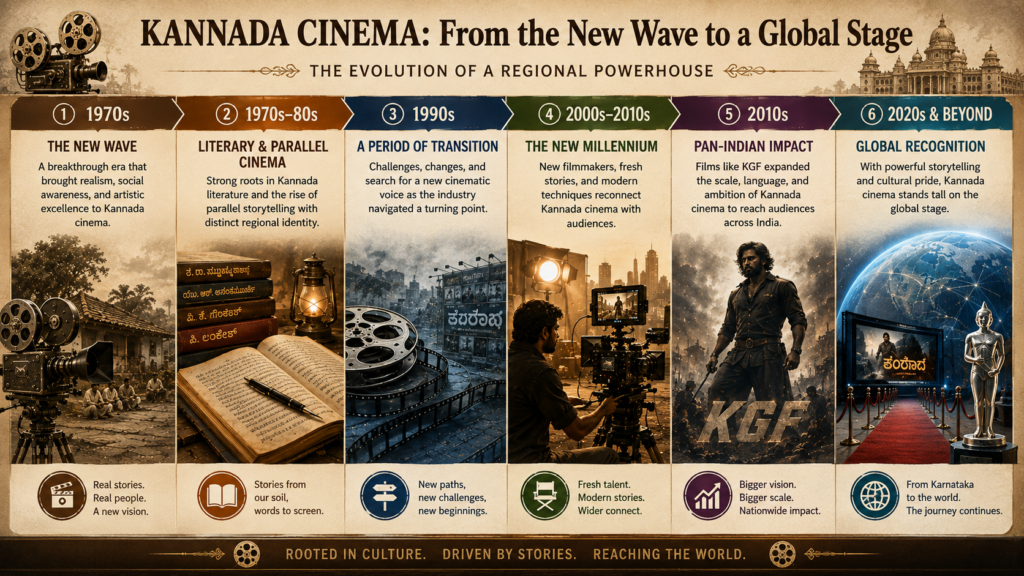
A visual timeline tracing Kannada cinema’s journey from the New Wave of the 1970s to its contemporary national and global presence.
Key Takeaways
- The 1970s Kannada New Wave transformed the industry’s artistic possibilities.
- Samskara became a landmark for socially engaged and literary Kannada cinema.
- Kannada literature played a major role in shaping serious filmmaking.
- Later generations developed new forms of storytelling rather than simply repeating the New Wave.
- The 2000s brought a fresh wave of experimentation and popular cinema.
- KGF, Kantara, and other contemporary films expanded Kannada cinema’s national visibility.
- Digital platforms and pan-Indian distribution have made Kannada films increasingly accessible to international audiences.
- The industry’s greatest strength remains its ability to combine local culture with universal storytelling.
Kannada cinema did not reach the wider world by leaving Karnataka behind. It reached the world by making Karnataka part of the story.
If you want to test what you’ve learned about the industry’s history and milestones, try our Kannada Cinema GK MCQs for a quick knowledge check.
🌐 Read in Hindi
Prefer reading this article in Hindi?
👉 हिंदी में पढ़ें:
कन्नड़ सिनेमा: न्यू वेव से वैश्विक मंच तक
This version of the article offers the same depth, perspective, and storytelling.
🔖 External sources are referenced for educational and historical context. All content rights and credits belong to their respective owners.