
When regional stories crossed borders and changed the scale, language, and imagination of Indian cinema.
ENG | हिंदी
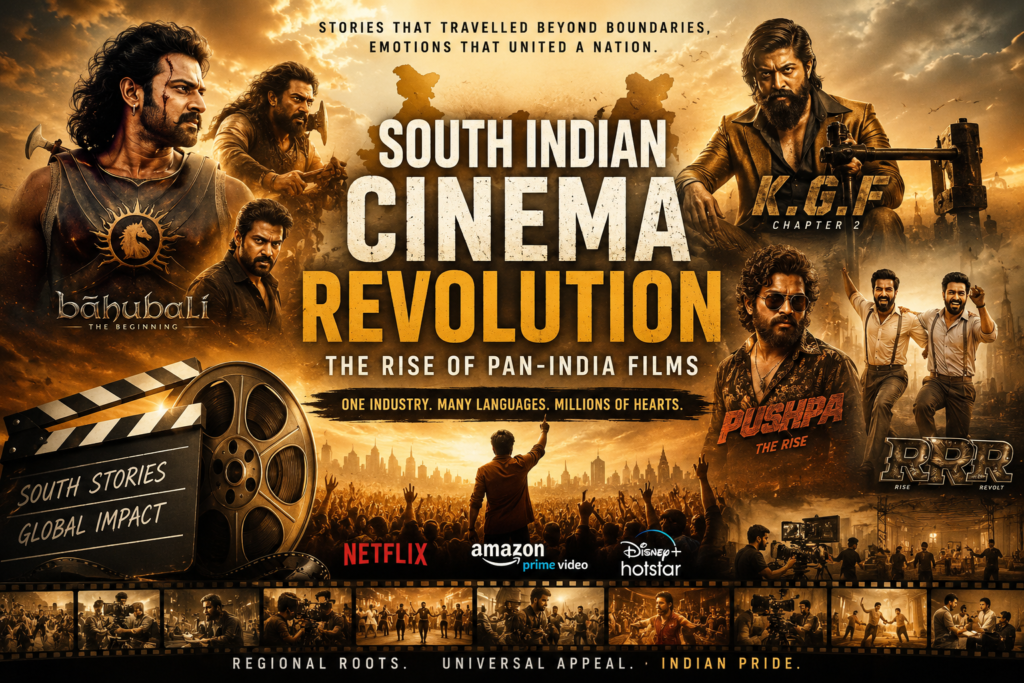
The South Indian cinema revolution transformed regional storytelling into a nationwide cinematic phenomenon.
From Telugu spectacle and Tamil mass cinema to Kannada blockbusters and Malayalam storytelling, South Indian films expanded beyond regional markets to redefine what a nationwide Indian film could be.
The South Indian cinema revolution transformed the landscape of Indian cinema in ways that would have seemed difficult to imagine just a few decades ago. For years, Bollywood dominated the national conversation around Indian films, while regional industries were often discussed primarily within their own linguistic and cultural markets.
That balance began to change dramatically during the 2010s and 2020s. Telugu, Tamil, Kannada, and Malayalam films increasingly crossed linguistic and regional boundaries, reaching audiences across India and, in some cases, gaining significant international recognition. Powerful storytelling, emotionally rooted narratives, large-scale action and spectacle, technological innovation, dubbing and wider distribution, and the rapid growth of streaming platforms all contributed to this transformation.
Films such as Baahubali, KGF, Pushpa, and RRR became highly visible examples of this shift. Their success demonstrated that films rooted in regional languages and cultures could attract audiences far beyond their traditional markets and compete for attention on a national—and increasingly global—stage.
But the South Indian cinema revolution was about more than a succession of blockbuster films. It challenged long-standing assumptions about the centre and periphery of Indian filmmaking, expanded the idea of “pan-India” cinema, and changed how audiences, distributors, and the wider film industry viewed regional-language films.
This article traces how South Indian regional cinema grew into a powerful pan-India phenomenon, how its major industries helped reshape contemporary Indian filmmaking, and why this transformation continues to influence the stories, stars, production ambitions, and audience expectations of modern Indian cinema.
📑 In This Article
🌟 Quick Facts & Insights — South Indian Cinema Revolution
The films, technologies, audiences, and changing industry dynamics behind a major shift in modern Indian cinema.
The South Indian cinema revolution was not driven by a single film or industry. It emerged through the growing cross-regional reach of Telugu, Tamil, Kannada, and Malayalam cinema, supported by wider distribution, dubbing, streaming, technological ambition, and changing audience preferences.
- 🎥 Regional films increasingly became nationwide successes, with major releases reaching audiences across multiple Indian languages and markets.
- 🌍 Dubbing, wider theatrical distribution, satellite television, and streaming expanded accessibility, helping South Indian films travel beyond their traditional linguistic regions.
- 💥 Large-scale action and spectacle gained greater national visibility, particularly through Telugu and Kannada blockbusters.
- 🎶 Songs and background scores became important parts of cross-regional film culture, often reaching audiences beyond the films’ original language markets.
- ⭐ Actors and filmmakers developed nationwide recognition, reducing some of the traditional boundaries between regional and national stardom.
- 📺 Streaming accelerated the discovery of regional cinema, while subtitles made Malayalam, Tamil, Telugu, and Kannada films more accessible to audiences unfamiliar with those languages.
- 🎬 The success of South Indian films influenced the wider Hindi-film market, contributing to remakes, collaborations, changing production ambitions, and renewed interest in mass-oriented commercial storytelling.
Together, these developments shifted the position of South Indian regional cinema within the national film conversation. Industries with long-established histories and distinct cultural identities were no longer being viewed primarily through a regional lens; they were increasingly influencing how contemporary Indian cinema was produced, distributed, marketed, and experienced.
–– ✦ ✦ ––
🎥 The Rise of Regional Cinema in India
Long before the pan-India blockbuster, regional film industries were building their own cinematic identities.
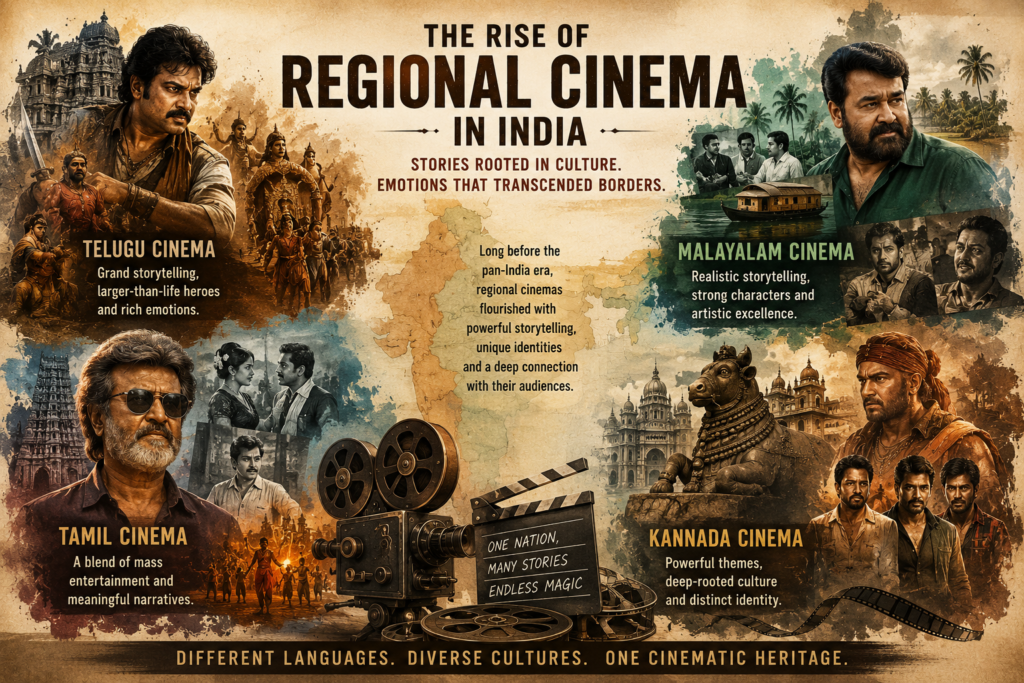
Regional cinema in India developed strong cultural and storytelling traditions long before the pan-India era.
The recent national visibility of South Indian cinema rests on traditions developed over many decades, as Telugu, Tamil, Kannada, and Malayalam filmmakers created distinctive industries shaped by language, literature, theatre, mythology, popular culture, and social change.
Indian cinema has always been multilingual and regionally diverse. Long before the term “pan-India” became part of contemporary film culture, Telugu, Tamil, Kannada, and Malayalam cinema had already developed substantial artistic, cultural, and commercial traditions of their own.
These industries evolved within distinct linguistic and cultural environments. Their films drew upon regional literature and theatre, mythology and folklore, music and devotional traditions, family life, social realities, and changing political and cultural identities. Over time, each industry developed its own stars, filmmakers, genres, audiences, and approaches to storytelling.
Their influence was never confined entirely to regional boundaries. Films, performers, technicians, stories, and musical traditions circulated between South Indian industries and other parts of Indian cinema through multilingual productions, remakes, dubbed releases, and creative collaborations. Yet in much of the national media and popular conversation, Hindi cinema—and particularly Bollywood—often remained the dominant shorthand for “Indian cinema.”
What changed in the 2000s and accelerated dramatically during the 2010s and 2020s was therefore not the emergence of South Indian cinema itself, but the scale of its cross-regional visibility. Wider distribution, dubbed releases, satellite television, digital platforms, ambitious production strategies, and changing audience habits increasingly allowed films to travel beyond their traditional linguistic markets.
This shift laid the groundwork for the modern South Indian cinema revolution. Industries with long-established histories were now reaching wider audiences on new terms, helping transform regional-language cinema from a frequently overlooked part of the national conversation into one of the most visible and influential forces in contemporary Indian filmmaking.
–– ✦ ✦ ––
🌍 Streaming, Dubbing, and the Expansion of South Indian Cinema
From dubbed television broadcasts to streaming libraries, new distribution channels helped regional stories travel far beyond their traditional markets.
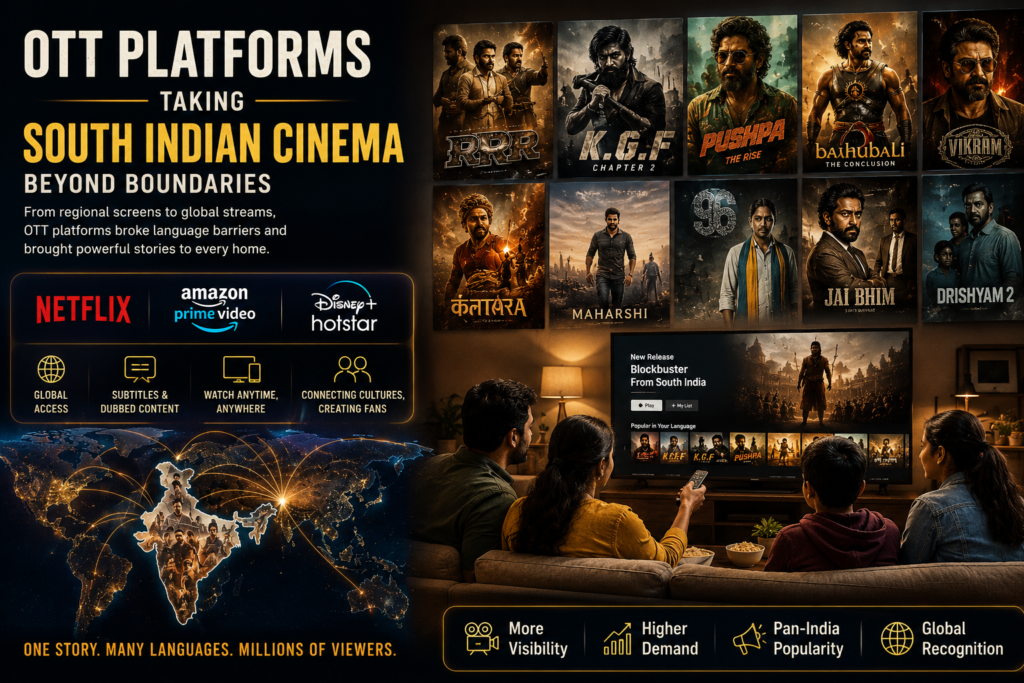
Streaming platforms helped South Indian films reach audiences beyond linguistic and regional boundaries.
Streaming platforms accelerated the reach of South Indian cinema, but the transformation had begun earlier through satellite television, dubbed releases, wider theatrical distribution, and digital circulation—gradually introducing Telugu, Tamil, Kannada, and Malayalam films to audiences across linguistic boundaries.
For decades, the circulation of regional films beyond their home-language markets was limited by distribution networks, theatrical access, and language barriers. This began to change as dubbed South Indian films found wider audiences through satellite television and later through digital platforms, creating familiarity with stars, genres, and storytelling traditions outside their original regions.
The expansion of Hindi-dubbed films was particularly important in introducing Telugu, Tamil, and Kannada commercial cinema to audiences in northern and western India. Television broadcasts and online video circulation helped build an audience for dubbed South Indian films even before many of these productions received major nationwide theatrical releases.
Streaming platforms accelerated this transformation. With subtitles, multiple audio tracks, and on-demand access, audiences could more easily discover films that might previously have received little or no theatrical exposure in their regions. This was especially significant for a wider range of cinema—from Telugu and Tamil commercial films to Malayalam dramas and Kannada productions—because digital access allowed viewers to explore stories beyond familiar language markets.
OTT services therefore did more than provide another distribution channel. They contributed to a changing viewing culture in which language became less of a barrier to discovering regional cinema. At the same time, streaming should be understood as part of a broader transformation that also included dubbing, satellite television, YouTube and other digital circulation, wider theatrical distribution, and increasingly coordinated multilingual releases.
Together, these developments strengthened the South Indian cinema revolution by making regional films more accessible across India and beyond. They also prepared audiences for the next major development: the rise of films conceived, distributed, and marketed for multiple linguistic markets—the modern pan-India film phenomenon.
–– ✦ ✦ ––
💥 The Pan-India Film Phenomenon
When regional-language films stopped being defined by regional boundaries.
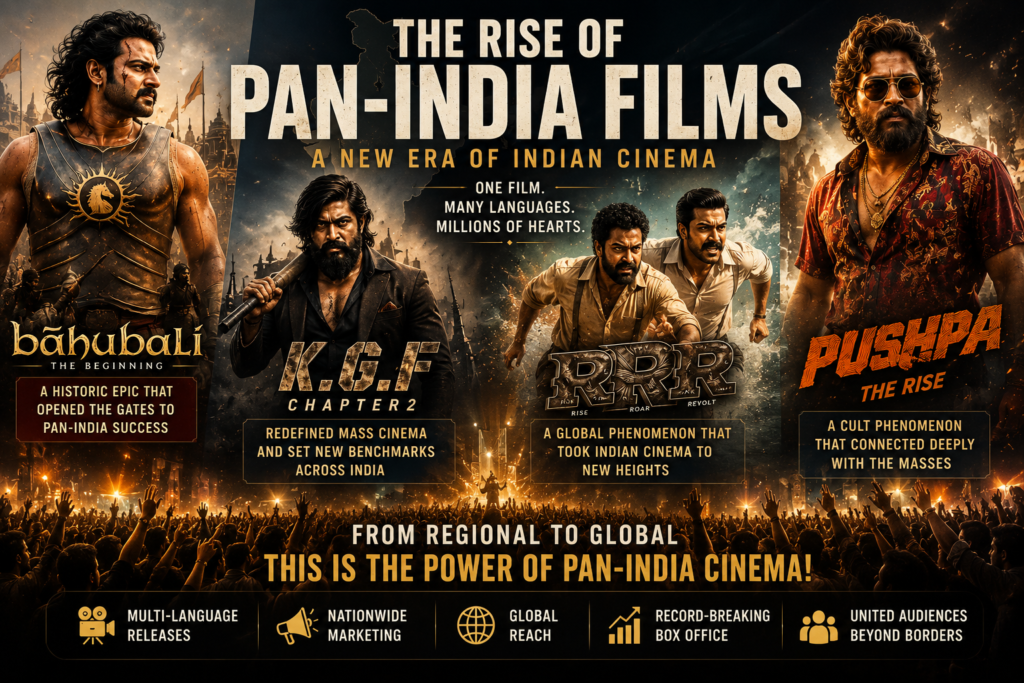
Pan-India blockbusters redefined the scale and popularity of modern Indian commercial cinema.
The rise of pan-India cinema marked a major shift in modern Indian filmmaking: films rooted in one language and cultural tradition could now be dubbed, distributed, marketed, and embraced across multiple regions on an unprecedented scale.
The idea of films travelling across linguistic boundaries is not new to Indian cinema. Earlier productions, including major Tamil and other regional films, had already reached audiences beyond their home markets through dubbing, remakes, multilingual production, and wider distribution. What changed during the 2010s was the scale, coordination, and commercial ambition behind this cross-regional reach.
The Baahubali films became a defining turning point in this transformation. Beginning with Baahubali: The Beginning in 2015, S. S. Rajamouli’s epic demonstrated that a film originating in Telugu cinema could be positioned as a nationwide cinematic event, supported by multilingual versions, extensive distribution, large-scale marketing, spectacle, and storytelling designed to travel across linguistic markets. Its success helped bring the idea of the modern pan-India film into mainstream industry conversation.
Other major successes expanded this model. The KGF films brought Kannada cinema unprecedented nationwide visibility, while Pushpa: The Rise found a substantial audience beyond its original Telugu market. RRR combined large-scale spectacle with emotionally accessible storytelling and went further, achieving significant international recognition as well as success across Indian language markets. Together, such films demonstrated that the language in which a film originated no longer had to determine the geographical limits of its audience.
But pan-India cinema is more than dubbing a regional film into several languages. In its contemporary form, it increasingly involves coordinated multilingual releases, wider theatrical distribution, cross-regional promotion, large production ambitions, and marketing strategies designed to reach audiences in several linguistic markets at once. At the same time, the label itself remains debated: simply announcing a film as “pan-India” does not guarantee that audiences across India will embrace it.
The phenomenon therefore represents both a distribution strategy and a change in audience culture. Viewers have become more accustomed to watching films across languages, while filmmakers and producers increasingly think beyond the traditional boundaries of a single regional market.
For the South Indian cinema revolution, this was a decisive development. Telugu and Kannada blockbusters in particular demonstrated the commercial possibilities of nationwide releases, while the wider circulation of Tamil and Malayalam films reinforced a broader shift toward cross-language viewing. The result was not the disappearance of regional cinema, but something more significant: regional identity itself could become the foundation for national—and sometimes international—appeal.
–– ✦ ✦ ––
🎶 Music, Emotion, and Mass Storytelling
Where music, emotion, spectacle, and star power turned popular storytelling into a shared cinematic experience.
One important strand of the South Indian cinema revolution emerged from mass-oriented commercial filmmaking, particularly in Telugu and Tamil cinema, where heightened emotion, memorable music, heroic characters, and spectacle helped stories connect with audiences across linguistic boundaries.
Popular South Indian cinema has long drawn strength from the close relationship between music, emotion, performance, and spectacle. In many mainstream Telugu and Tamil films—and in different forms across Kannada and Malayalam commercial cinema—songs, family relationships, romance, comedy, action, and heroic conflict have often been woven together within a single narrative.
This approach reflects a broader tradition of Indian popular filmmaking in which genre boundaries remain fluid. A commercial film may shift between intimate family drama and large-scale action, or between humour, romance, music, and moments of intense emotional conflict. Rather than treating these elements as separate genres, filmmakers often combine them to create an experience designed for collective theatrical engagement.
Music has been especially important to this tradition. Songs can carry romance, celebration, grief, devotion, or cultural identity, while background scores often heighten dramatic tension and reinforce the screen presence of major stars. In mass-oriented films, carefully staged entrances, climactic confrontations, memorable dialogue, and emotionally charged musical cues can turn individual scenes into moments of shared audience excitement.
The recent pan-India era amplified the reach of this storytelling style. As dubbed and multilingual releases brought major South Indian films to wider audiences, songs, background scores, dialogue, character moments, and star performances increasingly circulated beyond their original language markets. At the same time, this mass-commercial tradition represents only one dimension of South Indian cinema; Malayalam realism, Tamil social and political storytelling, Kannada experimentation, and the diverse traditions within Telugu cinema demonstrate a much broader cinematic landscape.
The emotional intensity, larger-than-life heroes, music, and crowd-oriented entertainment found in many contemporary South Indian blockbusters also invite comparison with an earlier tradition of Hindi popular filmmaking—the Bollywood masala era, when action, romance, family drama, music, comedy, and social conflict were similarly brought together within highly accessible commercial narratives.
To explore that earlier tradition and its distinctive historical context, read:
👉 Masala Era of Bollywood: Rise of the Angry Young Man
–– ✦ ✦ ––
🎬 Telugu and Tamil Cinema’s Growing Influence
Two powerful film traditions, different creative paths—and an expanding influence on the wider landscape of Indian cinema.
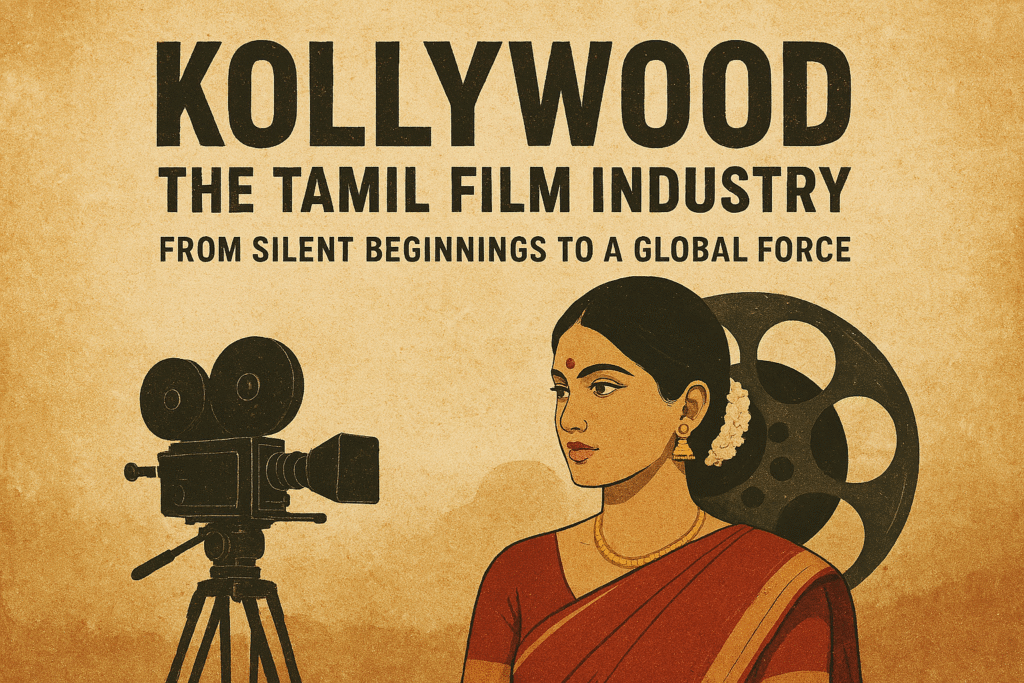
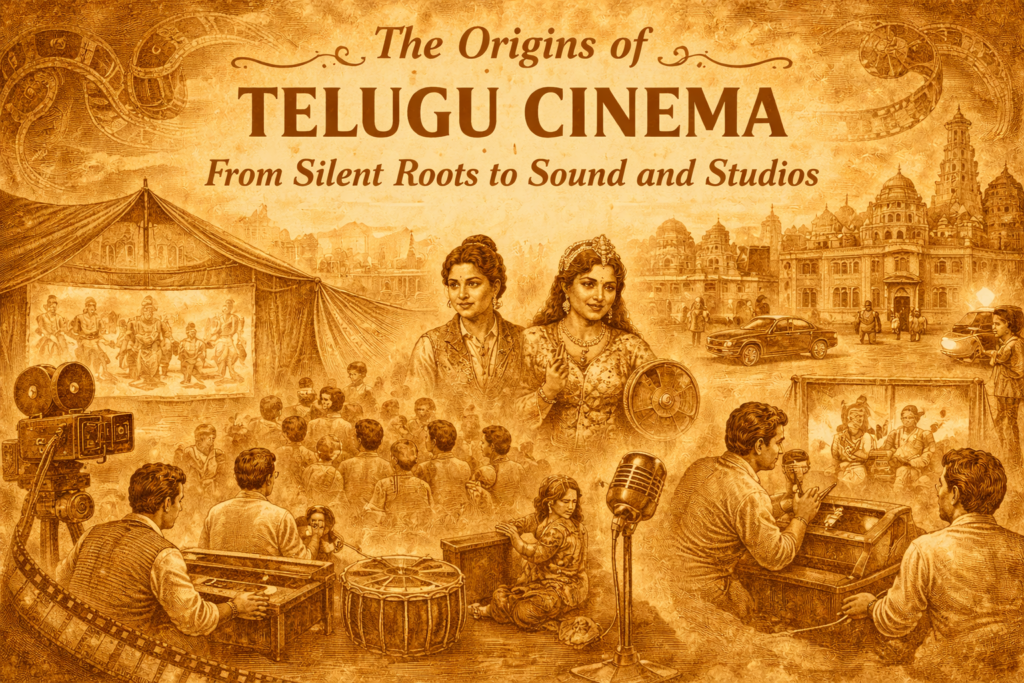
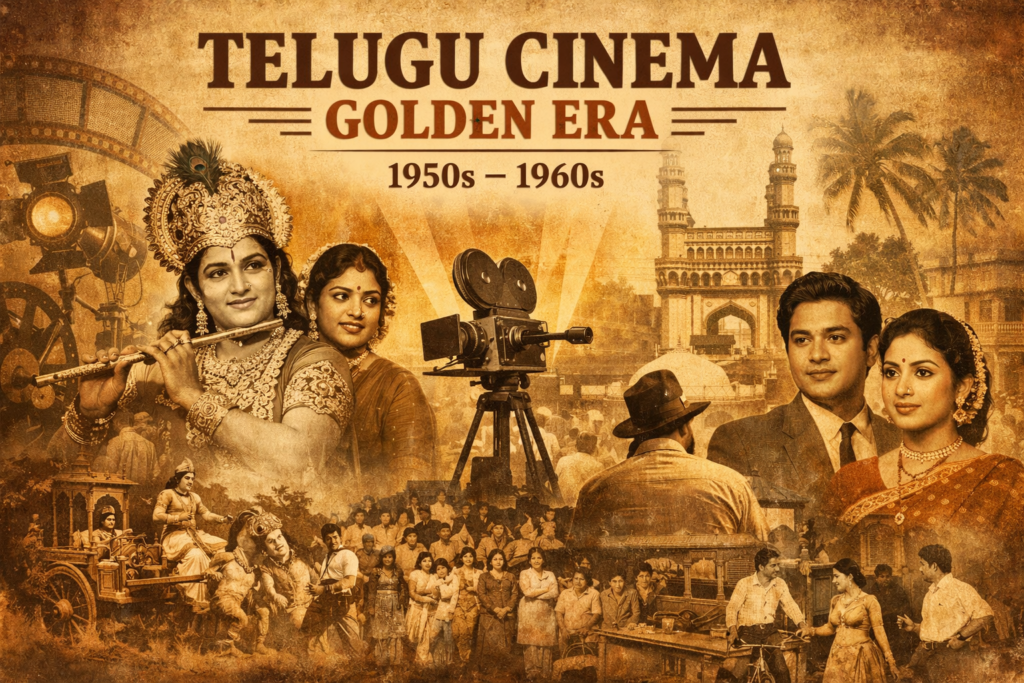
Telugu and Tamil cinema were major forces in South Indian filmmaking long before the recent pan-India wave. What changed in the 2000s and 2010s was the scale of their cross-regional reach, as ambitious productions, influential filmmakers, major stars, remakes, dubbing, and multilingual releases brought their films to increasingly wider audiences.
Telugu and Tamil cinema have long occupied important positions within Indian filmmaking. Both developed strong studio traditions, star cultures, musical identities, technical expertise, and distinctive approaches to popular storytelling. Their films also circulated beyond their home markets through remakes, multilingual productions, dubbed versions, television, and creative exchange with other Indian film industries.
Telugu Cinema and the Rise of Large-Scale Spectacle
Telugu cinema became especially influential in the development of the contemporary pan-India blockbuster. Filmmakers increasingly combined emotionally direct storytelling with action, mythology, fantasy, visual effects, star power, and large production ambitions.
S. S. Rajamouli played a particularly important role in this transformation. Films such as Magadheera and Eega demonstrated the potential for ambitious Telugu storytelling to travel beyond its immediate market, while the Baahubali films dramatically expanded that possibility. Their success showed producers and distributors that a Telugu-origin film could be marketed and released as a nationwide cinematic event rather than being confined primarily to its original linguistic market.
That momentum continued with films such as Pushpa and RRR, reinforcing the visibility of Telugu stars, directors, technicians, and production styles across India. The result was not simply a series of successful films; it contributed to greater confidence in large budgets, multilingual distribution, nationwide promotion, and stories designed to travel across language markets.
Tamil Cinema and Cross-Regional Influence
Tamil cinema followed a different but equally important trajectory. Long before “pan-India” became a widely used industry label, Tamil films, filmmakers, composers, technicians, and stars had already built audiences and influence beyond Tamil Nadu.
Its impact has ranged from popular star-driven cinema to socially and politically engaged storytelling, technically ambitious productions, and films that crossed linguistic boundaries through dubbing and remakes. Filmmakers working in Tamil cinema also helped demonstrate that regional-language films could combine distinctive cultural identities with themes and emotions capable of travelling to wider audiences.
The exchange between Tamil and other Indian film industries has been particularly visible through remakes and creative collaboration. Tamil and Telugu films have frequently been adapted across languages, while directors, actors, composers, cinematographers, and technicians have worked across regional boundaries. Hindi cinema, too, has repeatedly adapted successful films originating in both industries. This cross-pollination predates the contemporary pan-India era and forms an important part of the longer history behind today’s increasingly interconnected Indian film culture.
Different Traditions, Expanding Reach
Telugu and Tamil cinema should therefore not be treated as interchangeable components of a single “South Indian” style. Telugu cinema’s recent national visibility has been strongly associated with large-scale event films and the modern pan-India blockbuster, while Tamil cinema’s wider influence also reflects decades of cross-language circulation, distinctive filmmakers, major stars, music, remakes, technical innovation, and varied traditions of commercial and socially engaged filmmaking.
Together, however, their expanding reach helped alter perceptions of where nationally influential Indian cinema could originate. Their success contributed to a broader environment in which language became less of a barrier, regional stars gained wider recognition, filmmakers collaborated across industries, and audiences became increasingly willing to watch films originating outside their own linguistic regions.
This growing influence became one of the central forces behind the South Indian cinema revolution—but Telugu and Tamil cinema were not alone. Kannada cinema would soon demonstrate, through a different path, how a regional industry could achieve extraordinary nationwide visibility.
–– ✦ ✦ ––
🎥 Kannada Cinema and the Rise of Pan-India Action Films
From a long-established regional tradition to a new era of nationwide visibility.
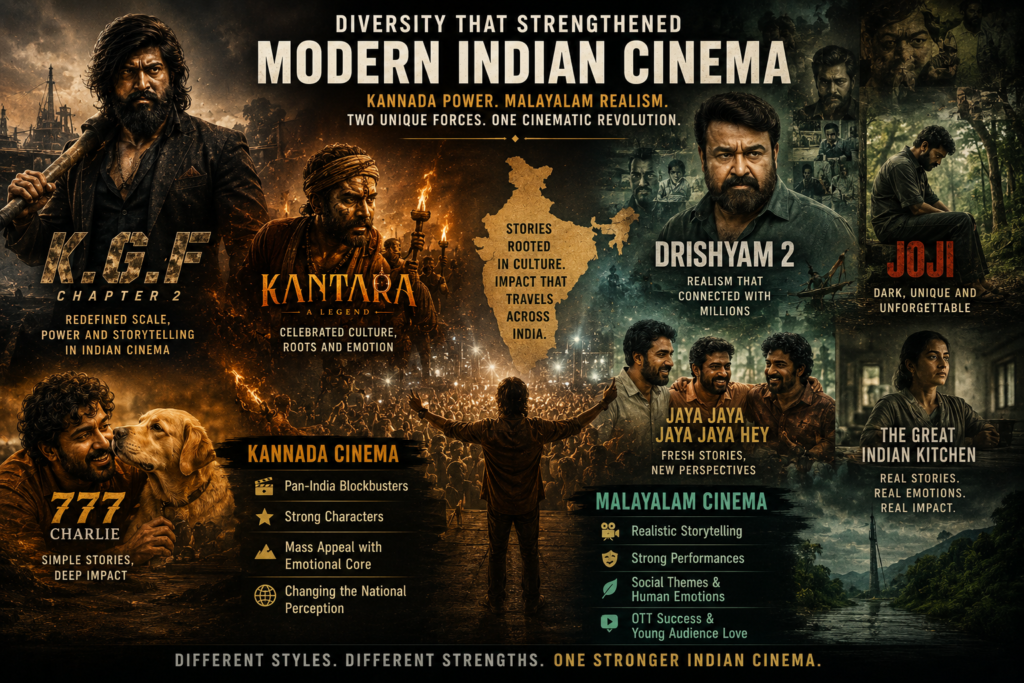
Kannada and Malayalam cinema expanded the artistic and commercial diversity of modern Indian cinema.
Kannada cinema had developed its own rich history of stars, literary influence, artistic filmmaking, and popular entertainment long before the pan-India era. What changed with films such as KGF was the scale on which a Kannada production could be marketed, distributed, and embraced across India.
Kannada cinema’s emergence as a major force in the contemporary pan-India conversation did not happen overnight. The industry had already built a substantial cinematic tradition through generations of filmmakers, performers, writers, and technicians. Yet for much of its history, Kannada films generally had less visibility outside Karnataka than films from some of India’s larger regional industries.
A decisive shift came with Prashanth Neel’s KGF: Chapter 1 in 2018. Starring Yash, the film combined stylized action, a larger-than-life protagonist, striking visual design, an emphatic background score, and ambitious world-building with a release strategy designed to reach audiences well beyond the Kannada-language market. It was dubbed into Hindi, Tamil, Telugu, and Malayalam and distributed across markets where original Kannada films had previously struggled to secure comparable theatrical reach.
The breakthrough expanded dramatically with KGF: Chapter 2 in 2022. Its nationwide commercial success transformed Yash into a widely recognized star and demonstrated that a Kannada-language franchise could compete at the highest levels of the Indian theatrical market. The film crossed ₹1,000 crore worldwide, while its success also brought greater national attention to director Prashanth Neel, producer Hombale Films, and the wider Kannada film industry.
But Kannada cinema’s expanding reach was not limited to the KGF model of large-scale action. Rishab Shetty’s Kantara offered a strikingly different example. Deeply rooted in the landscape, customs, folklore, and cultural traditions of coastal Karnataka, the film grew from a Kannada release into a much wider success. Its reception demonstrated that a film did not necessarily need to dilute its regional identity to reach audiences beyond its home market; local cultural specificity itself could become a source of wider appeal.
Together, KGF and Kantara illustrated two important possibilities for contemporary Kannada cinema. One emphasized scale, action, star power, and pan-India distribution; the other showed the cross-regional potential of culturally rooted storytelling. Their success increased interest in Kannada films, filmmakers, actors, technicians, and production companies while helping the industry occupy a more prominent position in national conversations about Indian cinema.
Kannada cinema therefore became an important part of the South Indian cinema revolution not because it suddenly discovered ambitious filmmaking, but because its films began reaching wider audiences on an unprecedented scale. The transformation reinforced one of the defining lessons of the pan-India era: a film could remain firmly rooted in a regional language and cultural identity while still finding audiences across India.
–– ✦ ✦ ––
📺 Malayalam Cinema and Realistic Storytelling
Where literary depth, social observation, and cinematic experimentation created a distinctive storytelling tradition.
Malayalam cinema followed a different path to wider recognition. Rather than being defined primarily by large-scale spectacle, many of its most influential films built their reputation through strong writing, grounded characters, literary and social influences, experimentation, and stories closely connected to everyday life in Kerala.
Malayalam cinema has long occupied a distinctive place within South Indian filmmaking. Its reputation for realistic and character-driven storytelling did not emerge suddenly with the streaming era; it developed through decades of interaction among literature, theatre, film societies, parallel cinema, popular filmmaking, and Kerala’s changing social and cultural landscape.
A major turning point came with the Malayalam New Wave of the 1970s. Adoor Gopalakrishnan’s Swayamvaram (1972) helped introduce a new cinematic language centred on social reality, visual expression, and serious engagement with contemporary life. The film-society movement that developed in Kerala also exposed audiences and aspiring filmmakers to Indian and international cinema, helping create an environment in which film could be approached as an art form alongside literature and theatre.
Filmmakers such as G. Aravindan, John Abraham, K. G. George, Padmarajan, Bharathan, and later Shaji N. Karun expanded this landscape in different directions. Their work cannot be reduced to a single style: Malayalam cinema encompassed parallel and art cinema, literary adaptation, political and social commentary, psychological drama, satire, and more accessible forms of mainstream storytelling. By the 1980s, these different currents were helping create a particularly rich film culture in Kerala.
The influence of the Malayalam New Wave extended well beyond the movement itself, shaping later generations of filmmakers and contributing to the industry’s growing international recognition. This continuing transformation—from the New Wave of the 1970s to a wider global audience—is explored in greater depth in our article on the evolution of Malayalam cinema.
This longer tradition helps explain why contemporary Malayalam films are frequently associated with strong screenwriting, layered characters, social observation, and relatively grounded storytelling. Rather than relying on spectacle alone, many films derive their impact from everyday situations, moral ambiguity, family and community relationships, humour, suspense, and close attention to the social environments in which their characters live.
Digital distribution and streaming gave this tradition greater visibility outside Kerala. Subtitles and easier access allowed viewers unfamiliar with Malayalam to discover films that might previously have had limited theatrical circulation in their regions. This wider exposure helped bring Malayalam actors, filmmakers, writers, and storytelling traditions into a broader national conversation about Indian cinema.
Yet Malayalam cinema should not be defined by realism alone. It also includes comedy, thrillers, romance, action, star-driven commercial cinema, experimental work, and other popular genres. What distinguishes its contribution to the South Indian cinema revolution is therefore not one fixed style, but the demonstration that relatively intimate, culturally specific, and narratively ambitious films can travel across linguistic boundaries without depending exclusively on blockbuster scale.
In this sense, Malayalam cinema represents another dimension of the same transformation seen elsewhere in South India. If films such as Baahubali and KGF demonstrated the cross-regional possibilities of scale and spectacle, the wider discovery of Malayalam films showed that storytelling itself could become a powerful vehicle for crossing regional and linguistic boundaries.
–– ✦ ✦ ––
⭐ The Rise of Pan-India Stardom
When regional stars began commanding audiences across languages, markets, and cultural boundaries.
The pan-India era did more than expand the reach of individual films. It also transformed the visibility of their leading actors, allowing stars established in Telugu, Kannada, Tamil, and other regional industries to build recognition among audiences far beyond their traditional markets.
Cross-regional stardom is not new to Indian cinema. Actors such as Kamal Haasan and Rajinikanth had already built substantial recognition beyond their primary language markets decades before “pan-India star” became a widely used industry label. The contemporary shift lies less in the invention of nationwide stardom than in the scale, coordination, and speed with which multilingual releases and major film franchises can now expand an actor’s audience.
The Baahubali films became a defining example of this transformation. Prabhas, already an established star in Telugu cinema, gained nationwide recognition as the films reached audiences across multiple language markets. His association with large-scale productions after Baahubali further demonstrated how a star originating in a regional industry could become central to films designed for audiences across India.
The KGF franchise produced a comparable breakthrough for Yash. Already successful within Kannada cinema, he gained dramatically wider recognition as Rocky became one of the defining characters of the contemporary pan-India blockbuster era. The franchise showed that nationwide star appeal could emerge from an industry that had previously received considerably less mainstream visibility outside its home region.
Allu Arjun’s Pushpa films offered another example. His screen presence, characterisation, dialogue, music, and dance reached audiences well beyond the Telugu market, strengthening his nationwide recognition. The success of Pushpa demonstrated how a culturally and geographically rooted character could become widely familiar without abandoning the regional identity at the centre of the story.
RRR expanded the phenomenon in another direction. Ram Charan and Jr NTR gained greater nationwide visibility through the film, while its international reception introduced their performances to audiences well beyond India. The film’s journey demonstrated that contemporary Indian stardom could operate at several levels at once—regional roots, national recognition, and growing international visibility.
Pan-India stardom is therefore closely connected to changes in distribution, dubbing, marketing, streaming, social media, and audience behaviour. Viewers who discover an actor through one multilingual blockbuster can more easily explore that performer’s earlier work, while songs, scenes, interviews, and promotional material circulate across linguistic markets through digital platforms.
At the same time, a successful pan-India film does not automatically create lasting nationwide stardom. Sustained star appeal depends on whether audiences continue to engage with an actor across subsequent films, languages, genres, and markets. The term “pan-India star” is therefore most useful when it describes continuing cross-regional audience recognition rather than functioning simply as a promotional label.
The rise of this new star culture became another important dimension of the South Indian cinema revolution. Prabhas, Yash, Allu Arjun, Ram Charan, Jr NTR, and other performers increasingly became part of a national film conversation in which stardom was less rigidly defined by linguistic boundaries. Their growing visibility also reflected a larger change: audiences were becoming more willing to follow stars and stories across languages rather than expecting nationally prominent cinema to originate primarily in Hindi.
–– ✦ ✦ ––
🌐 How South Indian Films Reshaped Bollywood
From remakes and shared talent to changing ideas of scale, spectacle, and nationwide appeal.

The South Indian cinema revolution reshaped audience expectations, storytelling, and stardom across India.
The relationship between Bollywood and South Indian cinema has never been one-way. For decades, stories, stars, filmmakers, technicians, music, and creative ideas have moved between industries—but the recent success of South Indian films changed the scale of that exchange and challenged long-standing assumptions about the centre of mainstream Indian cinema.
Hindi cinema and South Indian film industries have influenced one another for generations. Successful Tamil, Telugu, Malayalam, and Kannada films have been remade in Hindi, just as Hindi films have been adapted into southern languages. Actors, directors, composers, cinematographers, choreographers, and technicians have also worked across linguistic industries, making creative exchange a long-established feature of Indian filmmaking.
What changed during the South Indian cinema revolution was therefore not the existence of this exchange, but its visibility and direction. Films such as Baahubali, Pushpa, KGF, RRR, and Kantara reached Hindi-speaking audiences directly through dubbed or multilingual releases rather than depending primarily on later Hindi remakes. Their success demonstrated that audiences could embrace the original stars, filmmaking styles, cultural settings, and regional identities of films produced outside the Hindi industry.
From Remakes to Direct Cross-Language Audiences
For many years, remaking a successful regional film was one of the principal ways its story reached another major language market. Hindi cinema has adapted numerous films originating in Tamil, Telugu, Malayalam, and Kannada cinema, often relocating their settings, changing performers, and modifying cultural details for Hindi-speaking audiences.
The growth of dubbed releases and streaming altered that relationship. Viewers increasingly had access to the original films themselves, sometimes long before a Hindi remake appeared. This created a new challenge for remakes: audiences who had already watched and appreciated an original film could compare a Hindi adaptation directly with its source. Industry discussions around films such as Jersey and Vikram Vedha reflected concerns that straightforward remakes could become less attractive when the originals were already widely accessible.
Scale, Spectacle, and the Return of Mass Cinema
The nationwide success of major South Indian blockbusters also intensified discussion within Bollywood about large-scale theatrical entertainment. Hero-centred storytelling, heightened emotion, action, memorable music, dramatic staging, and visually ambitious spectacle became increasingly prominent in conversations about what could draw mass audiences back to cinemas.
Yet it would be misleading to describe these qualities as inventions of contemporary South Indian cinema that Bollywood simply adopted. Hindi cinema has its own long history of spectacle, melodrama, action, music, and larger-than-life stars—particularly through the masala traditions of earlier decades. The recent shift is better understood as a renewed emphasis on mass theatrical storytelling, influenced by changing audience expectations and the extraordinary visibility of successful Telugu, Tamil, and Kannada films.
Collaboration Across Film Industries
Perhaps the clearest sign of change has been the growing visibility of cross-industry collaboration. Directors, actors, composers, technicians, and production companies increasingly work on projects intended for audiences across several linguistic markets rather than remaining associated with only one regional industry.
Jawan (2023) became a prominent example. A Hindi-language film starring Shah Rukh Khan, it was directed by Tamil filmmaker Atlee and featured Nayanthara and Vijay Sethupathi in major roles. Its success illustrated how the contemporary Indian blockbuster could combine talent, storytelling traditions, production cultures, and audiences associated with different film industries rather than fitting neatly into a simple “Bollywood versus South” divide.
A More Interconnected Indian Cinema
South Indian films therefore did not “replace” Bollywood, nor did influence suddenly begin flowing in only one direction. Their growing nationwide success helped weaken an older hierarchy in which Hindi cinema was routinely treated as synonymous with Indian cinema while films in other languages were grouped primarily under the label of “regional cinema.”
The deeper transformation has been toward a more interconnected film culture. Audiences increasingly follow films, stars, directors, and stories across linguistic boundaries; producers think more seriously about multiple regional markets; and collaborations connect industries that retain their own languages and cultural identities.
In that sense, South Indian films reshaped Bollywood not simply by influencing particular genres or filmmaking styles, but by helping reshape the competitive and creative landscape in which Hindi cinema operates. The result is a broader shift toward an Indian film culture in which national visibility is increasingly possible from multiple cinematic centres.
–– ✦ ✦ ––
📽️ Legacy of the South Indian Cinema Revolution
Beyond blockbusters, a lasting shift in how Indian cinema is created, circulated, and understood.
The lasting impact of the South Indian cinema revolution extends beyond box-office records. It has widened the national space available to regional-language films, encouraged audiences to cross linguistic boundaries, strengthened collaboration between industries, and challenged the assumption that nationally visible Indian cinema must originate primarily in Hindi.
The most important legacy of the South Indian cinema revolution may not be any single film, star, or box-office milestone. Its deeper significance lies in changing the relationship between regional identity and national visibility. Telugu, Tamil, Kannada, and Malayalam cinema had rich histories long before the recent pan-India wave; what changed was their ability to reach wider audiences while remaining rooted in their own languages and cultural traditions.
Regional Identity Became an Advantage
The success of films such as Baahubali, KGF, Pushpa, RRR, and Kantara demonstrated that regional identity need not prevent nationwide appeal. In different ways, these films carried distinctive settings, cultural references, storytelling traditions, characters, and languages into markets far beyond their original regions.
This helped challenge an older assumption that a film needed to pass through Hindi cinema—or be remade in Hindi—to achieve widespread recognition across India. Dubbed and multilingual releases increasingly allowed audiences to encounter the original films, performers, and creative identities more directly.
Language Barriers Became More Permeable
Dubbing, subtitles, satellite television, streaming, digital promotion, and wider theatrical distribution made it easier for audiences to watch films in languages other than their own. This did not erase India’s linguistic differences; instead, it made movement across those differences more common.
As audiences became more accustomed to Telugu, Tamil, Kannada, Malayalam, and other regional-language films, the idea of what constituted mainstream Indian entertainment began to broaden. The contemporary popularity of the term “pan-India” itself reflects this shift, although the label remains debated and cross-language cinema existed long before it became fashionable.
Indian Film Industries Became More Interconnected
The revolution also accelerated collaboration. Actors, directors, composers, technicians, producers, and distributors increasingly work across linguistic markets, while films are conceived and promoted with multiple audiences in mind.
Such exchange is not new—Indian film industries have shared talent, stories, remakes, and techniques for generations. What has changed is its scale and visibility.
The Meaning of “Indian Cinema” Began to Expand
Perhaps the most significant cultural legacy has been a gradual weakening of the tendency to use Bollywood as shorthand for Indian cinema. The nationwide success of films originating in southern industries made it increasingly difficult to understand India’s film culture through a Hindi-cinema-centred lens alone. Industry debate around the term “pan-India” has itself highlighted questions about why non-Hindi films are often given a special label when Hindi films with nationwide ambitions are simply treated as mainstream Indian cinema.
This does not mean that regional distinctions are disappearing. Telugu, Tamil, Kannada, and Malayalam cinema continue to have their own histories, audiences, stars, aesthetics, industries, and cultural identities. Their growing national visibility matters precisely because these differences have not had to disappear.
A Revolution Still in Progress
The legacy is also more complicated than a simple story of uninterrupted success. A multilingual release, large budget, or “pan-India” label does not guarantee that a film will connect with audiences across regions. Recent experience continues to show that only some films genuinely achieve sustained cross-language appeal.
The more enduring transformation is therefore not a formula for producing blockbusters. It is the expansion of possibilities: a Telugu epic, a Kannada action franchise, a culturally rooted regional story, or an intimate Malayalam drama can now enter a national conversation without first surrendering the identity that made it distinctive.
That may ultimately be the defining legacy of the South Indian cinema revolution. It did more than shift box-office power or create a new generation of pan-India stars—it helped reshape the idea of Indian cinema itself as a multilingual, multi-centred cinematic culture in which stories can travel across regions while remaining deeply rooted in where they began.
Continue Exploring Regional Cinema
The transformation of Indian cinema extends beyond the southern film industries. Punjabi cinema developed its own distinctive identity through music, regional culture, and strong connections with diaspora audiences, while Bengali cinema followed another influential path shaped by literature, realism, parallel cinema, and artistic experimentation.
Explore these cinematic traditions:
👉 Punjabi Cinema History: Music, Culture, and the Global Punjabi Identity
👉 Bengali Cinema Legacy: Realism, Literature, and Artistic Revolution
The growing influence of regional cinema also forms part of the larger transformation of contemporary Hindi filmmaking—from multiplex culture and global audiences to streaming and changing production strategies.
👉 Modern Bollywood Era: Global Cinema, Multiplex Culture, and Streaming Revolution
–– ✦ ✦ ––
❓ Frequently Asked Questions (FAQs)
Quick answers to the key questions behind the changing reach and influence of South Indian cinema.
From pan-India releases and cross-language audiences to dubbing, streaming, stardom, and changing industry dynamics, these questions explain the major forces behind the South Indian cinema revolution.
What is the South Indian cinema revolution?
The South Indian cinema revolution refers to the growing national—and in some cases international—visibility and influence of Telugu, Tamil, Kannada, and Malayalam cinema, particularly during the 2010s and 2020s. It does not mean these industries suddenly became important during this period; rather, their films began reaching wider audiences through changing distribution, dubbing, multilingual releases, streaming, ambitious productions, and evolving audience habits.
Why did South Indian films become popular across India?
South Indian films reached wider audiences through a combination of strong storytelling, culturally rooted narratives, major stars, music, spectacle, improved production values, dubbed releases, wider theatrical distribution, satellite television, digital circulation, and streaming. Films such as Baahubali, KGF, Pushpa, and RRR gave this cross-regional shift particularly high visibility.
What does “pan-India film” mean?
A pan-India film is generally understood as a film intended to reach audiences across several Indian linguistic and regional markets rather than primarily its original language market. Contemporary pan-India releases often use dubbing or multilingual versions, coordinated distribution, nationwide promotion, and marketing across multiple regions. Cross-language films existed much earlier, but the term became especially prominent during the modern blockbuster era.
Did OTT platforms create the South Indian cinema revolution?
No. Streaming platforms significantly accelerated the discovery of regional films, but they were only one part of a broader transformation. Satellite television, Hindi and other dubbed versions, theatrical distribution, remakes, YouTube and digital circulation, subtitles, multilingual releases, and changing audience preferences had already helped films travel across linguistic boundaries.
Which South Indian film industries contributed to this transformation?
Telugu, Tamil, Kannada, and Malayalam cinema all contributed, but in different ways. Telugu cinema became particularly prominent through large-scale pan-India blockbusters; Tamil cinema brought a long tradition of cross-language influence and diverse commercial filmmaking; Kannada cinema gained unprecedented nationwide visibility through films such as KGF and Kantara; and Malayalam cinema reached wider audiences through its strong writing, varied genres, grounded storytelling, and growing digital accessibility.
Which films helped popularize the modern pan-India phenomenon?
The Baahubali films became a major turning point in the contemporary pan-India model. The KGF franchise, Pushpa films, and RRR further demonstrated the nationwide potential of regional-language productions. Other films, including Kantara, showed that culturally specific regional stories could also travel successfully beyond their original markets.
How did South Indian cinema influence Bollywood?
The relationship is better understood as long-standing creative exchange rather than one-way influence. Hindi and South Indian film industries have shared stories, remakes, actors, filmmakers, composers, and technicians for decades. More recently, the nationwide success of South Indian films intensified competition, encouraged cross-industry collaboration, influenced expectations around theatrical scale and mass entertainment, and reduced the need for some regional stories to reach Hindi-speaking audiences primarily through remakes.
What is pan-India stardom?
Pan-India stardom describes sustained recognition across multiple linguistic and regional markets. Actors such as Prabhas, Yash, Allu Arjun, Ram Charan, and Jr NTR gained much wider audiences through major cross-language releases, although cross-regional Indian stardom existed long before the contemporary “pan-India” label.
Is the South Indian cinema revolution only about blockbuster action films?
No. Large-scale action and spectacle are highly visible parts of the phenomenon, but they represent only one dimension of it. Malayalam cinema’s wider discovery, Tamil cinema’s varied storytelling traditions, culturally rooted films such as Kantara, and the diverse histories of Telugu and Kannada cinema demonstrate that cross-regional appeal can emerge through very different cinematic forms.
What is the lasting impact of the South Indian cinema revolution?
Its most important legacy may be the widening of what audiences understand as nationally significant Indian cinema. Regional-language films can now enter national conversations more directly, audiences increasingly watch films across linguistic boundaries, and collaborations among Indian film industries have become more visible. The transformation has helped reinforce the idea of Indian cinema as a multilingual and multi-centred film culture rather than one defined primarily by Bollywood.
🌐 Read in Hindi
Prefer reading this article in Hindi?
👉 हिंदी में पढ़ें:
क्षेत्रीय सिनेमा क्रांति: कैसे दक्षिण भारतीय फ़िल्मों ने भारतीय सिनेमा को नई दिशा दी
This version of the article offers the same depth, perspective, and storytelling.
🔖 External sources are referenced for educational and historical context. All rights and credits belong to their respective owners.