
Tracing the evolution of India’s most celebrated film awards through seven decades of cinematic excellence.
ENG | हिंदी
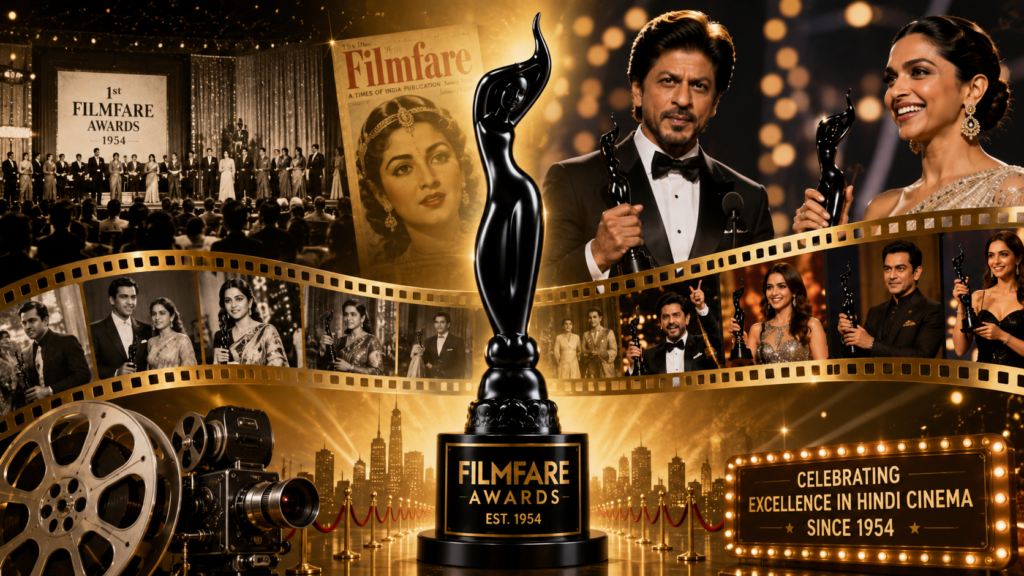
Since 1954, the Filmfare Awards have celebrated cinematic excellence while becoming one of Bollywood’s most enduring symbols of artistic achievement.
Inspired by the Academy Awards yet uniquely Indian in spirit, the Filmfare Awards have honored outstanding achievements in Hindi cinema since 1954. Over the decades, they have become one of Bollywood’s most recognized symbols of artistic excellence, celebrating the films, performances, and creative talents that have shaped generations of moviegoers.
The history of the Filmfare Awards is closely intertwined with the evolution of modern Bollywood. Since their inception in 1954, the awards have recognized excellence in filmmaking while reflecting the changing tastes, technologies, and storytelling traditions of Indian cinema.
Inspired by Hollywood’s Academy Awards but developed with a distinctly Indian identity, the Filmfare Awards quickly became Bollywood’s most influential annual celebration. From legendary actors and visionary directors to unforgettable films and timeless music, the awards have honored many of the artists who defined different eras of Hindi cinema.
The Filmfare Awards represent one chapter in the broader story of Bollywood’s remarkable journey. If you’d like to explore how Hindi cinema evolved from its early beginnings into one of the world’s largest film industries, begin with our Reel Bollywood series.
This article traces the history of the Filmfare Awards—from their origins in the 1950s to their continued relevance in the twenty-first century—exploring how they have celebrated cinematic excellence while evolving alongside Bollywood itself.
📑 In This Article
🎬 How the History of the Filmfare Awards Began
The early 1950s marked a period of rapid growth for the Indian film industry. Following India’s independence, Hindi cinema was entering a new era of artistic confidence, producing films that combined powerful storytelling, memorable music, and socially relevant themes.
This remarkable growth was built upon decades of cinematic innovation that began long before Bollywood emerged. To discover how motion pictures evolved from their earliest experiments into a global art form, explore our Reel Origins series.
As Bollywood matured, there was growing recognition that outstanding achievements in filmmaking deserved a prestigious platform for celebration. Inspired by the success of Hollywood’s Academy Awards, The Times of India Group introduced the Filmfare Awards to honor excellence in Hindi cinema and encourage higher creative standards within the industry.
From the very beginning, the awards were intended not only to recognize popular success but also to celebrate artistic merit across various aspects of filmmaking.
–– ✦ ✦ ––
🏛️ The First Filmfare Awards (1954)
The inaugural Filmfare Awards ceremony was held on 21 March 1954 in Mumbai, bringing together many of the leading personalities of the Indian film industry.
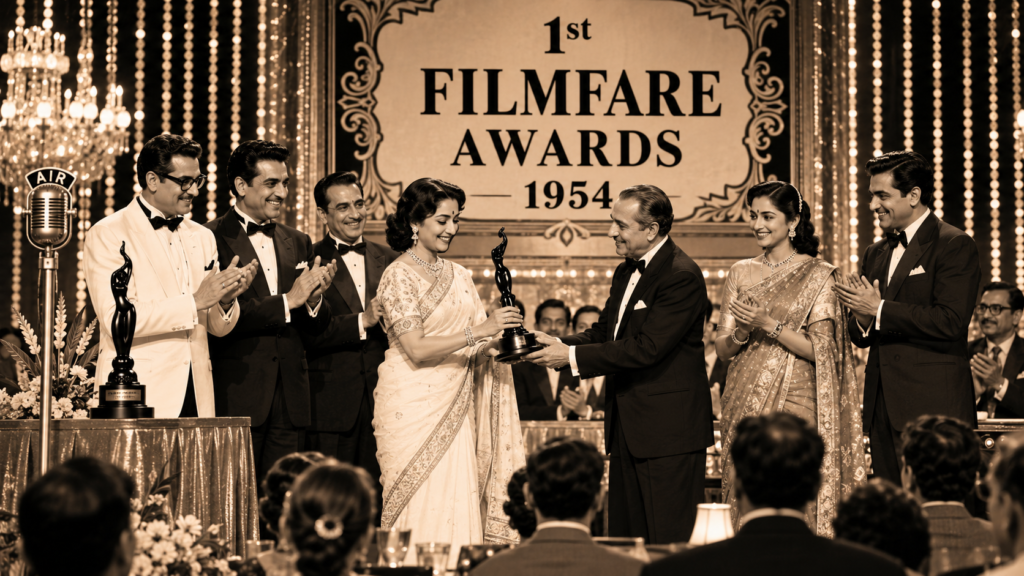
The inaugural Filmfare Awards ceremony in 1954 marked the beginning of India’s most celebrated annual film awards.
During the first ceremony, only a handful of competitive awards were presented, including Best Film, Best Director, Best Actor, and Best Actress. The event reflected the industry’s desire to establish a credible and prestigious system for recognizing cinematic excellence.
One of the evening’s most celebrated winners was Do Bigha Zamin, which received the Best Film award and became one of the earliest examples of socially conscious cinema being recognized at the highest level.
Although modest compared with today’s grand televised ceremonies, the inaugural Filmfare Awards laid the foundation for what would become India’s most celebrated annual film awards.
–– ✦ ✦ ––
🏆 The Iconic Black Lady Trophy
One of the most recognizable symbols of the Filmfare Awards is its elegant Black Lady trophy. Standing gracefully with arms raised in celebration, the statuette represents artistic excellence, creativity, and the enduring spirit of Indian cinema.

The Black Lady trophy has become one of the most recognizable symbols of cinematic excellence in Hindi cinema.
Designed by sculptor N. G. Pansare, the trophy was commissioned by The Times of India Group and has remained largely unchanged since the awards were introduced. Unlike the golden Oscar statuette, the Filmfare trophy’s distinctive black finish has become an iconic symbol of Bollywood’s highest honors.
For generations of actors, directors, musicians, writers, and technicians, winning the Black Lady has represented one of the most cherished achievements in Hindi cinema.
–– ✦ ✦ ––
🌟 Growth During Bollywood’s Golden Era
The Filmfare Awards grew alongside Bollywood’s Golden Era during the 1950s, 1960s, and early 1970s—a period widely celebrated for its artistic excellence, unforgettable music, and powerful storytelling.
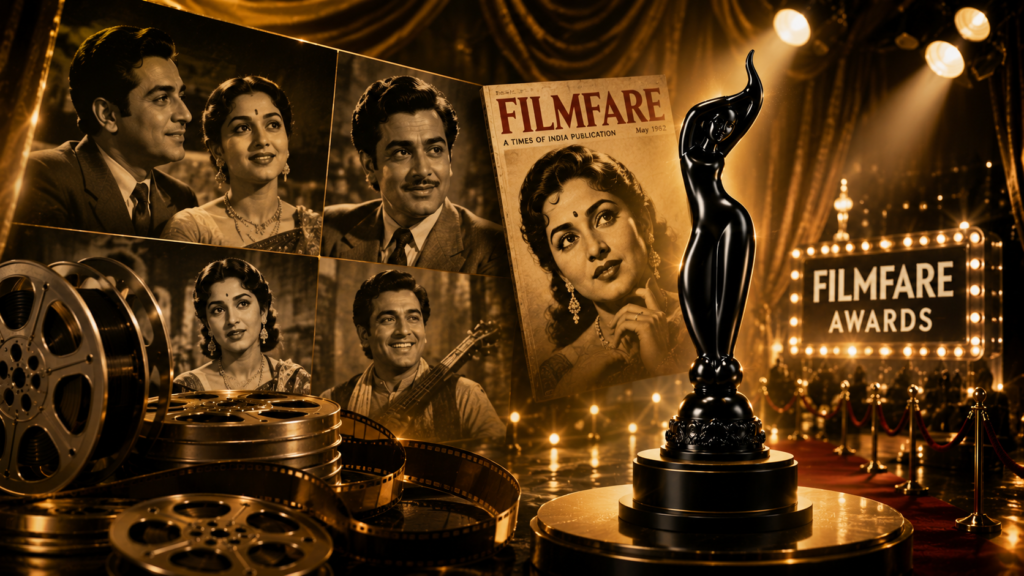
As Bollywood flourished during its Golden Era, the Filmfare Awards became one of the industry’s highest honors.
As the Indian film industry expanded, the awards gained prestige and became one of the most anticipated events on Bollywood’s annual calendar. Winning a Filmfare Award came to symbolize both critical recognition and lasting contribution to Indian cinema.
This remarkable period witnessed legendary filmmakers, actors, actresses, composers, lyricists, and playback singers receiving recognition for works that continue to influence Indian cinema today.
Bollywood’s creative renaissance during these decades provided the perfect environment for the Filmfare Awards to flourish. To explore this extraordinary period in greater detail, read our article on the Golden Era of Bollywood.
–– ✦ ✦ ––
🎶 Celebrating Music, Performance, and Storytelling
Unlike many international film awards, the Filmfare Awards have always reflected the unique role of music in Indian cinema.
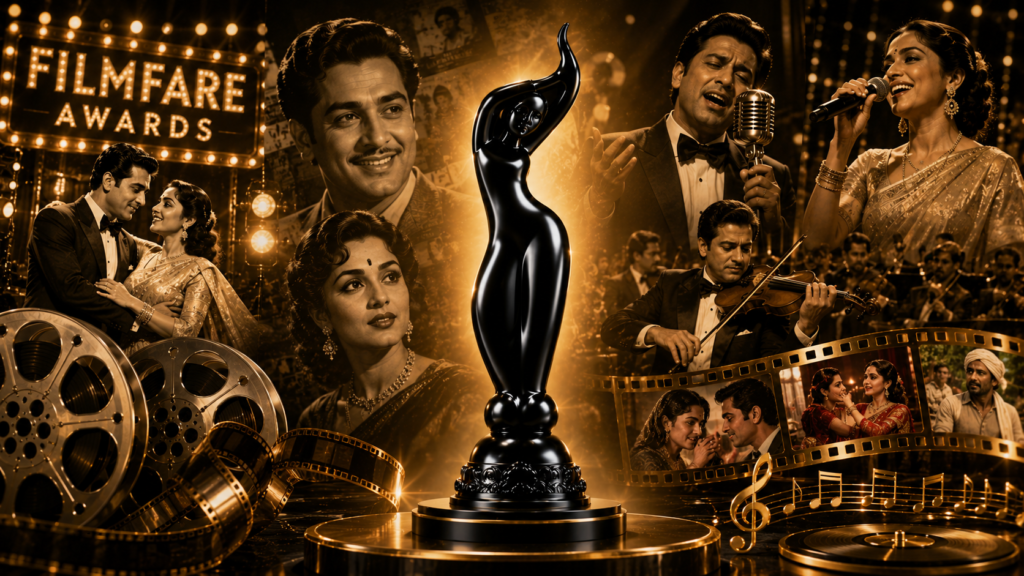
Filmfare’s recognition of music reflects the central role songs have always played in Bollywood storytelling.
As Bollywood musicals became an integral part of Indian popular culture, Filmfare gradually introduced awards recognizing playback singers, music directors, and lyricists alongside traditional acting and filmmaking categories.
These additions acknowledged that songs were not simply entertainment but essential elements of cinematic storytelling, often carrying a film’s emotional depth and cultural identity.
Many of Bollywood’s greatest musical legends—including composers, lyricists, and playback singers—received Filmfare recognition, helping preserve their artistic legacy for future generations.
The evolution of Bollywood’s unforgettable musical tradition is explored further in our article on Music in Bollywood: From Playback Singing to Modern Soundtracks.
–– ✦ ✦ ––
🎭 Expanding Categories and Changing Cinema
As Bollywood evolved, the Filmfare Awards continued to adapt to changing filmmaking practices and audience expectations.

New categories have enabled the Filmfare Awards to recognize excellence across every aspect of filmmaking.
New award categories were introduced to recognize achievements in screenplay writing, editing, cinematography, choreography, costume design, sound, visual effects, and numerous other creative disciplines that contribute to filmmaking.
The awards also evolved to acknowledge emerging talent, technical innovation, and changing cinematic styles, reflecting Bollywood’s transformation from a studio-driven industry into one embracing diverse storytelling and modern production techniques.
Today, the Filmfare Awards continue to celebrate excellence across a broad spectrum of artistic and technical achievements while adapting to the ever-changing landscape of Indian cinema.
–– ✦ ✦ ––
🌍 Filmfare’s Influence Beyond Bollywood
Although the Filmfare Awards were established to honor excellence in Hindi cinema, their influence has extended far beyond Bollywood.
Over the decades, Filmfare has helped shape public appreciation for quality filmmaking while inspiring similar award ceremonies across India’s diverse film industries. The recognition received by filmmakers, actors, musicians, and technicians has often contributed to preserving their legacy and introducing their work to new generations of audiences.
As Indian cinema gained international recognition, the Filmfare Awards also became an important cultural symbol, showcasing Bollywood’s growing influence across the world.
–– ✦ ✦ ––
💻 The Filmfare Awards in the Modern Era
The arrival of satellite television, digital media, and streaming platforms transformed how audiences experience the Filmfare Awards.

Today’s Filmfare Awards continue to evolve alongside India’s modern film industry and changing audience expectations.
What began as an industry event gradually evolved into one of India’s most widely watched entertainment ceremonies, reaching millions of viewers across the globe through television broadcasts and online platforms.
The awards have continued to evolve by recognizing changing storytelling styles, new filmmaking technologies, and emerging creative voices. While Bollywood itself has become increasingly global, the Filmfare Awards have remained one of its most enduring traditions.
As Bollywood entered the digital age, filmmaking continued to evolve through multiplex cinema, globalization, and streaming platforms. Explore this transformation in our article on the Modern Bollywood Era.
–– ✦ ✦ ––
🎥 Why the Filmfare Awards Still Matter
For generations of filmmakers and audiences alike, the Filmfare Awards have represented more than an annual awards ceremony.
Winning a Filmfare Award is widely regarded as one of Bollywood’s highest professional honors, recognizing artistic excellence, technical achievement, and memorable storytelling.
Beyond celebrating commercial success, the awards have highlighted performances, films, and creative contributions that continue to influence Indian cinema long after their original release.
For audiences, the Filmfare Awards provide an opportunity to rediscover timeless classics while celebrating the evolving creativity of contemporary Bollywood.
–– ✦ ✦ ––
📅 Timeline: Key Milestones in Filmfare Awards History
The history of the Filmfare Awards spans more than seven decades of Indian cinema. The timeline below highlights some of the major milestones that shaped the evolution of Bollywood’s most celebrated film awards.

The Filmfare Awards have evolved alongside Bollywood for more than seven decades, celebrating excellence across generations of Indian cinema.
1954 — The first Filmfare Awards ceremony is held in Mumbai.
1950s–1960s — The awards gain prestige during Bollywood’s Golden Era.
1960s — New categories gradually recognize playback singers, lyricists, and music directors.
1970s–1980s — Technical and creative award categories continue to expand.
1990s — Television broadcasts bring the Filmfare Awards to audiences across India.
2000s — Digital media and international audiences broaden the ceremony’s global reach.
2010s–Present — The awards continue to evolve alongside changing filmmaking styles, streaming platforms, and new generations of artists.
–– ✦ ✦ ––
🕊️ Legacy of the Filmfare Awards
The history of the Filmfare Awards reflects far more than the story of an annual awards ceremony. It mirrors the remarkable evolution of Bollywood itself—from the optimistic years following India’s independence to today’s globally connected film industry.
For over seventy years, the Filmfare Awards have celebrated unforgettable performances, timeless music, visionary filmmakers, and cinematic innovation. They have recognized artists whose work has entertained audiences, reflected changing social values, and enriched the cultural heritage of Indian cinema.
As Bollywood continues to evolve, the Filmfare Awards remain one of its most respected institutions, honoring the creativity, craftsmanship, and storytelling that have defined generations of Hindi filmmaking.
Like many of the world’s great film awards, the Filmfare Awards celebrate artistic excellence while preserving the cinematic legacy of their industry. Across the world, prestigious film awards have long recognized creative achievement while reflecting the unique traditions of their respective film industries. The Academy Awards play a similarly significant role in world cinema, recognizing outstanding achievements in filmmaking while remaining deeply rooted in Hollywood’s cinematic tradition.
Together, these two institutions reflect the enduring pursuit of excellence that has shaped both Bollywood and world cinema. To explore the origins and evolution of the Oscars, read our article on the History of the Academy Awards: From 1929 to the Present.
–– ✦ ✦ ––
Frequently Asked Questions (FAQs)
1. What are the Filmfare Awards?
The Filmfare Awards are annual awards presented by the Filmfare magazine of The Times Group to recognize excellence in Hindi cinema. Established in 1954, they honor outstanding achievements across acting, directing, music, technical crafts, and filmmaking, making them one of Bollywood’s most prestigious awards.
2. When were the first Filmfare Awards held?
The inaugural Filmfare Awards ceremony took place on 21 March 1954 in Mumbai. The event recognized outstanding achievements in Hindi cinema released during the previous year and marked the beginning of India’s most celebrated annual film awards.
3. Why are the Filmfare Awards important?
The Filmfare Awards have played a significant role in celebrating artistic excellence and encouraging high standards in Bollywood. For decades, they have recognized many of Indian cinema’s greatest films, actors, directors, musicians, writers, and technicians while preserving their contributions for future generations.
4. What is the Filmfare Black Lady Trophy?
The Black Lady is the iconic trophy presented to Filmfare Award winners. Designed by sculptor N. G. Pansare, the statuette has become one of the most recognizable symbols of excellence in Indian cinema since the awards began in 1954.
5. How are the Filmfare Awards different from the National Film Awards?
While the Filmfare Awards primarily recognize excellence in Hindi cinema and are organized by a private media group, the National Film Awards are presented by the Government of India and honor achievements across multiple Indian languages. Both are prestigious but differ in scope, selection process, and purpose.
6. Are the Filmfare Awards India’s equivalent of the Oscars?
The Filmfare Awards are often compared to the Academy Awards (Oscars) because both recognize excellence in filmmaking and have become iconic institutions in their respective film industries. However, Filmfare has developed its own identity by celebrating Bollywood’s unique traditions of storytelling, music, and performance.
7. Why do the Filmfare Awards continue to matter today?
The Filmfare Awards remain relevant because they continue to celebrate artistic excellence while adapting to changing filmmaking styles and audience expectations. Winning a Filmfare Award remains one of the highest recognitions in Bollywood and often becomes an important milestone in a filmmaker’s or artist’s career.
This article explores the historical evolution of the Filmfare Awards and their lasting significance in Bollywood. For readers interested in the latest Filmfare Awards ceremony, current award categories, recent winners, and official announcements, the Filmfare Awards official website provides the most up-to-date information.
🌐 Read in Hindi
Prefer reading this article in Hindi?
👉 हिंदी में पढ़ें:
फिल्मफेयर अवॉर्ड्स का इतिहास: 1954 से वर्तमान तक
This version of the article offers the same depth, perspective, and storytelling.
🔖 External sources are referenced for educational and historical context. All content rights and credits belong to their respective owners.