
From Hollywood’s Foreign Press to Eight Decades of Film, Television, and Entertainment Recognition.
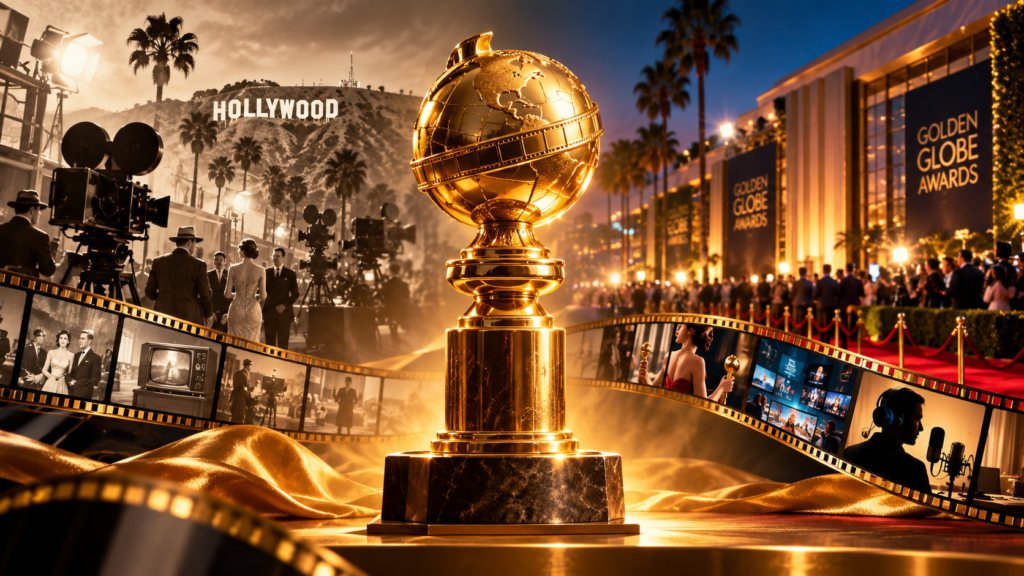
From Hollywood’s foreign press to modern entertainment recognition, the Golden Globes have evolved across more than eight decades.
AI-generated visual for The Reel Retro.
The history of the Golden Globe Awards traces their journey from a modest Hollywood ceremony organized by international journalists in 1944 to a major entertainment institution. Spanning more than eight decades, this evolution reflects the changing worlds of film, television, international recognition, and institutional reform.
Every year, the Golden Globe Awards bring together leading figures from film, television, and the wider entertainment industry. Beyond the glamour of red carpets and acceptance speeches, however, lies a fascinating history shaped by Hollywood’s changing culture, international journalism, technological advances, and debates over institutional credibility.
What began as an initiative by foreign correspondents in the 1940s gradually developed into an influential awards tradition. The Golden Globes established a distinctive identity by recognizing both film and television, separating dramatic productions from musicals and comedies, and celebrating achievements across national boundaries.
Unlike the Academy Awards, whose voting membership consists of film industry professionals, the Golden Globes developed through the participation of journalists reporting on Hollywood for international audiences. This difference helped shape their particular place in the entertainment awards landscape.
The institution’s journey has not been without controversy. Questions about representation, transparency, and voting practices eventually contributed to major reforms, including the dissolution of the Hollywood Foreign Press Association (HFPA) in 2023.
The 83rd Golden Globe Awards, held in January 2026, marked another milestone with the introduction of the Best Podcast category, extending recognition beyond traditional film and television.
From its early Hollywood beginnings to its evolving role in contemporary entertainment, the history of the Golden Globes offers a revealing perspective on how artistic achievement is celebrated—and how the institutions behind these celebrations change over time.
📑 In This Article
Golden Globe Awards: At a Glance
| Historical milestone | Key detail |
|---|---|
| Founding organization | Hollywood Foreign Correspondents Association (HFCA) |
| Founding association established | 1943 |
| First awards presentation | February 11, 1944 |
| First ceremony location | 20th Century Fox Studios, Los Angeles, California |
| Original purpose | Recognizing excellence in motion pictures |
| Television recognition | Introduced during the 1950s |
| Hollywood Foreign Press Association formed | 1955 |
| Major institutional restructuring | HFPA dissolved and Golden Globes reorganized in 2023 |
| Latest ceremony covered | 83rd Golden Globe Awards — January 11, 2026 |
| New category in 2026 | Best Podcast (inaugural award) |
–– ✦ ✦ ––
The Birth of the Golden Globe Awards (1943–1946)
The Golden Globe Awards emerged during World War II, when foreign journalists covering Hollywood sought greater professional cooperation and recognition for cinematic achievement. Between 1943 and 1946, their initiative developed from a small journalists’ association into an annual awards tradition, complete with its first ceremonies and a distinctive globe-shaped trophy.
Foreign Journalists and Hollywood During World War II
The origins of the Golden Globe Awards can be traced to Hollywood during World War II, at the height of the Golden Age of Hollywood, when American cinema had already established a substantial international audience. Films produced by major Hollywood studios reached viewers across national borders, while interest in American filmmakers, actors, and productions continued to grow.
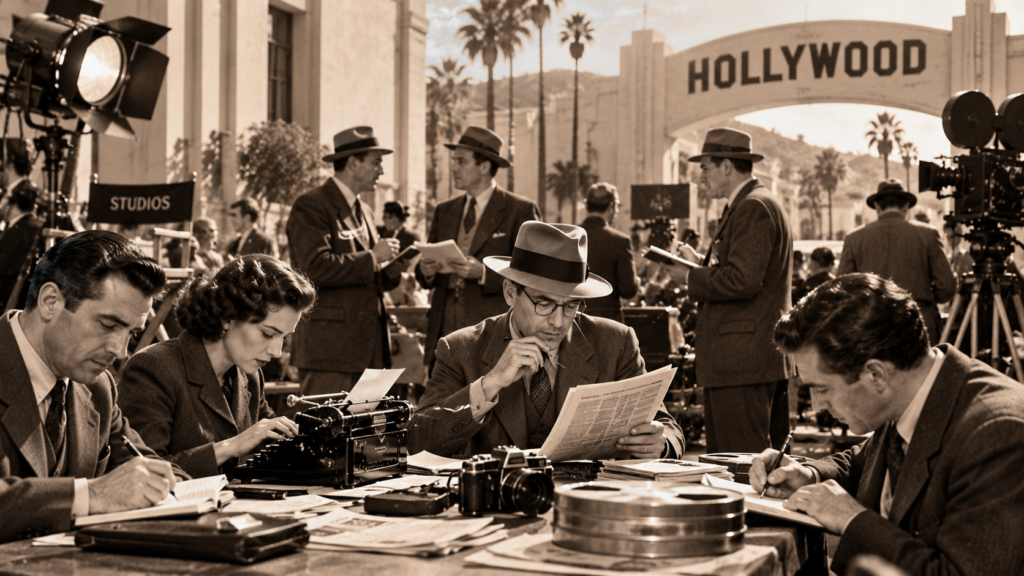
Foreign correspondents covering Hollywood established the Hollywood Foreign Correspondents Association in 1943.
AI-generated visual for The Reel Retro.
Foreign journalists based in Los Angeles played an important role in reporting Hollywood news to audiences abroad. However, obtaining interviews, accessing studios, and maintaining professional relationships with the film industry presented challenges for correspondents representing international publications.
In 1943, a group of these journalists established the Hollywood Foreign Correspondents Association (HFCA) to strengthen professional cooperation and improve access to Hollywood’s filmmaking community.
The association initially focused on facilitating the work of foreign correspondents, but its members soon developed another ambition: recognizing outstanding achievements in American motion pictures.
This initiative laid the foundation for an awards tradition that would eventually become one of Hollywood’s most prominent annual events.
The First Golden Globe Awards in 1944
The first Golden Globe Awards presentation took place on February 11, 1944, at 20th Century Fox Studios in Los Angeles, honoring achievements in films released during 1943.
Unlike today’s elaborate televised ceremonies, the inaugural event was a modest, informal gathering organized by members of the Hollywood Foreign Correspondents Association.
Among the first recipients were:
- Best Film: The Song of Bernadette (1943)
- Best Actress: Jennifer Jones for The Song of Bernadette (1943)
- Best Actor: Paul Lukas for Watch on the Rhine (1943)
Rather than receiving the familiar golden statuettes, the winners were presented with commemorative scrolls recognizing their achievements.
The success of this initial presentation encouraged the association to continue its awards initiative, establishing a new tradition in which international journalists recognized Hollywood’s cinematic achievements.
Although modest in scale, the 1944 ceremony marked the beginning of an institution that would grow alongside the American entertainment industry.
The Origins of the Golden Globe Trophy
The distinctive Golden Globe statuette, now closely associated with Hollywood’s awards culture, was not part of the inaugural ceremony.
In 1945, members of the association organized a competition to develop a trophy design that would reflect the organization’s international character.
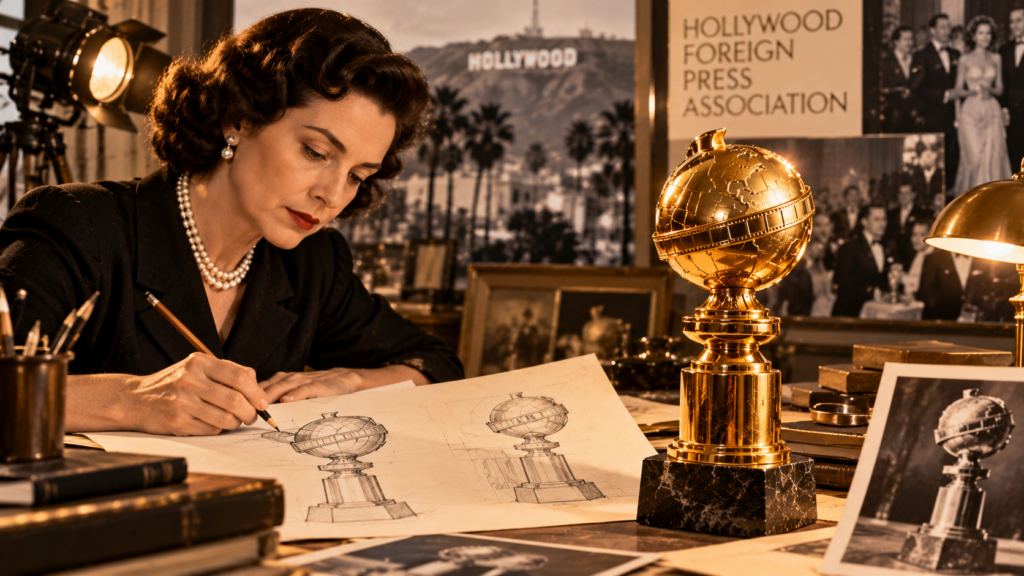
The globe-shaped trophy, proposed by Marina Cisternas, became a defining symbol of the Golden Globes in 1946.
AI-generated visual for The Reel Retro.
Marina Cisternas, who served as association president during 1945–1946, proposed a golden globe resting on a cylindrical pedestal. The design symbolized the worldwide perspective of the foreign journalists who had established the awards.
The globe-shaped statuette was first presented on March 30, 1946, at the Hollywood Knickerbocker Club, giving the ceremony a recognizable visual identity that would endure through subsequent decades.
Meanwhile, the awards had already begun developing a more formal public presence. On April 16, 1945, the association held its first gala banquet at the Beverly Hills Hotel, marking a transition from the modest inaugural gathering toward a more established Hollywood social event.
Together, these early developments—the creation of the journalists’ association, the first awards presentation, the formal banquet, and the introduction of the trophy—laid the foundations for the Golden Globes’ emergence as a lasting institution in entertainment history.
–– ✦ ✦ ––
The Golden Globes Find Their Identity (1950s–1960s)
The 1950s and 1960s were formative decades in the history of the Golden Globe Awards. During this period, the organization underwent significant changes, introduced award categories that distinguished it from other Hollywood ceremonies, and expanded its recognition beyond motion pictures to include television.
These developments helped transform the Golden Globes from a relatively small initiative of foreign journalists into an increasingly established institution within Hollywood’s entertainment culture.
The Formation of the Hollywood Foreign Press Association
In 1950, disagreements among members led to a division within the original journalists’ organization. The Hollywood Foreign Correspondents Association continued presenting the Golden Globe Awards, while a separate group, the Foreign Press Association of Hollywood, established its own awards.
The split lasted until 1955, when the two organizations reunited to form the Hollywood Foreign Press Association (HFPA).
For nearly seven decades, the HFPA administered the Golden Globes, maintaining relationships with Hollywood studios, performers, and international media representatives.
This distinction is important to the awards’ history: although the Golden Globes originated with the Hollywood Foreign Correspondents Association in 1943, the HFPA became the organization most closely identified with the ceremony until its dissolution in 2023.
Why Drama and Musical or Comedy Became Separate Categories
One of the Golden Globes’ most recognizable features emerged in 1951, when the awards introduced separate categories for dramatic films and musicals or comedies.
The distinction allowed different filmmaking traditions to receive recognition within their respective genres. Rather than placing every production in direct competition for a single major film award, the Golden Globes created separate opportunities to acknowledge dramatic storytelling and lighter or musically driven entertainment.
Over time, this approach also became a defining feature of the acting awards, with leading performances recognized in Drama and Musical or Comedy categories.
The division remains a notable difference between the Golden Globes and the Academy Awards, whose principal Best Picture and leading-acting categories do not follow the same genre-based structure.
By introducing this system, the Golden Globes established an awards identity that distinguished them from other major Hollywood honors.
The Cecil B. DeMille Award and Recognition of Lifetime Achievement
In 1952, the Golden Globes introduced the Cecil B. DeMille Award, an honorary distinction recognizing outstanding contributions to the entertainment industry.
Its first recipient was Cecil B. DeMille himself, a pioneering Hollywood filmmaker whose career spanned the silent era and the transition to sound cinema.
Unlike competitive awards honoring individual films or performances, the Cecil B. DeMille Award celebrated sustained professional achievement and lasting influence on the entertainment industry.
Over subsequent decades, the distinction recognized numerous influential figures in cinema, reflecting the Golden Globes’ growing commitment to honoring both contemporary accomplishments and Hollywood’s historical legacy.
Television Enters the Golden Globes
During the 1950s, television emerged as a powerful new force in American entertainment, presenting a growing challenge to Hollywood’s traditional film industry. As more households acquired television sets, broadcasting began reshaping audience habits, storytelling formats, and Hollywood’s relationship with the public.
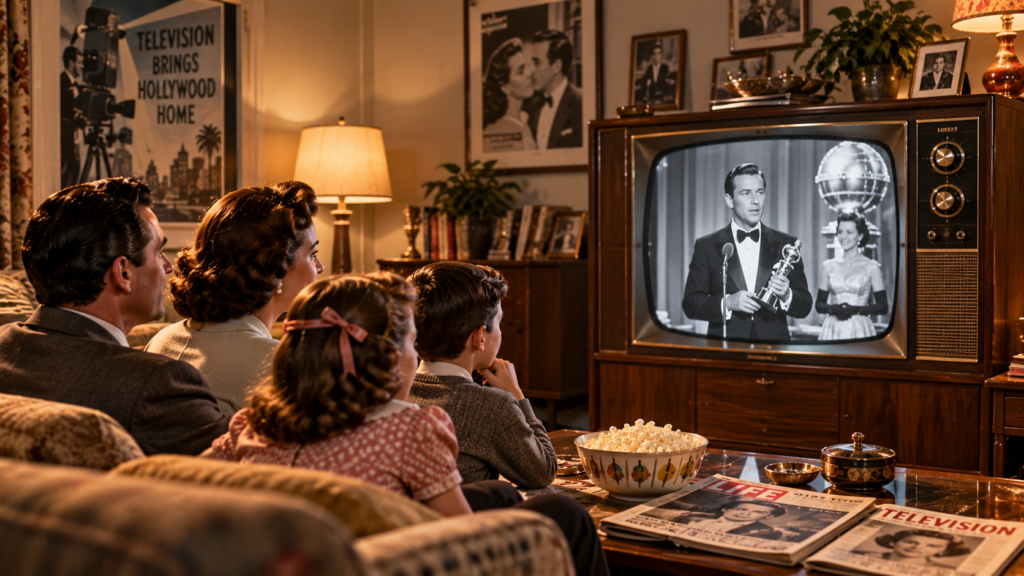
As television transformed American entertainment, the Golden Globes began recognizing television achievements in the 1950s.
AI-generated visual for The Reel Retro.
The Golden Globes gradually responded to this changing entertainment landscape by extending their recognition beyond motion pictures.
Television achievements first received Golden Globe recognition in 1956, and the awards expanded their television categories in the following years, including further recognition in 1957.
This development became one of the institution’s defining characteristics. Unlike the Academy Awards, which concentrate on motion pictures, the Golden Globes evolved into a ceremony recognizing achievements in both film and television.
The decision would gain even greater significance as television progressed from traditional network broadcasting to cable channels, premium programming, and eventually global streaming platforms.
–– ✦ ✦ ––
Hollywood Glamour and the Golden Globes’ Growing Influence (1970s–1990s)
The 1970s marked a period of profound transformation in American cinema. A new generation of filmmakers challenged established studio conventions, introducing more complex characters, unconventional narratives, and stories that reflected changing social attitudes.
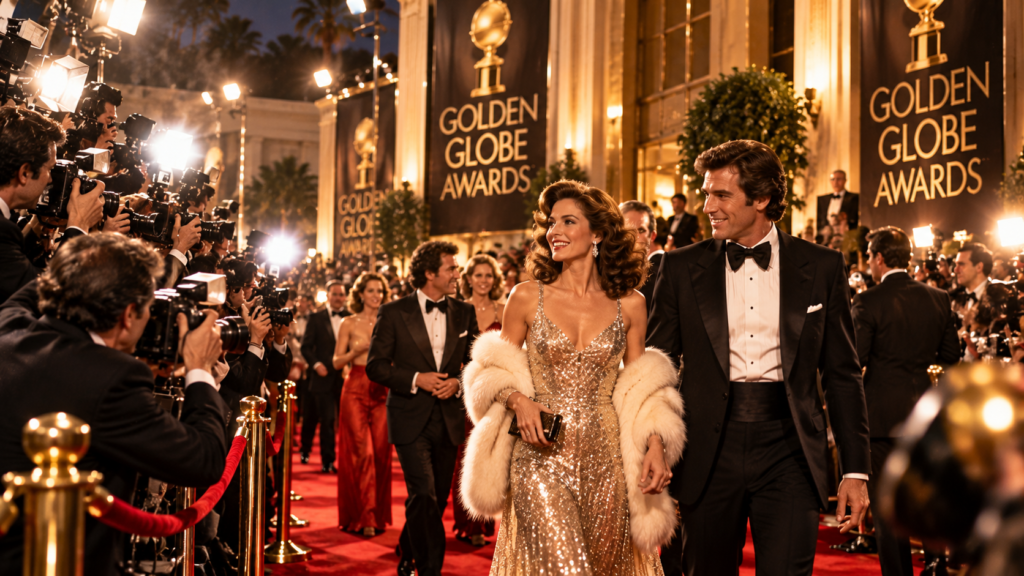
From the 1970s through the 1990s, televised ceremonies and celebrity culture strengthened the Golden Globes’ public visibility.
AI-generated visual for The Reel Retro.
As Hollywood’s creative and commercial landscape evolved, the Golden Globe Awards gained greater visibility, developing from an industry-focused celebration into an increasingly prominent event in American entertainment culture.
The New Hollywood Era and Changing Film Culture
The New Hollywood movement, which emerged during the late 1960s and flourished throughout the 1970s, reshaped American filmmaking by giving directors greater creative influence and encouraging experimentation with established storytelling traditions.
Filmmakers such as Francis Ford Coppola, Martin Scorsese, and Steven Spielberg became central figures in this transformation, although their approaches differed considerably.
Films such as The Godfather (1972), Taxi Driver (1976), and Jaws (1975) illustrated the era’s diversity—from crime dramas and psychologically complex narratives to commercially successful spectacle-driven filmmaking.
The Golden Globes reflected these changes by recognizing many of the filmmakers, performances, and productions associated with contemporary American cinema. Their distinct Drama and Musical or Comedy categories also provided multiple avenues for films and performers to gain recognition.
As Hollywood moved toward the blockbuster-oriented industry of the 1980s and 1990s, the Golden Globes continued to reflect changing cinematic tastes and the evolving relationship between artistic achievement and commercial success.
From Industry Recognition to a Major Entertainment Event
During the 1970s, 1980s, and 1990s, the Golden Globe Awards became increasingly visible beyond Hollywood’s professional circles.
Television broadcasts, celebrity appearances, red-carpet coverage, and memorable acceptance speeches helped transform the ceremony into a widely followed entertainment event. The growing attention of newspapers, magazines, and television networks further strengthened its public profile.
Unlike the more formal presentation traditionally associated with the Academy Awards, the Golden Globes developed a reputation for a comparatively relaxed atmosphere, with film and television personalities gathering in a shared social setting.
This combination of competitive recognition and celebrity culture contributed to the ceremony’s distinctive appeal.
By the 1990s, the Golden Globes had secured a prominent place in Hollywood’s annual awards calendar, attracting attention not only for their winners but also for the personalities, speeches, and cultural moments surrounding the event.
However, increased visibility also brought greater scrutiny of the Hollywood Foreign Press Association, particularly concerning its membership, voting practices, and relationships with the entertainment industry. These questions would become increasingly significant in the decades ahead.
–– ✦ ✦ ––
The Golden Globes in the 21st Century: Global Cinema, Animation and Streaming
The 21st century brought far-reaching changes to the global entertainment industry. Digital filmmaking, computer-generated imagery (CGI), international distribution, and the rise of streaming platforms transformed how films and television programs were produced, distributed, and experienced by audiences.
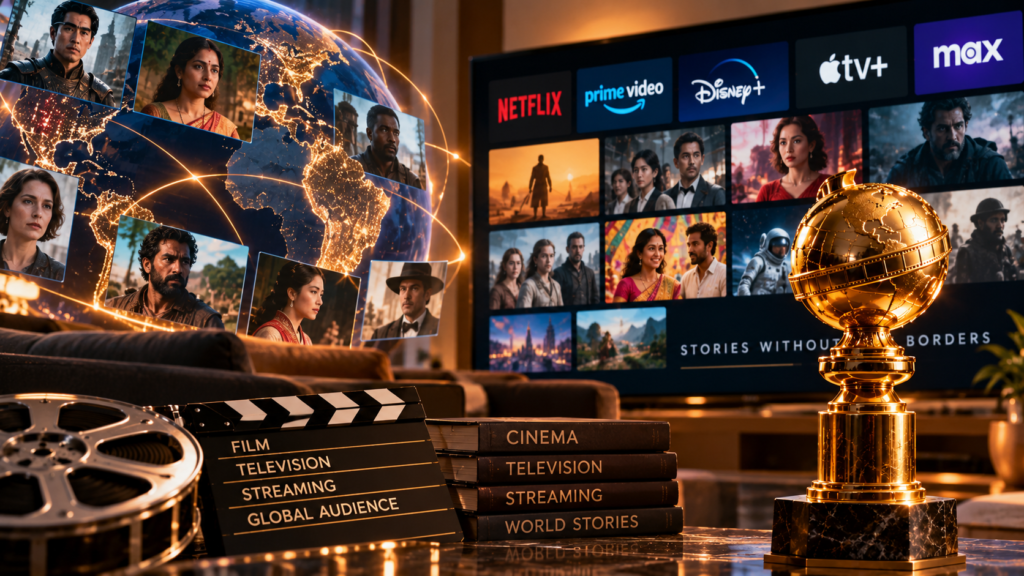
Streaming platforms and international productions reshaped the entertainment landscape recognized by the Golden Globes.
AI-generated visual for The Reel Retro.
As the boundaries between traditional cinema, television, and digital entertainment evolved, the Golden Globes adapted to an increasingly interconnected media landscape. New award categories, greater attention to international productions, and the growing prominence of streaming content reflected these changes.
Recognizing Animated Feature Films
In 2007, the Golden Globes introduced the Best Motion Picture – Animated category, giving feature-length animated films a dedicated place within the awards.
The inaugural nominees were Cars (2006), Happy Feet (2006), and Monster House (2006), with Pixar’s Cars receiving the first award.
The introduction of this category acknowledged animation’s growing importance as a major form of cinematic storytelling. Advances in computer-generated imagery had expanded the creative possibilities of animation, while animated features increasingly attracted audiences across different age groups and national markets.
By recognizing animation separately, the Golden Globes provided another prominent platform for celebrating achievements in a medium that combined visual innovation, storytelling, and technical artistry.
International Films and the Golden Globes
The Golden Globes have maintained an international identity since their founding by foreign correspondents covering Hollywood. However, the recognition of films produced outside the United States developed through changing award categories and eligibility practices.
During the 1950s and early 1960s, the Samuel Goldwyn International Award recognized films from outside the United States, reflecting an early effort to acknowledge cinematic achievement beyond Hollywood.
Over subsequent decades, international-film recognition evolved through various categories, eventually taking the form of the contemporary Best Motion Picture – Non-English Language award.
In the 21st century, films such as Roma (2018) and Parasite (2019) demonstrated how non-English-language cinema could gain substantial visibility within international awards culture.
These developments reflected the growing circulation of films across national and linguistic boundaries, supported by film festivals, international distribution, and, increasingly, streaming platforms.
Nevertheless, international recognition has not always meant equal visibility for every filmmaking tradition. Distribution opportunities, publicity, eligibility requirements, and voting practices continue to influence which films reach major awards ceremonies.
The Streaming Revolution and Changing Television Culture
The rapid expansion of streaming platforms during the 2010s and 2020s transformed the relationship between films, television programs, and their audiences.
Services such as Netflix and Amazon Prime Video introduced new distribution models, allowing productions to reach viewers across countries without depending entirely on traditional theatrical releases or broadcast schedules.
For the Golden Globes, this shift brought streaming-produced films and television programs into established award categories, challenging older distinctions between theatrical cinema, network television, and digital entertainment.
Television dramas, comedies, and limited series distributed through streaming platforms became increasingly prominent during awards season. Productions such as House of Cards and The Crown illustrated the growing recognition of streaming-era television within the Golden Globes.
Although film and television continued to be evaluated through separate award categories, these changing distribution models formed part of Hollywood’s broader digital transformation, reshaping how screen entertainment was created, consumed, and celebrated.
The Carol Burnett Award and Television Legacy
In 2018, the Golden Globes announced the creation of the Carol Burnett Award, an honorary distinction recognizing outstanding contributions to television.
The award was presented for the first time in January 2019, with Carol Burnett herself becoming its inaugural recipient.
A pioneering performer and comedian, Burnett helped shape American television entertainment through her work in variety programming, comedy, and performance.
The establishment of this award acknowledged television’s cultural importance and its lasting influence on popular entertainment.
Alongside the Cecil B. DeMille Award, traditionally associated with distinguished careers in film, the Carol Burnett Award strengthened the Golden Globes’ commitment to recognizing exceptional contributions across both major screen industries.
–– ✦ ✦ ––
Controversies, Criticism, and Institutional Reform
The history of the Golden Globe Awards includes not only Hollywood glamour and artistic recognition but also recurring questions about the credibility of the institution behind them.
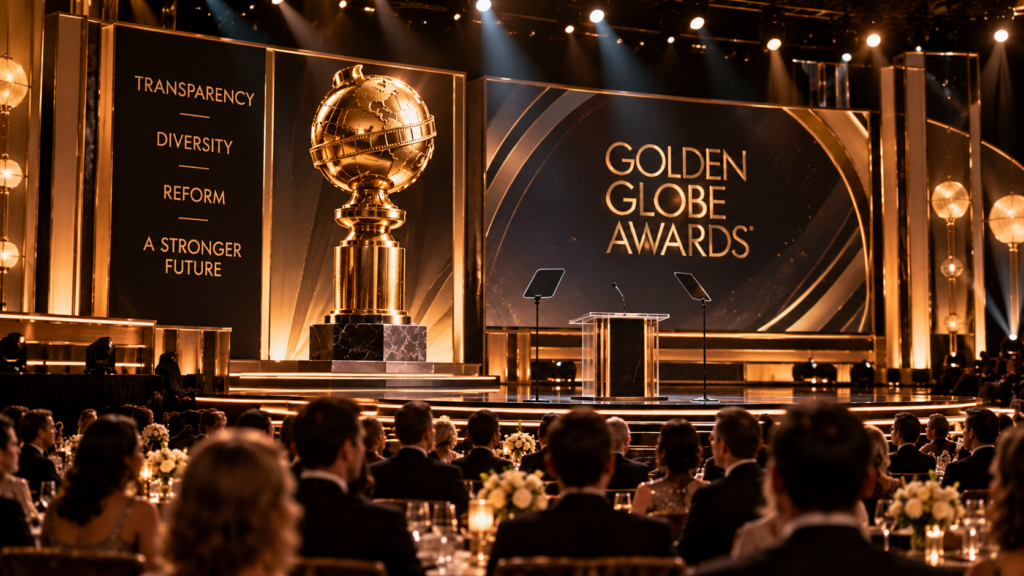
The 2023 restructuring marked a major turning point in the Golden Globes’ organization and governance.
AI-generated visual for The Reel Retro.
Concerns about voting practices, membership diversity, transparency, and professional ethics intensified in the early 2020s. The resulting controversy prompted widespread criticism, disrupted the awards’ television broadcast, and ultimately contributed to a fundamental restructuring of the organization.
Criticism of the Hollywood Foreign Press Association
For decades, the Hollywood Foreign Press Association (HFPA) operated with a relatively small group of journalists responsible for selecting Golden Globe nominees and winners. Critics questioned whether its membership, internal procedures, and relationships with Hollywood studios provided sufficient transparency and accountability.
In February 2021, an investigation by the Los Angeles Times brought renewed attention to allegations of ethical and financial improprieties. It also revealed that the HFPA, then comprising approximately 87 members, had no Black members.
The findings intensified concerns about representation within an organization responsible for recognizing achievements across an increasingly diverse international entertainment industry.
The criticism extended well beyond the media. Prominent performers, publicists, studios, and entertainment companies called for meaningful changes, while several organizations suspended cooperation with the HFPA.
Although the association announced reforms addressing membership diversity, governance, and professional conduct, questions remained about whether those measures would restore confidence in the awards.
The 2022 Broadcast Interruption
The controversy soon had direct consequences for the Golden Globes’ public presentation.
In May 2021, NBC announced that it would not televise the 2022 Golden Globe Awards, explaining that the HFPA needed additional time to implement meaningful institutional reforms.
The 79th Golden Globe Awards nevertheless proceeded on January 9, 2022, as a private event without the customary televised ceremony, celebrity audience, or red-carpet celebrations. Winners were announced publicly, but the event lacked the extensive broadcast coverage that had become central to the Golden Globes’ identity.
The interruption represented a significant setback for an awards ceremony that had spent decades building its reputation as a major Hollywood entertainment event.
It also demonstrated how concerns about governance and credibility could affect an awards institution’s relationships with broadcasters, studios, and the wider entertainment industry.
The ceremony returned to NBC in January 2023, but the organizational transformation was not yet complete.
The Dissolution of the HFPA in 2023
A decisive institutional change followed in June 2023, when Dick Clark Productions and Eldridge acquired the Golden Globes’ assets, rights, and properties from the Hollywood Foreign Press Association.
The transaction resulted in the winding down of the HFPA and its membership, ending the organization’s long-standing role in administering the awards.
Under the new arrangement, the Golden Globes moved from a membership-led nonprofit association to a commercially operated awards enterprise, with Dick Clark Productions and its partners responsible for producing and developing the ceremony.
A separate nonprofit organization, the Golden Globe Foundation, was established to continue the charitable and philanthropic activities associated with the former HFPA, including support for film-related education and cultural initiatives.
This restructuring marked a major turning point in the awards’ history. Although the Golden Globes retained their name and international-journalist voting tradition, the institutional structure that had governed them for decades had fundamentally changed.
How Golden Globe Voting Changed
The Golden Globes’ restructuring also brought changes to the organization and composition of its voting body.
Rather than relying exclusively on the former HFPA membership, nominations and winners are now determined by a broader group of international entertainment journalists selected under established eligibility and professional standards.
The revised voting framework includes provisions concerning journalistic qualifications, conflicts of interest, and ethical conduct. It was designed to expand international participation and address concerns about the transparency and credibility of the previous system.
By October 2023, the Golden Globes had announced a voting body of 300 journalists representing 76 countries for the 81st awards ceremony, illustrating the scale of the changes introduced after the HFPA’s dissolution.
Nevertheless, institutional reform does not automatically resolve every question about fairness, representation, or the influence of awards within the entertainment industry.
The Golden Globes’ experience illustrates how public scrutiny, changing cultural expectations, and demands for accountability can reshape even long-established Hollywood institutions.
–– ✦ ✦ ––
Golden Globes vs Oscars: How Are They Different?
The Golden Globe Awards and the Academy Awards (Oscars) are among Hollywood’s most recognizable entertainment honors. Although both celebrate cinematic achievement, they differ in their origins, voting bodies, award categories, and overall scope.
The Oscars, first presented in 1929, are organized by the Academy of Motion Picture Arts and Sciences, whose membership consists of professionals working across the film industry. The Golden Globes, established in 1944 by foreign correspondents covering Hollywood, developed a distinct tradition of journalist-led voting and recognition extending beyond motion pictures.
These differences help explain why the two ceremonies sometimes honor the same films and performers while producing different results.
| Feature | Golden Globe Awards | Academy Awards (Oscars) |
|---|---|---|
| First ceremony | 1944 | 1929 |
| Historical origins | Hollywood-based foreign correspondents | Academy of Motion Picture Arts and Sciences |
| Principal voters | International entertainment journalists | Academy members from the film industry |
| Entertainment coverage | Film, television, and podcasts (since 2026) | Motion pictures |
| Best Picture categories | Separate Drama and Musical or Comedy awards | One principal Best Picture award |
| Career achievement recognition | Cecil B. DeMille Award | Academy Honorary Award and other honorary distinctions |
Do Golden Globe Winners Predict Oscar Winners?
Golden Globe results often influence public discussions about potential Academy Award contenders because both ceremonies recognize many of the same films and performers during Hollywood’s annual awards season.
A Golden Globe victory can increase a film’s visibility, strengthen its awards-season profile, and draw attention to performances that may also be considered for Oscars.
However, Golden Globe winners do not necessarily become Oscar winners. The two institutions have different voting bodies, eligibility requirements, and award structures. In particular, the Golden Globes’ separate Drama and Musical or Comedy categories can produce multiple winners where the Academy recognizes only one.
Although the Golden Globes can offer an early indication of awards-season momentum, their results should not be treated as reliable predictions of Academy Award outcomes.
Both ceremonies remain influential, but each reflects a different approach to recognizing achievements in entertainment.
–– ✦ ✦ ––
The 83rd Golden Globe Awards (2026): A New Chapter in Entertainment Recognition
The 83rd Golden Globe Awards, held on January 11, 2026, at the Beverly Hilton in Beverly Hills, California, celebrated achievements across film and television while introducing a significant new category for podcasting.
Hosted by comedian Nikki Glaser, the ceremony brought together established filmmakers, international productions, streaming-era television series, and emerging forms of entertainment.
More than eight decades after the inaugural awards presentation in 1944, the 2026 ceremony offered a contemporary illustration of how the Golden Globes continued to evolve while maintaining their longstanding traditions.
Major Winners of the 2026 Golden Globe Awards
The 83rd ceremony recognized achievements across a wide range of film and television categories. Among the notable winners were:
| Award category | Winner |
|---|---|
| Best Motion Picture – Drama | Hamnet |
| Best Motion Picture – Musical or Comedy | One Battle After Another |
| Best Director – Motion Picture | Paul Thomas Anderson — One Battle After Another |
| Best Motion Picture – Animated | KPop Demon Hunters |
| Best Motion Picture – Non-English Language | The Secret Agent (Brazil) |
| Best Television Series – Drama | The Pitt |
| Best Television Series – Musical or Comedy | The Studio |
| Best Television Limited Series, Anthology Series or Motion Picture Made for Television | Adolescence |
One Battle After Another, directed by Paul Thomas Anderson, emerged as the ceremony’s most-awarded film, winning four Golden Globes, including Best Motion Picture – Musical or Comedy, Best Director, Best Screenplay, and Best Supporting Female Actor for Teyana Taylor.
Hamnet, directed by Chloé Zhao, received Best Motion Picture – Drama, while the Brazilian film The Secret Agent won Best Motion Picture – Non-English Language. The animated musical KPop Demon Hunters also received recognition, reflecting the continued prominence of animation in contemporary cinema.
In television, The Pitt, The Studio, and Adolescence won the principal awards for drama, musical or comedy, and limited-series programming, respectively.
Together, these results demonstrated the breadth of the Golden Globes’ contemporary recognition, encompassing theatrical filmmaking, international cinema, animation, and television productions distributed through traditional and streaming platforms.
The First Golden Globe for Best Podcast
One of the ceremony’s most historically significant developments was the introduction of the Best Podcast category, extending Golden Globe recognition beyond its traditional film and television awards.
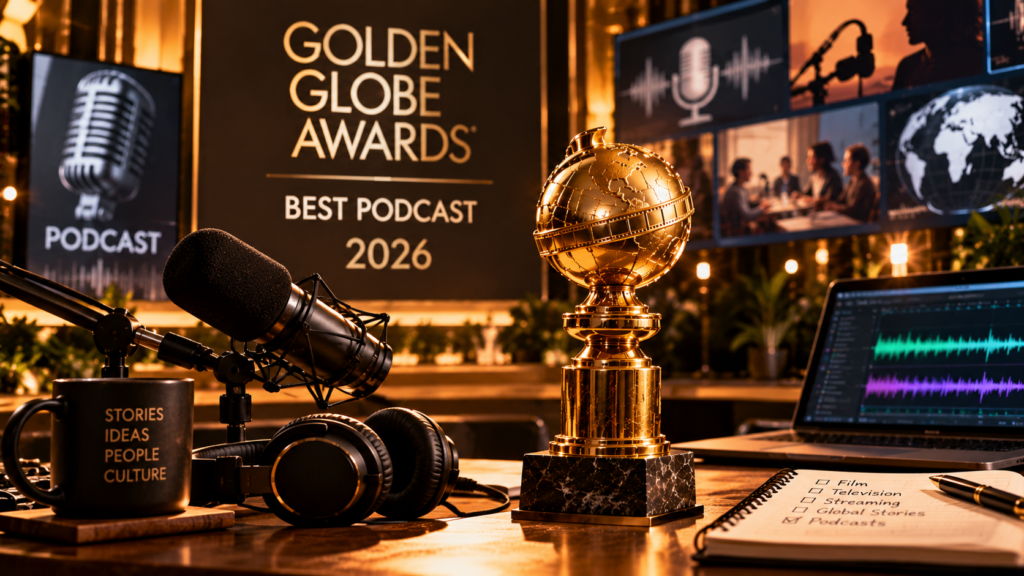
The inaugural Best Podcast award in 2026, won by Good Hang with Amy Poehler, marked the Golden Globes’ expansion into audio entertainment.
AI-generated visual for The Reel Retro.
The inaugural award went to Good Hang with Amy Poehler, a comedy and interview podcast hosted by actress and comedian Amy Poehler.
Podcasting had become an established form of digital entertainment, encompassing interviews, documentary storytelling, comedy, news, and cultural commentary. Its growing popularity reflected changing audience habits and the expansion of entertainment beyond conventional screen-based formats.
By recognizing a podcast for the first time in 2026, the Golden Globes acknowledged this evolving media landscape and broadened the range of creative work eligible for their honors.
The decision represented another step in the institution’s history of expanding its scope—from motion pictures in the 1940s to television in the 1950s and podcasting in the 2020s.
What the 2026 Ceremony Reveals About the Golden Globes
Viewed against the awards’ longer history, the 2026 ceremony illustrated three aspects of their evolving identity.
International recognition remained important, with the success of Brazil’s The Secret Agent highlighting the continued presence of non-English-language cinema within the awards.
Film and television recognition continued to define the ceremony, reflecting the expansion that began during the 1950s and later adapted to the growth of streaming entertainment.
Recognition beyond screen media marked a newer development, as the Best Podcast category brought audio-based entertainment into the Golden Globes’ established awards structure.
These developments demonstrated how the Golden Globes could preserve their historical identity while adapting to changing creative practices, distribution technologies, and audience expectations.
–– ✦ ✦ ––
The Legacy of the Golden Globe Awards
Across more than eight decades, the Golden Globe Awards have established a distinctive place in Hollywood’s cultural and entertainment history. What began as an initiative by foreign journalists evolved into an internationally recognized awards tradition, reflecting changes in filmmaking, television, and the wider entertainment landscape.
The Golden Globes’ lasting identity rests partly on their approach to recognition. By honoring both film and television, distinguishing between Drama and Musical or Comedy, and celebrating influential careers through honorary awards, the institution developed traditions that set it apart from other major entertainment honors.
Beyond recognizing individual achievements, the Golden Globes have also helped shape awards-season conversations, bringing attention to filmmakers, performers, and productions from different creative traditions. Their international origins and evolving categories have contributed to their recognizable position within Hollywood’s awards culture.
Yet their legacy is not defined by prestige alone. The controversies surrounding the Hollywood Foreign Press Association and its dissolution in 2023 demonstrated that even long-established cultural institutions face growing expectations of transparency, representation, and accountability.
The introduction of the Best Podcast category in 2026 further illustrated the awards’ willingness to recognize emerging forms of entertainment while maintaining their historical connections to film and television.
Ultimately, the Golden Globes’ significance extends beyond trophies, celebrity appearances, and individual winners. Their history offers a broader perspective on how artistic achievement is recognized, how entertainment industries evolve, and how the institutions celebrating them respond to changing cultural expectations.
–– ✦ ✦ ––
Conclusion: From Hollywood’s Foreign Press to an Evolving Entertainment Institution
From a modest gathering of international journalists in 1944 to a prominent entertainment awards ceremony, the Golden Globes have undergone a remarkable transformation. Their journey reflects not only changes in filmmaking and television but also the evolving ways in which artistic achievement is recognized and celebrated.
The 83rd Golden Globe Awards in 2026, with the introduction of the Best Podcast category, illustrated how an institution originally devoted to motion pictures continues to broaden its understanding of entertainment.
Ultimately, the history of the Golden Globe Awards reveals that awards ceremonies are more than celebrations of individual talent. They are also reflections of the industries, cultural expectations, and institutions that shape the recognition of creative achievement.
–– ✦ ✦ ––
Frequently Asked Questions (FAQs)
When were the Golden Globe Awards first held?
The first Golden Globe Awards presentation took place on February 11, 1944, at 20th Century Fox Studios in Los Angeles, California. Organized by the Hollywood Foreign Correspondents Association, the ceremony recognized achievements in films released during 1943.
Who founded the Golden Globe Awards?
The Golden Globe Awards were established by the Hollywood Foreign Correspondents Association (HFCA), founded in 1943 by international journalists covering the American film industry. The organization sought to strengthen professional cooperation and recognize outstanding Hollywood filmmaking.
What is the difference between the Golden Globes and the Oscars?
The Golden Globes are voted on by international entertainment journalists and recognize achievements in film, television, and, since 2026, podcasting. The Oscars are voted on by members of the Academy of Motion Picture Arts and Sciences and focus on motion pictures.
Why do the Golden Globes have separate Drama and Musical or Comedy categories?
The Golden Globes introduced separate Drama and Musical or Comedy categories in 1951 to recognize different filmmaking traditions. This distinction allows dramatic films and performances to receive recognition separately from musicals and comedies.
What happened to the Hollywood Foreign Press Association?
The Hollywood Foreign Press Association (HFPA) was dissolved in 2023 following the acquisition and restructuring of the Golden Globes. The awards moved to a commercial ownership structure, while the nonprofit Golden Globe Foundation was established to continue charitable and educational activities.
What was new at the 2026 Golden Globe Awards?
The 83rd Golden Globe Awards, held on January 11, 2026, introduced the Best Podcast category. Good Hang with Amy Poehler became the inaugural winner, marking the awards’ expansion beyond traditional film and television recognition.
🌐 Read in Hindi
Prefer reading this article in Hindi?
👉 हिंदी में पढ़ें:
गोल्डन ग्लोब अवार्ड्स का इतिहास: 1944 से आज तक
This version of the article offers the same depth, perspective, and storytelling.
🔖 External sources are referenced for educational and historical context. All content rights and credits belong to their respective owners.