
Where Literature, Realism, and Human Stories Transformed Indian Cinema
ENG | हिंदी
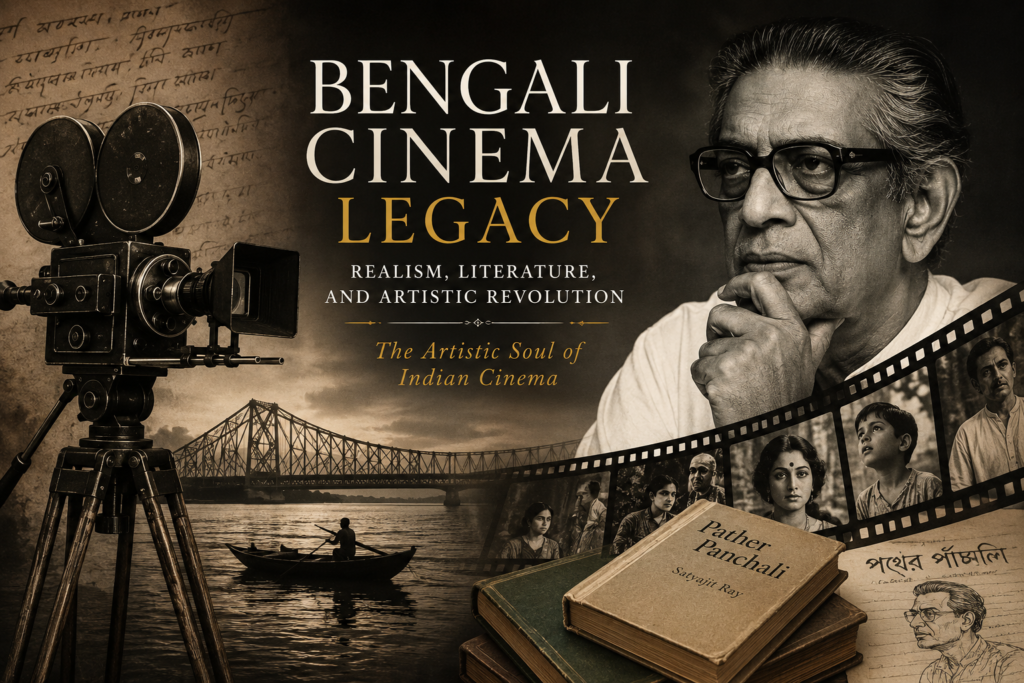
The Bengali cinema legacy shaped artistic Indian filmmaking through realism, literature, and emotional storytelling.
The Bengali cinema legacy grew from a powerful meeting of literature, social realism, and artistic vision—creating a film tradition that reshaped Indian filmmaking and earned recognition far beyond India.
The Bengali cinema legacy occupies a unique and respected place in Indian film history.
While Bollywood became associated with large-scale entertainment and South Indian cinema reshaped modern commercial filmmaking, Bengali cinema earned global recognition through realism, literary storytelling, and artistic innovation.
For decades, Bengali filmmakers explored human emotions, social realities, political struggles, family relationships, and philosophical themes through a cinematic style that influenced not only Indian cinema but filmmakers around the world.
Directors such as Satyajit Ray, Ritwik Ghatak, and Mrinal Sen helped transform Bengali cinema into one of the world’s most respected artistic film traditions. Their films demonstrated how deeply rooted local stories could address universal human experiences while bringing new approaches to realism, visual storytelling, and social observation.
The Bengali cinema legacy was not built on spectacle or commercial formulas alone. Its enduring strength came from storytelling, realism, literature, and emotional depth.
In this post, we explore how Bengali cinema shaped artistic filmmaking in India, influenced the parallel cinema movement, and created a lasting cinematic legacy that continues to inspire filmmakers today.
📑 In This Article
🌟 Quick Facts — Bengali Cinema Legacy
Bengali cinema played a major role in shaping artistic Indian filmmaking.
- 🎥 Bengali cinema became internationally respected for realism and storytelling
- 📚 Literature strongly influenced Bengali film narratives
- 🌍 Bengali filmmakers gained recognition at global film festivals
- 🎬 Satyajit Ray became one of the world’s most celebrated directors
- 🖋️ Bengali cinema influenced India’s parallel cinema movement
- 🎭 Social realism and emotional subtlety became defining characteristics
- 📺 Modern streaming platforms introduced Bengali classics to younger audiences
Together, these developments established Bengali cinema as one of the most influential artistic traditions in Indian film history.
–– ✦ ✦ ––
❗ Boost FAQs — Bengali Cinema
What is Bengali cinema known for?
Bengali cinema is known for realism, literary storytelling, artistic filmmaking, and internationally acclaimed directors.
Why is Satyajit Ray important?
Satyajit Ray is considered one of the greatest filmmakers in world cinema and helped bring international recognition to Indian art films.
What is parallel cinema?
Parallel cinema was an Indian film movement focused on realism, social themes, and artistic storytelling rather than commercial formulas.
–– ✦ ✦ ––
🎥 Early History of Bengali Cinema
Bengali cinema has one of the oldest and richest traditions in Indian filmmaking.
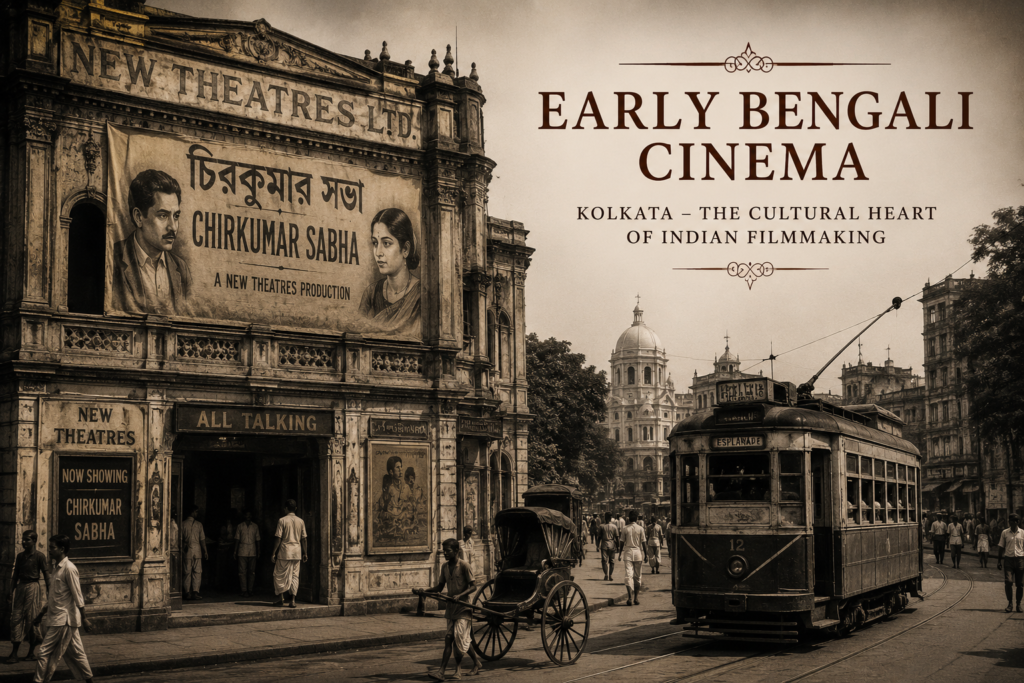
Early Bengali cinema developed alongside Kolkata’s rich literary and cultural traditions.
During the early 20th century, Kolkata emerged as one of India’s major cultural and artistic centers. Bengali literature, theater, music, and visual arts deeply influenced the development of regional cinema.
Studios such as:
- New Theatres
- Aurora Film Corporation
helped shape early Indian filmmaking through technically advanced productions and sophisticated storytelling.
The Bengali film industry quickly developed a reputation for:
- literary adaptations
- emotional storytelling
- musical innovation
- and intellectual themes.
Many early Bengali films also influenced Hindi cinema during Bollywood’s formative decades.
The development of Bengali cinema took place alongside many of the formative decades of Indian filmmaking. While Bengali filmmakers pursued literary and artistic storytelling, Hindi cinema was simultaneously evolving its own identity through music, social themes, and star-driven narratives. Explore that period in:
👉 Bollywood Golden Era: Music, Social Change, and Cinematic Excellence
–– ✦ ✦ ––
📚 Literature and Storytelling in Bengali Cinema
One of the defining strengths of Bengali cinema was its close relationship with literature.

Literature became one of the defining creative foundations of Bengali cinema.
Many Bengali films were adapted from works by legendary writers such as:
- Rabindranath Tagore
- Sarat Chandra Chattopadhyay
- Bibhutibhushan Bandyopadhyay
These literary influences gave Bengali cinema:
- emotional complexity
- psychological realism
- philosophical depth
- and socially grounded narratives.
Unlike purely commercial storytelling models, Bengali filmmakers often focused on ordinary people and human relationships.
This literary tradition became one of the foundations of artistic Indian cinema.
–– ✦ ✦ ––
🌍 Satyajit Ray and International Recognition
No discussion of the Bengali cinema legacy is complete without Satyajit Ray.
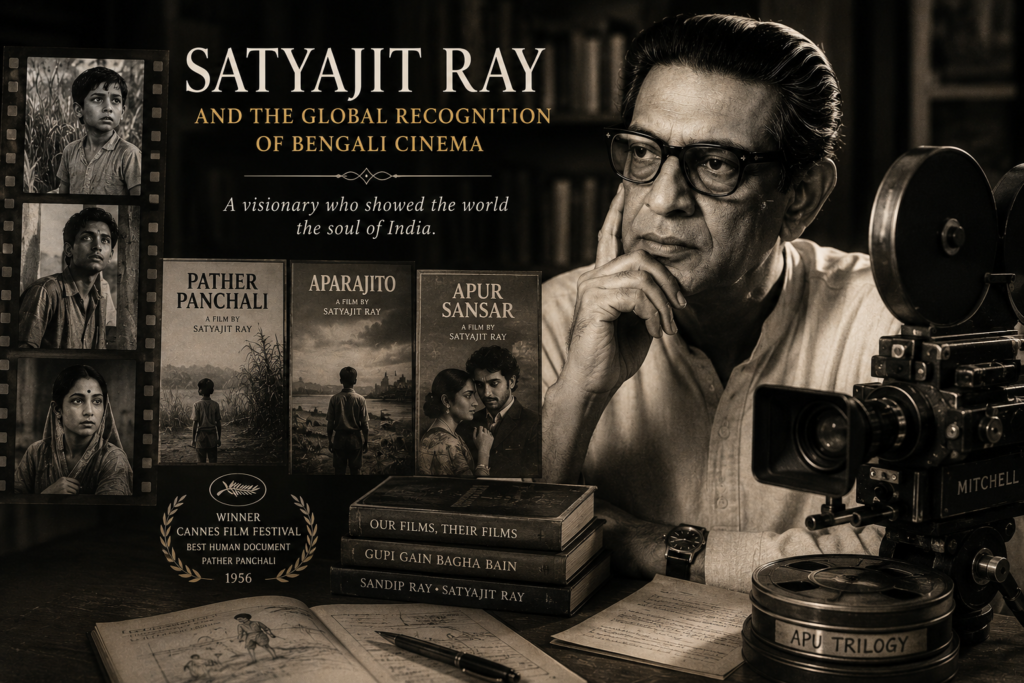
Satyajit Ray helped Bengali cinema achieve international artistic recognition.
Ray’s films brought Indian cinema global critical recognition during the 1950s and 1960s.
His famous Apu Trilogy:
- Pather Panchali
- Aparajito
- Apur Sansar
became internationally celebrated for:
- realism
- emotional subtlety
- visual storytelling
- and humanistic themes.
Ray’s filmmaking style influenced directors around the world, including:
- Martin Scorsese
- Akira Kurosawa
- Wes Anderson
His success demonstrated that Indian cinema could achieve artistic recognition far beyond commercial entertainment.
–– ✦ ✦ ––
🎬 Ritwik Ghatak and Political Cinema
While Satyajit Ray became internationally famous, Ritwik Ghatak developed a more emotionally intense and politically charged cinematic style.
Ghatak’s films explored:
- displacement
- partition trauma
- migration
- class struggle
- cultural identity
His filmmaking combined realism with symbolic and experimental techniques.
Although his films achieved greater recognition after his lifetime, Ghatak later became highly influential among filmmakers and film scholars.
His work remains an essential part of Bengali cinema history.
–– ✦ ✦ ––
🎭 Mrinal Sen and Social Realism
Mrinal Sen helped expand Bengali cinema’s role in India’s parallel cinema movement.
His films often examined:
- political unrest
- urban inequality
- middle-class anxieties
- social transformation
Sen experimented with narrative structures and cinematic techniques while maintaining strong political and social themes.
Together, Ray, Ghatak, and Sen formed one of the most respected artistic filmmaking traditions in world cinema.
–– ✦ ✦ ––
📺 Bengali Cinema and the Parallel Cinema Movement
The Bengali cinema legacy became deeply connected to India’s parallel cinema movement.

Bengali filmmakers played a major role in shaping India’s parallel cinema movement.
Unlike mainstream commercial films, parallel cinema emphasized:
- realism
- social commentary
- artistic experimentation
- character-driven storytelling
Many filmmakers across India were inspired by Bengali cinema’s artistic approach.
This influence extended into:
- Hindi parallel cinema
- Malayalam realism
- independent Indian filmmaking
The movement proved that Indian cinema could explore complex social and philosophical ideas without relying entirely on commercial spectacle.
The success of Bengali filmmakers helped inspire artistic movements across India, influencing regional industries far beyond West Bengal. In recent decades, regional storytelling has gained unprecedented national recognition through Telugu, Tamil, Kannada, and Malayalam cinema. Explore this evolution in:
👉 Regional Cinema Revolution: How South Indian Films Reshaped Indian Cinema
–– ✦ ✦ ––
🎶 Music, Culture, and Emotional Realism
Although Bengali cinema became famous for realism, music remained an important artistic element.
Unlike large-scale commercial song sequences, Bengali films often used music:
- subtly
- emotionally
- and poetically.
Cultural traditions, folk influences, and Rabindra Sangeet also shaped Bengali film music.
The emotional realism of Bengali cinema influenced later filmmakers across India, including directors working in both Bollywood and regional cinema.
–– ✦ ✦ ––
🌐 Bengali Cinema’s Influence on Modern Indian Cinema
The Bengali cinema legacy continues influencing Indian filmmakers even today.
Modern directors continue drawing inspiration from:
- literary storytelling
- realism
- emotional subtlety
- socially grounded narratives
Streaming platforms have also introduced younger audiences to classic Bengali films and restored masterpieces.
The artistic traditions established by Bengali filmmakers remain an important counterbalance to spectacle-driven commercial cinema.
The influence of Bengali cinema can still be seen in many contemporary Indian films that prioritize character development, emotional depth, and socially grounded storytelling. As Indian cinema entered the era of globalization, multiplex audiences, and streaming platforms, these artistic traditions continued evolving in new forms. Discover that transformation in:
👉 Modern Bollywood Era: Global Cinema, Multiplex Culture, and Streaming Revolution
–– ✦ ✦ ––
📽️ Legacy of Bengali Cinema
The Bengali cinema legacy helped redefine what Indian cinema could achieve artistically.
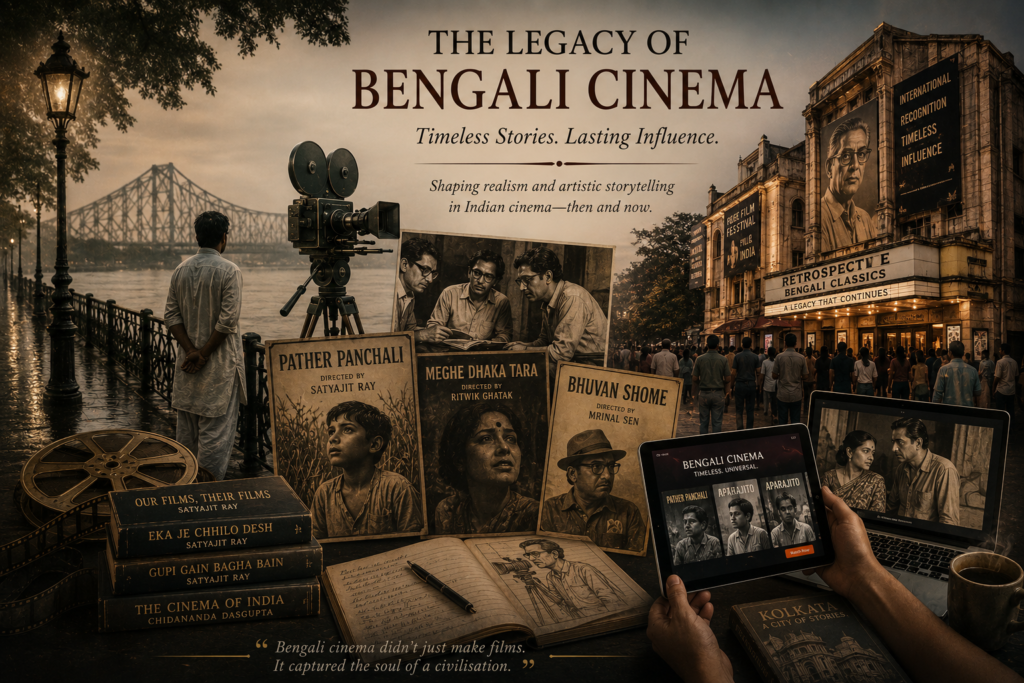
The Bengali cinema legacy continues influencing realism and artistic storytelling in Indian cinema today.
It demonstrated that films could:
- explore human emotions deeply
- reflect social realities
- adapt literary masterpieces
- and achieve international artistic recognition.
Global film institutions and historical cinema references continue recognizing the importance of Bengali filmmakers in world cinema history. Publications such as Britannica – Indian Cinema discuss the influence of Bengali filmmakers on artistic Indian cinema and global film culture.
Even as Indian cinema evolved through globalization, streaming platforms, and pan-India entertainment, Bengali cinema’s commitment to realism and storytelling continued influencing generations of filmmakers.
While Bengali cinema became internationally respected for realism, literature, and artistic filmmaking, Punjabi cinema followed a different path by celebrating music, cultural identity, and community traditions. Explore this equally important regional film journey in:
👉 Punjabi Cinema History: Music, Culture, and the Global Punjabi Identity
–– ✦ ✦ ––
❓ Frequently Asked Questions (FAQs)
Why is Bengali cinema considered artistic?
Because of its strong literary influences, realism, emotional storytelling, and internationally respected filmmakers.
Who are the most famous Bengali filmmakers?
Satyajit Ray, Ritwik Ghatak, and Mrinal Sen are among the most influential.
Did Bengali cinema influence Bollywood?
Yes. Bengali cinema influenced Bollywood through storytelling, realism, literary adaptations, and parallel cinema traditions.
🔗 Connecting the Bigger Picture
If South Indian cinema reshaped modern commercial filmmaking…
👉 Bengali cinema helped shape the artistic and intellectual identity of Indian cinema itself.
🌐 Read in Hindi
Prefer reading this article in Hindi?
👉 हिंदी में पढ़ें:
बांग्ला सिनेमा की विरासत: यथार्थवाद, साहित्य और कलात्मक क्रांति
This version of the article offers the same depth, perspective, and storytelling.
🔖 External sources are referenced for educational and historical context. All rights and credits belong to their respective owners.